


Overview
NYU Tandon urban scientists learn to harness data and emerging technologies to address complex challenges facing modern cities. In the M.S. in Urban Data Science program at Tandon's Center for Urban Science + Progress (CUSP), you will develop a powerful foundation in urban informatics, spatial analytics, and machine learning, empowering you to create sustainable, efficient, and equitable urban environments worldwide.
Prerequisites
- Single-variable calculus
- Basic programming (Python and R)
- Statistics and probability
- Geographic information systems (GIS) and spatial analytics
- Fundamental computer science principles
Application Requirements
- Online application
- Official Transcripts
- Resume
- Statement of Purpose
- 1-minute video
- 2 Letters Of Recommendation
- English Language Proficiency Testing (where applicable)
- $90 application fee
Find out more about Admission Requirements.
Tuition varies based on your program, term admitted and credit hours.
We are committed to keeping graduate studies affordable for all of our students. You’ll have access to on-campus employment programs that include teaching and research assistantships, as well as financial aid, scholarships, grants, and loans.
Explore our Tuition, Financial Aid, and Scholarships page to learn more about these opportunities.
Prospective Students
For questions about the application process, application status or to talk to an admissions counselor:
Office of Graduate Enrollment and Admissions
NYU Tandon School of Engineering
engineering.gradinfo@nyu.edu
646-997-3182
Accepted and Enrolled Students
For questions about the curriculum or courses:
Center for Urban Science + Progress (CUSP)
NYU Tandon School of Engineering
370 Jay Street, 9th Floor
Brooklyn, NY 11201
cusp.education@nyu.edu
646-997-3182
For general advising questions:
Office of Graduate Enrollment and Admissions
engineering.gradinfo@nyu.edu
646-997-3182
At a Glance
1st
Dedicated urban science and progress research center in NYC
8 Knowledge Tracks
Including Artificial Intelligence, Policy Analytics, and Sustainability
$108,102
Average Base Salary Class of 2025 Master’s Graduates
Market Outlook
The NYC Advantage
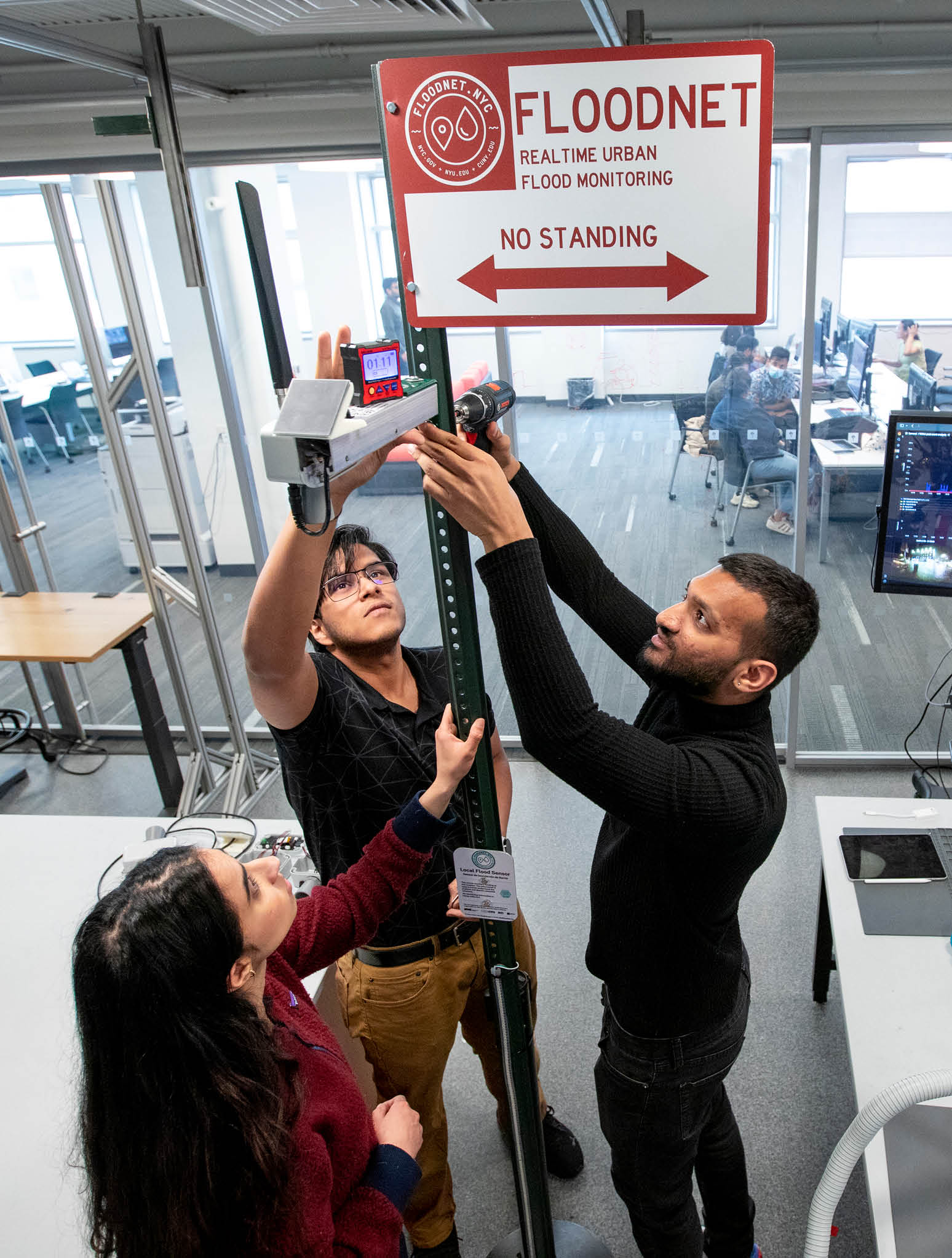
NYU Tandon urban science students have a unique advantage: New York City serves as their living laboratory. Located at the epicenter of global urbanization, the Center for Urban Science + Progress provides direct access to city agency datasets, real-world infrastructure challenges, and an expansive network of civic leaders and industry partners. With one of the world's most dynamic and complex metropolises right outside your door, there's no better place to earn your master's in Applied Urban Science and Informatics.
Curriculum
The Master's in Urban Data Science degree is a two-year, 36-credit program comprising a core curriculum — 18 required credits and a non-credit lab — and 18 elective credits enabling students to customize their coursework to their career goals. Up to 6 of the elective credits may be taken outside CUSP from any NYU School, except the School of Professional Studies, with approval from the CUSP Education Team.
For students new to policy, the 0-credit course Foundations in Policy, Research & Writing (CUSP-GX-8000) is offered at the start of the program during the first half of the fall semester.
| Requirement Area | Credits |
|---|---|
| Core Courses | 12 |
| Capstone Project | 6 |
| Electives | 18 |
| Total Credits | 36 |
Students in the M.S. in Urban Data Science program engage with data at every stage, from acquisition to visualization. Through course assignments and extracurricular activities, CUSP fosters collaboration between students and local government agencies, non-profits, private companies, and community organizations, empowering them to apply their skills to address real-world urban challenges.
- Capstone Projects: During the two-semester Urban Science Intensive, students collaborate with a sponsor—a city agency, industry partner, entrepreneur, or researcher—to leverage data-driven insights on a pressing urban challenge.
- Data Dives: CUSP partners with global and New York City-based organizations to host week-long hackathons.
- Vertically Integrated Projects (VIP): These multi-year, multidisciplinary projects are open to all NYU students and emphasize innovative and research-driven education.
Semester 1
- CUSP-GX 7000 — Data Governance, Ethics, and Privacy
- CUSP-GX 7013 — Introduction to Applied Data Science
- CUSP-GX 7043 / CUSP-GX 7053 — Urban Science and Policy Methodologies*
Semester 2
- CUSP-GX 7023 — Applied Data Science
- CUSP-GX 7033 — Machine Learning for Cities
- CUSP-GX 7043 / CUSP-GX 7053 — Urban Science and Policy Methodologies*
Semester 3
- CUSP-GX 7103 — Capstone Urban Science Intensive I
Semester 4
- CUSP-GX 7113 — Capstone Urban Science Intensive II
* The 3-credit Urban Science and Policy Methodologies may be taken during the Fall or Spring semester: Civic Analytics and Urban Intelligence AND/OR Innovative City Governance.
Knowledge Tracks
To help students align electives with their career goals, the Master's in Urban Data Science program offers eight overlapping Knowledge Tracks: AI, Complex Systems, GIS, Mobility and Transportation Systems, Policy Analytics, Smart Infrastructure, Sustainability, and Urban Technology Management. These serve as a guide, and students are not limited to choosing electives from one track exclusively.
Master AI and machine learning techniques to address urban challenges and create more efficient, equitable, and resilient cities.
- CUSP-GX-8093 Data Visualization
- CUSP-GX-8813 Design for Innovation with AI and ML
- CUSP-GX-8863 From Correlation to Causation: Data Science for Decision Making
- CUSP-GX-8873 Urban Computing and Artificial Intelligence
- CUSP-GX-8843 Virtual and Augmented Reality
Model urban environments to assess climate risks, optimize transportation infrastructure, and analyze complex city-scale interactions for sustainable, resilient urban planning.
- CUSP-GX-8043 Advanced Spatial Analytics
- CUSP-GX-8123 Climate Risk Analysis and Urban Sustainability
- CUSP-GX-8153 Complex Urban Systems
- CUSP-GX-8863 Correlation to Causation: Data Science for Decision Making
- CUSP-GX-8053 Urban Decision Models
- CUSP-GX 8883 Urban Transportation and Logistics Systems
Spatialize and visualize data using advanced mapping technologies to support decision-making on urban issues.
- CUSP-GX-5053 Geographic Information Systems (GIS)
- CUSP-GX-8033 Urban Spatial Analytics
- CUSP-GX-8043 Advanced Spatial Analytics
- CUSP-GX-8093 Data Visualization
- CUSP-GX-8103 Data-Driven Methods for Policy Evaluation
- CUSP-GX-8113 Monitoring Cities
- CUSP-GX-8853 Understanding Urban Subsurfaces: Identifying, Integrating, and Operationalizing Relevant Data Streams
This track focuses on using spatial analytics, network science, causal methods, and behavioral data to understand, plan, and improve urban mobility, transportation, transit, and logistics systems.
Transportation
- TR-GY 7073 Travel Behavioral Informatics
- TR-GY 7133 Public Transit Operations Planning
CUSP
- CUSP-GX 9113 Network Science for Cities
- CUSP-GX 8033 Urban Spatial Analytics
- CUSP-GX 8863 From Correlation to Causation: Data Science for Decision Making
- CUSP-GX 8883 Urban Transportation and Logistics Systems
Explore how data-driven insights can support policies related to land use planning, transportation, housing, sustainability, and the role of civic technology in empowering citizens through smart cities, open data, and digital tools.
- CUSP-GX-8833 City Immersion
- CUSP-GX-7043 Civic Analytics and Urban Intelligence
- CUSP-GX-8013 Data-Driven Methods for Policy Evaluation
- CUSP-GX-8823 Digital Civics for Social Innovation
- CUSP-GX-5053 Geographic Information Systems
- CUSP-GX-7053 Innovative City Governance
- CUSP-GX-8133 The Citizen and the City
- CUSP-GX-8053 Urban Decision Models
Develop and implement infrastructure for smart cities, and explore the role of emerging technologies in improving city services and residents' quality of life.
- CUSP-GX-8083 Big Data Management and Analysis
- CUSP-GX-8833 City Immersion
- CUSP-GX-8823 Digital Civics for Social Innovation
- CUSP-GX-8143 Internet of Things Security
- CUSP-GX-8113 Monitoring Cities
- CUSP-GX-8063 Urban Sensing
- CUSP-GX-8843 Virtual and Augmented Reality
- CUSP-GX 8883 Urban Transportation and Logistics Systems
Use data to assess climate risks and guide cities in adapting to environmental changes for long-term sustainability and resilience.
- CUSP-GX-8123 Climate Risk Analysis and Urban Sustainability
- CUSP-GX-8153 Complex Urban Systems
- CUSP-GX-8063 Urban Sensing
- CUSP-GX-8033 Urban Spatial Analytics
Explore how entrepreneurship in emerging technologies can transform cities envisioning new tools for governance, infrastructure, and planning.
CUSP x MOT
- MG-GY-8813 Design for Innovation with AI and ML
- MG-GY-9013 Design Thinking for Creative Problem Solving
- MG-GY-7703 Entrepreneurship
- MG-GY-8673 Technology Strategy
- MG-GY-8203 Project Management
CUSP
- CUSP-GX-8083 Big Data Management and Analysis
- CUSP-GX-7043 Civic Analytics and Urban Intelligence
- CUSP-GX-8823 Digital Civics for Social Innovation
- CUSP-GX-8863 From Correlation for Causation: Data Science for Decision Making
- CUSP-GX-7053 Innovative City Governance
- CUSP-GX-8873 Urban Computing and Artificial Intelligence
- CUSP-GX-8133 The Citizen and The City
Meet our Faculty and Alumni



Our Students
The Master's in Urban Data Science program is highly interdisciplinary, welcoming students from diverse backgrounds with strong quantitative skills and a passion for urban challenges.
The Fall 2025 cohort has 78 students, with an average age of 24, and 39% of them are female. Our students come from all kinds of academic backgrounds—see the most recent degrees and majors they earned before joining us!

Research at CUSP
To benefit the city and other partners, CUSP’s research is both mission - and impact - oriented.
Student Work
Experiential Learning at CUSP


Transportation Systems, M.S.

Emerging Technologies, M.S.

Urban Science: Sensing, Complexity, & Informatics, Doctoral Track
To earn a Master of Science in Urban Data Science, students must complete 36 credits to qualify for graduation.
The M.S. in Urban Data Science is offered as an on-campus program with flexible full-time and part-time course options to fit your academic pace.
Fall Semester
- December 1: M.S. priority consideration
- February 15: M.S. general consideration
- Online application
- Official Transcripts
- Resume
- Statement of Purpose
- 1-minute video
- 2 Letters Of Recommendation
- English Language Proficiency Testing (where applicable)
- $90 application fee
Yes, there are several financial aid resources available to prospective students:
- CUSP Rising Scholars: Incoming students may be awarded a scholarship to cover the tuition cost of 3 credits for their first semester.
- CUSP Experiential Scholars: After completing two semesters, enrolled students may apply for this scholarship to support internships or guided research.
- Merit Scholarships: All students admitted to NYU Tandon School of Engineering are automatically considered for merit-based scholarships.
Students in this program have direct access to state-of-the-art facilities at the Center for Urban Science + Progress (CUSP) located at 370 Jay Street. Facilities include advanced spatial analytics labs, urban sensing technology suites, and high-performance computing environments designed for big data management and urban systems modeling.
Yes, for prospective students without technical backgrounds, we recommend two pathways to develop your prerequisite skills:
- Urban Computing Skills Lab: CUSP offers an 8-week online summer course for admitted students at no additional charge to strengthen their programming and statistical skills.
- NYU Tandon Bridge program: This 21- or 28-week program prepares individuals without STEM backgrounds for graduate degrees at NYU Tandon.
If you have questions about your qualifications, contact cusp.education@nyu.edu.