

New in 2027
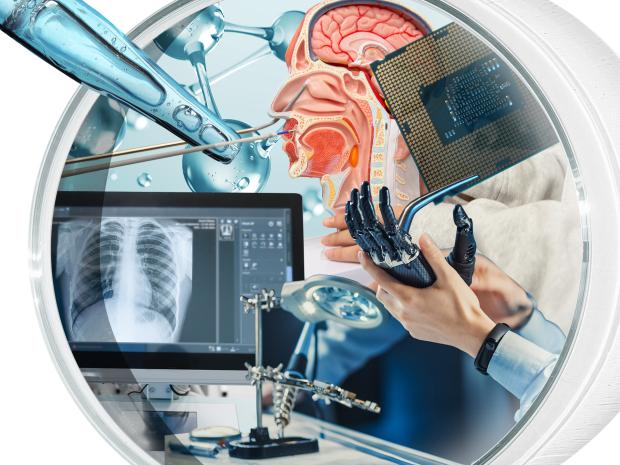
Biomedical engineering, a multi-disciplinary field, is behind some of the most important medical breakthroughs today. Working closely together, engineers, scientists, mathematicians, and physicians have developed artificial organs, internal and external prosthetics, multiple imaging modalities, software and hardware for medical devices, and diagnostic and therapeutic devices. Biomedical Engineers are uniquely positioned to pursue various careers by employing their cross-disciplinary knowledge to solve pertinent problems beginning from their biological origin to the final engineered solution, with widespread societal impact.
In the Bachelor of Science in Biomedical Engineering, you will learn to apply engineering principles to the advancement of healthcare and medical technologies by faculty from both NYU Tandon School of Engineering and NYU Grossman School of Medicine. Students can also be able to gain hands-on research experience by getting involved in faculty member’s labs.
As a biomedical engineer, you will greatly contribute to improved health care and quality of life. You can create new approaches and tools for medical imaging, tissue engineering and repair, bioinstrumentation and biosensors, mechanobiology, robotics and prosthetics, computational medicine, systems genetics, and a wide variety of other applications. Our flexible curriculum allows you to satisfy pre-health requirements to pursue a medical, dentistry, and pharmaceutical career after graduating. You will also be prepared in all topics covered in the Fundamentals of Engineering (FE) exam for becoming a licensed Professional Engineer (PE).
Curriculum
You must complete 128 credits to graduate from the School of Engineering with a Bachelor of Science in Biomedical Engineering, which are broken down into five components:.
- Mathematics and Sciences (47 credits)
- Humanities and social sciences (24 credits)
- Introduction to Engineering (13 credits)
- Biomedical Engineering (20 credits)
- STEM and Free Electives (24 credits)
The Biomedical Engineering course electives taken during senior year include graduate level coursework and a Senior design/capstone that prepares you for real-world industry and entrepreneurship. The curriculum also provides students with hands-on experience in various BME domains in the age of AI.
Sample Course Schedule
This typical course schedule provides guidance to students as to how they would normally be expected to complete the degree requirements. Students should be sure to consult their Academic Advisor before selecting courses for a given semester as prerequisites and course offering patterns are the primary considerations affecting registration.
|
1st Semester/Term |
Credits |
|
|---|---|---|
|
Calculus I for Engineers |
4 |
|
|
General Chemistry I |
3 |
|
|
General Chemistry Laboratory I |
1 |
|
|
Writing the Essay |
4 |
|
|
Introduction to Engineering and Design |
4 |
|
|
Credits |
16 |
|
|
2nd Semester/Term |
||
|
Calculus II for Engineers |
4 |
|
|
General Chemistry II |
3 |
|
|
General Chemistry Laboratory II |
1 |
|
|
Advanced Writing for Engineers |
4 |
|
|
Mechanics |
3 |
|
|
Problem Solving & Programming I or Introduction to Programming and Problem Solving |
3 |
|
|
Credits |
18 |
|
|
3rd Semester/Term |
||
|
Linear Algebra and Differential Equations |
4 |
|
|
Electricity, Magnetism, & Fluids |
3 |
|
|
General Physics Laboratory I |
1 |
|
|
Introduction to Cell and Molecular Biology |
3 |
|
|
Introduction to Cell and Molecular Biology Laboratory |
1 |
|
|
Engineering and Technology Forum |
1 |
|
|
Humanities and Social Sciences Elective (HUSS) #1 |
4 |
|
|
Credits |
17 |
|
|
4th Semester/Term |
||
|
Calculus III: Multi-Dimensional Calculus |
4 |
|
|
Waves, Optics, & Thermodynamics |
3 |
|
|
Introduction to Programming in C |
3 |
|
|
Introduction to Physiology |
3 |
|
|
Humanities and Social Sciences Elective (HUSS) #2 |
4 |
|
|
Credits |
17 |
|
|
5th Semester/Term |
||
|
Signals and Systems |
4 |
|
|
BE-UY 3003 |
Biomedical Engineering & Lab I |
4 |
|
BE-UY 3033 |
Quantitative Physiology I |
4 |
|
Humanities and Social Sciences Elective (HUSS) #3 |
4 |
|
|
Credits |
16 |
|
|
6th Semester/Term |
||
|
Probability and Statistics for Engineers |
4 |
|
|
BE-UY 3013 |
Biomedical Engineering & Lab II |
4 |
|
BE-UY 3043 |
Quantitative Physiology II |
3 |
|
Humanities and Social Sciences Elective (HUSS) #4 |
4 |
|
|
Credits |
15 |
|
|
7th Semester/Term |
||
|
BE-UY 4003 |
Biomedical Engineering Senior Design I |
3 |
|
Biomedical Engineering Elective #1 |
3 |
|
|
Biomedical Engineering Elective #2 |
3 |
|
|
Free Elective #1 |
3 |
|
|
Free Elective #2 |
3 |
|
|
Credits |
15 |
|
|
8th Semester/Term |
||
|
BE-UY 4013 |
Biomedical Engineering Senior Design II |
3 |
|
Biomedical Engineering Elective #3 |
3 |
|
|
Free Elective #3 |
3 |
|
|
Free Elective #4 |
3 |
|
|
Free Elective #5 |
3 |
|
|
Credits |
15 |
|
|
Total Credits |
128 |
|
Program Requirements
Six Core Courses (20 credits)
- BE-UY 3003 BIOMEDICAL ENGINEERING 1 & lab
- BE-UY 3013 BIOMEDICAL ENGINEERING 2 & lab
- BE-UY 3033 QUANTITATIVE PHYSIOLOGY 1
- BE-UY 3043 QUANTITATIVE PHYSIOLOGY 2
- BE-UY 4003 BIOMEDICAL ENGINEERING Senior DESIGN I
- BE-UY 4013 BIOMEDICAL ENGINEERING Senior DESIGN II
Additional Requirements
Mathematics: 4 courses, 16 credits
• MA-UY 1024 Calculus I for Engineers
• MA-UY 1124 Calculus II for Engineers
• MA-UY 2034 Linear Algebra and Differential Equations
• MA-UY 2114 Multi-dimensional Calculus
Science : 9 courses, 25 credits
- CM-UY 1013 - General Chemistry I
- CM-UY 1011 - General Chemistry I Lab
- CM-UY 1023 - General Chemistry II
- CM-UY 1021 - General Chemistry I Lab
- BMS-UY 1003 - Introduction to Cell and Molecular Biology
- BMS-UY 1001 - Introduction to Cell and Molecular Biology Laboratory
- BMS-UY 2003 - Introduction to Physiology
- BMS-UY 2001 - Introduction to Physiology Laboratory
- PH-UY 1013 Mechanics
- PH-UY 2121 General Physics Laboratory I
- PH-UY 2023 Electricity, Magnetism and Fluids
- PH-UY 2033 Waves, Optics and Thermodynamics
Computer methods: 2 courses, 6 credits
• CS-UY 1113 Problem Solving & Programming I
• CS-UY 2163 Introduction to Programming in C
Humanities and social sciences: 6 courses, 24 credits
• EXPOS-UA 1 Writing the Essay
• EXPOS-UY22 Advanced Writing for Engineers
• Four Humanities and Social Sciences Elective (HUSS) courses satisfying Tandon requirements (3000/4000 level, Advanced Seminar, Ethics)
• All undergraduate Tandon students are required to take at least 1 ethics class, as part of their 4-class
Humanities and Social Science (HUSS) requirement. Students should take at least one of the following classes: STS-UY 2144 Ethics and Technology, STS-UY 2214 Medical Ethics, or STS-UY 2914 Special Topics in Ethics.
Engineering foundation (4 courses, 13 credits)
• EG-UY 1004 Introduction to Engineering and Design
• EG-UY 1001 Engineering and Technology Forum
• ECE-UY 3054 Signals and Systems
• MA-UY 2224 Data Analysis
Electives (8 courses, 24 credits)
- Three biomedical engineering electives from the list below (9 credits)
- BE-GY 6203 Medical Imaging
- BE-GY 6303 Bio-Optics
- BE-GY 8103 Systems and Computational Simulation for Biomedical Engineering
- BE-GY 8203 Biomedical Modeling, Estimation, and Control
- BE-GY 9443 Tissue Engineering
- BE-GY 9453 Engineering Tissue Regeneration
- BE-GY 9753 Bioethics
- Five free electives (15 credits)
Please note, the NYU Bulletin is the authoritative source for all degree and program requirements.
Quick Links
Program Director

Michael Hanna
Academic Advisor