Elena Zubillaga Maharg
UN Sustainability Goal
- Quality Education
Areas of Impact
- Industrial, Urban & Environmental Sustainability
- Systems Engineering & Complex Decision-Making
Global Challenge: Climate Change & Public Health
Abstract:
This paper investigates the relationship between pipeline geometry and velocity profiles under laminar and turbulent conditions, utilizing fluid dynamics as a lens to evaluate Systems Engineering & Complex Decision-Making. The project looks at the advantages of current engineering choices and identifies where there is room for improvement. From a GLASS perspective, these flow patterns are more than just numbers; they are the key factors that engineers must balance when considering cost, system lifespan, and efficiency. This study explores the tension between old building limits and the potential for better systems.
I examine if our current infrastructure is truly the best it can be, or if we are simply following outdated manufacturing habits. Finally, this research aligns with UN Sustainable Development Goal 9 (Industry, Innovation, and Infrastructure). I argue that real innovation requires a big-picture approach. We must balance the hard facts of physics with the smart planning needed to build the resilient, sustainable industrial networks of the future.
Bio:
Elena Zubillaga Maharg holds a B.S. in Applied Physics with a minor in Business from NYU Tandon School of Engineering. Born in London and raised primarily in Madrid, Spain, she grew up in a multicultural household with strong ties to both northern and western Spain.
She has gained diverse professional experience across consulting, research, and biotechnology. As a summer intern at BNP Paribas in the Internal Consulting department, she led cross-functional initiatives, streamlined data workflows, and contributed to projects exploring the use of AI within the organization. She also worked as an R&D intern at Procter & Gamble, where she led projects focused on alternative packaging solutions. Earlier in her academic career, she interned at the Spanish National Research Council (CSIC) in Madrid, collaborating on research to develop biodegradable plastics derived from avocado pits.
During the academic year, she worked as a Data Science intern at a stealth-mode biotech startup, where she researched drug delivery systems, analyzed the competitive landscape, and supported market strategy through data-driven insights.
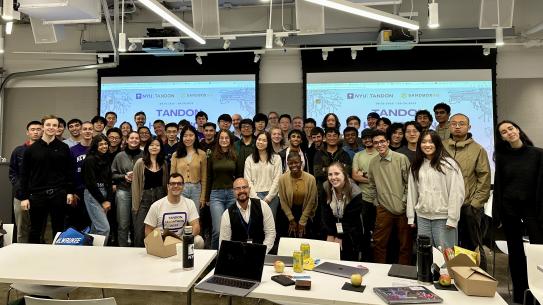
In addition to her professional experience, Elena placed third in NYU Tandon’s first annual quantum computing hackathon and second in the 2025 Tandon Consulting Case Competition.
She is also actively engaged in community service, volunteering with Fundación Balia in Madrid to support children from social services, and with NYU’s Give Where You Live program at a soup kitchen.