

NYC Center for Healthier Plastic Solutions
Accelerating Sustainable Plastics Development
Since 1950, the only pauses in the exponential growth in plastics production have been the 1970s oil crisis, the 2008 financial crisis and the COVID-19 pandemic. A further 30% increase is projected from 2025-2050. Much of the public concern about plastic has been focused on micro- and nanoplastics (MNP), but plastics represent a multidimensional and complex series of concerns for human health and the environment. The best documented health impacts relate to the release of monomers and additives widely detected in the general population, especially in communities located near production facilities.
Recycling has long been presented as a solution to these concerns, but recycled plastics themselves present health threats, and recycling itself is energy intensive. Plant- and other bio-based plastics have also been touted as a planet-friendly alternative and form of sustainable innovation, but they require high temperature to be recycled, and when the high costs force bioplastics into landfills, they produce methane, which is more potent than carbon dioxide in driving climate change. Laboratory studies also suggest greater oxidative stress and antiandrogenicity of chemicals found in liquids obtained from bioplastic bottles.
Reductions in plastic production and increases in reuse are slow to achieve, and will require substantial technical and financial assistance, particularly to low- and middle-income countries where production is rapidly increasing. Innovation is urgently needed to develop new plastic materials that reduce toxic exposures.
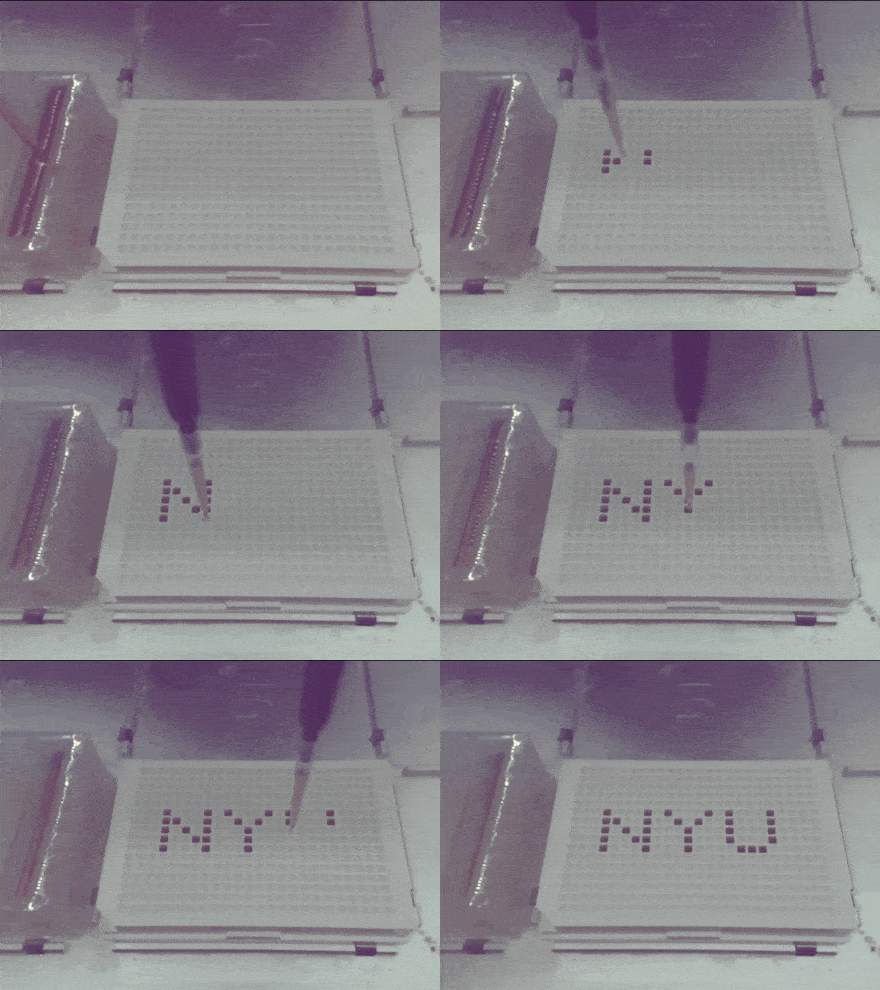
The NYC Center for Healthier Plastic Solutions responds to the challenge posed by plastic threats to human health and the environment through a dual-track approach, using high-throughput experimentation and AI to accelerate:
- Understanding: New tools and methods to detect, quantify, and trace how microplastics are formed, and how that depends on material characteristics and applications. We also seek to understand how microplastics and chemicals in plastic disrupt human and environmental health.
- Solutions: AI-accelerated design of next-generation polymers engineered to minimize toxic microplastic release.
Addressing this challenge requires rethinking polymer design from the ground up: pairing synthesis of new materials with rigorous characterization of how they fragment under real-world conditions. By uniting biomedical, chemical, and environmental engineers, polymer scientists, and medical researchers around shared high-throughput capabilities not widely available today, the Center closes the loop between discovery and design — accelerating the development of next-generation sustainable polymers with reduced health effects, and working to make plastic pollution a problem of the past.
Our Approach
Experimental Platforms:
Polymer Synthesis and Processing
Supports rapid, parallel synthesis of novel polymers, including those from non-petroleum feedstocks, using both solvent-based and bulk liquid-phase polymerization.
Micro- and Nanoplastics Characterization
A complementary analytical suite spanning the nano-to-micro size range provides chemical identity, size distribution, and abundance data for degradation products.
Accelerated Degradation Testing
HT-compatible protocols covering the three primary pathways by which plastics fragment into MNPs in the environment: mechanical, chemical, and thermal.
Thermal, Chemical, and Mechanical Characterization
Studies the molecular weight, thermal stability, and mechanical behavior to establish what factors govern fragmentation resistance.


People
Leadership
Miguel Modestino
Co-Director, NYC Center for Healthier Plastic Solutions; Director, Sustainable Engineering Initiative; Associate Professor, Chemical and Biomolecular Engineering
Electrochemical engineering; HT experimentation; ML-accelerated materials discovery; sustainable chemical manufacturing

Leonardo Trasande
Co-Director, NYC Center for Healthier Plastic Solutions; Professor of Pediatrics and Population Health
Health impacts of MNP exposure; endocrine-disrupting chemicals; epidemiology; policy
Affiliated Faculty and Staff

Vittorio Albergamo
Assistant Professor, Department of Pediatrics
Microplastic detection in human tissues; analytical toxicology; MNP links to cancer and chronic disease

Whitney Cowell
Assistant Professor, Department of Pediatrics
Placenta, micro- and nanoplastics, epidemiology

Irene de Lázaro
Assistant Professor, Biomedical Engineering
Nano-bio interactions of micro and nanoplastics, including their effects on cellular aging and cardiovascular health

Juan de Pablo
Executive Dean and Executive Vice President for Global Science and Technology
Polymer physics, molecular simulation, ML-driven materials design; institutional leadership

Rebecca Florsheim
Assistant Professor, Department of Medicine
Environmental health impacts, including micro- and nanoplastics accumulation

Akhgar Ghassbian
Associate Professor, Department of Pediatrics
Endocrine disrupting chemicals, neurodevelopment, thyroid function

Chiara Gianarelli
Professor, Department of Medicine
Immunology, ischemia, cardiovascular risk, micro- and nanoplastics

LaShanda Korley
Department Chair and Professor, Chemical and Biomolecular Engineering
Sustainable materials, plastics waste valorization, bio-inspired engineering

Pavel Kots
Associate Professor, Chemical and Biomolecular Engineering
Reaction engineering; plastic waste upcycling; industrial polymer chemistry; catalysis

Jin Kim Montclare
Professor, Chemical and Biomolecular Engineering
Artificial proteins that serve as basis for sustainable, nature-inspired materials to replace persistent plastics

Phillip Rauscher
Assistant Professor, Chemical and Biomolecular Engineering
Soft matter physics; thermophysical properties of polymers; ML-guided fluoropolymer replacement

Bridger Ruyle
Assistant Professor, Civil, Urban, and Environmental Engineering
Environmental fate of persistent chemicals (PFAS); water quality; analytical tools for trace contaminant quantification

Alison Shapiro
Managing Director (Tandon), NYC Center for Healthier Plastic Solutions; Postdoctoral Researcher, Chemical and Biomolecular Engineering
Sustainable materials, polymer synthesis and characterization

André Taylor
Professor, Chemical and Biomolecular Engineering
Electrochemical and advanced materials approaches for sustainable manufacturing; understanding and mitigating the impacts of microplastics and persistent materials in engineered systems

Sharine Wittkopp
Assistant Professor, Department of Medicine
Toxicology, polyfluoroalkylsubstances, immunology
Related Centers and Initiatives

Center for the Investigation of Environmental Hazards
A research center dedicated to studying the effects of environmental exposure on health outcomes.
Sustainable Engineering Initiative
Center for Plastics Innovation
A hub for transformative chemical conversion strategies and enabling cross-cutting tools.