

Institute for Engineering Health
NYU’s Institute for Engineering Health unites and blends expertises in translation biosciences from the Tandon School of Engineering and Langone Health/Grossman School of Medicine, in collaboration with the College of Arts and Sciences, School of Dentistry, and Courant Institute.

This cross-disciplinary effort integrates engineering, medicine, and the biological sciences to advance healthcare discovery, prevention, and treatment.
Rapid progress in genomics, imaging, data analysis, and bioengineering has transformed how we study and improve health. Engineers now play a key role in developing tools, therapies, and predictive models — from molecular to environmental scales. This new institute aims to drive innovation, improve health outcomes, and make care more effective and equitable.
Our Approach
We focus on engineering based on biological principles as a driver for impact. This includes design and modulation of biomolecules (e.g., metabolites, proteins, RNA, cells, microbiota), signaling and regulation pathways (e.g., synthetic and systems biology), and biophysical signals (e.g., matrices, flow fields, electrical fields). It also includes computational methodology to rationalize, discover, and design the aforementioned using modern computational and AI approaches.
We focus on three core areas, which encompass our foundational medical science and clinical impact areas.
1) Immunoengineering
Immune homeostasis and dysregulation play a central role in health and disease. Indeed, a convincing argument can be made that chronic inflammation leads to a considerable majority of disease conditions. Included in the framework are diseases and conditions, including:
- Autoimmune and inflammatory diseases such as Crohn’s disease
- Cancer (oncogenesis, progression, resistance to therapy)
- Cardiometabolic disease
- Neurodegeneration
- Neuropsychiatric conditions
- Unhealthy aging, associated with elevation of the overall inflammatory state
- Suppression of immunity to pathogens and response to vaccination.
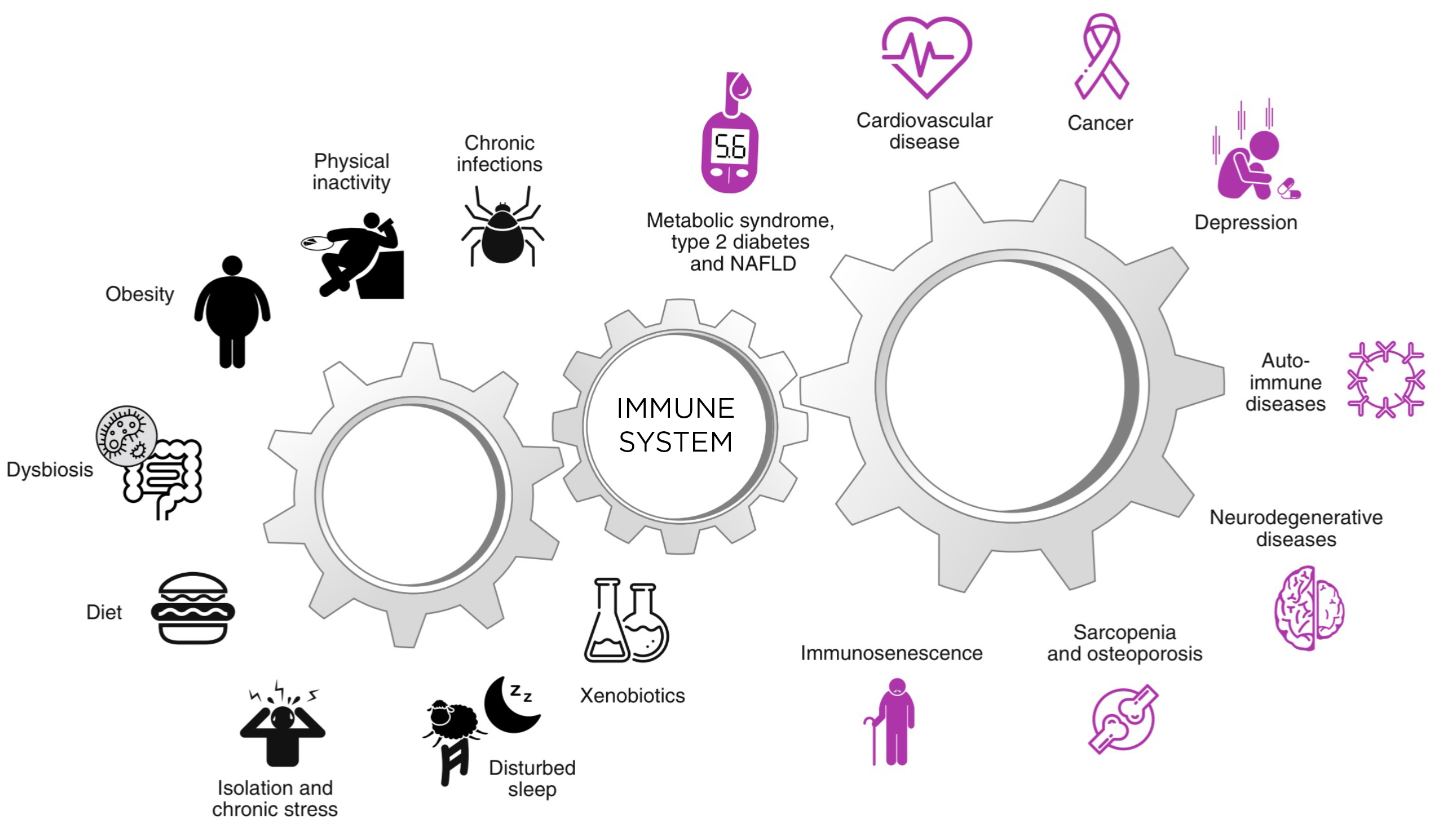
By understanding how the immune system balances attack and tolerance, we can develop new strategies to either boost its response — such as in cancer treatments — or calm it down when it becomes overactive, like in autoimmune diseases. Advances in vaccination could not only help prevent infections but also retrain the immune system to reduce allergic and autoimmune reactions — a technology we call “inverse vaccines.”
Additionally, since the immune system is strongly influenced by the microbiome (the collection of bacteria and other microbes in our bodies), engineering the microbiome presents another promising avenue for improving immune health.
2) Biological Engineering
Beyond immunity, other biological processes shape human health. By engineering key pathways — such as those that control cell signaling, gene activity, and how cells interact with their environment — we can develop new ways to maintain balance in the body and treat diseases.

In some cases, science can even go beyond the limits of natural evolution. For example, humans evolved to heal quickly from injuries, often forming scar tissue in the process. But in today’s world, where medical care is readily available, we might instead aim for optimal tissue regeneration rather than rapid, imperfect repair. Similarly, scientists can design signaling molecules that are stronger or more precise than those found in nature. Advances in chemical biology and artificial intelligence are also enabling the discovery of entirely new molecules that can block harmful processes or enhance beneficial ones.
3) Societal Impact
Scientific breakthroughs must also consider their real-world impact. Some of the most exciting medical advances — such as cell therapy for cancer, gene therapy for genetic disorders, and antibody treatments for inflammatory diseases — offer life-changing benefits. However, they can also be extremely expensive and difficult to access. For example, gene therapies for diseases like sickle-cell anemia are prohibitively expensive, especially in regions where the disease is most prominent. This initiative is committed to working toward solutions that are affordable, accessible, and sustainable for people everywhere.
Integrating Engineering, Biology, and Medicine
Advancing NYU’s mission in medicine and health requires a seamless integration of engineering, biology, chemical biology, computational biology, data science, and AI with foundational medical sciences and clinical practice. Achieving this vision necessitates collaboration across Tandon, Langone/Grossman, Dentistry, Arts & Sciences, and Courant, all coming together within an Institute led by Tandon.
Location and Infrastructure
To foster this interdisciplinary approach, the Institute will have a dual presence in Brooklyn and Manhattan.

Brooklyn
The NYU Tandon campus contains allied engineering disciplines such as Chemical and Biomolecular Engineering, Mechanical Engineering, and Electrical Engineering.
Manhattan
A short distance away from the main Langone Health site, this location ensures proximity to Chemical Biology, Biology, and the New York Genome Center. It also provides access to critical animal and core biological facilities, which are essential for translational research.
This structure enables a dynamic exchange — bringing medicine to Brooklyn and engineering to Manhattan — while allowing research groups to be strategically located based on their infrastructure needs. For instance, biological research requiring specialized lab space and vivariums would make use of space in Manhattan, while fabrication-intensive projects would use facilities like NYU Tandon’s Nanofabrication Cleanroom in Brooklyn.

Faculty Team and Contributions
Faculty will be recruited across schools to benefit existing academic units while strengthening the Institute itself. Faculty members will be based at NYU Tandon, NYU Grossman School of Medicine, and the Institute itself. This bilateral growth model ensures that both the Institute and its academic and clinical partners expand in a mutually beneficial way.
Global Engagement
NYU’s strong global presence presents an opportunity to enhance research in medicine and health through strategic international partnerships. Potential collaborations include locations like:
- Copenhagen (Cardiometabolic Disease)
- Basel (Immunoengineering)
- Paris (Translational Immunology)
- Pakistan (Maternal Health, potential collaboration)
These global connections extend NYU’s impact while fostering mutually beneficial collaborations in cutting-edge medical research.
Driving Innovation and Translational Impact
The Institute will actively foster the translation of discoveries beyond NYU through licensing, partnerships, and entrepreneurship. Many breakthroughs made by Institute faculty and researchers will have real-world applications, making them strong candidates for intellectual property protection and clinical development. However, successful translation doesn’t happen by chance — it requires a proactive culture of innovation, supported by:
- Funding for translational research
- Providing space and laboratory infrastructure for startups within NYU and the broader New York innovation ecosystem
- Connecting researchers with sources of capital to advance their discoveries
To maximize impact, the Institute will embed experienced entrepreneurs who can guide faculty and researchers through the commercialization process. These experts will help shape technology portfolios, ensuring innovations are positioned for success through licensing, partnerships, or company creation.
A dedicated translation team will engage with researchers from the earliest stages of ideation, helping refine concepts by evaluating:
- Intellectual property potential
- Market trends and competitive landscape
- Development pathways and timelines
Additionally, funding will be sought to support projects as they progress from discovery through clinical trials. This seamless integration of technological innovation and medical expertise — from initial discovery to clinical application and commercialization — will define the Institute’s commitment to real-world impact.
Leadership
