

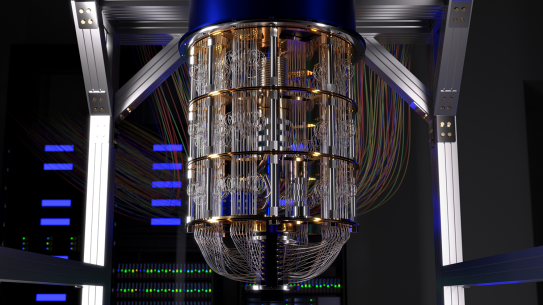
Quantum science looks at how the smallest particles of nature behave, often in ways that seem very different from our everyday world. Quantum technology takes those unusual properties and turns them into tools — like quantum computers that may one day solve problems classical computers can’t, or sensors that measure with extraordinary precision.
These technologies are especially promising for challenges that involve enormous complexity: simulating new materials or medicines, optimizing supply chains, or developing secure methods of communication. They also hold potential for advancing artificial intelligence and machine learning, where quantum computers could eventually help train models or analyze data in ways that aren’t possible today.
What You Learn
Our program is designed to give students both a solid grounding in the theory and hands-on experience with these technologies. You can learn a range of topics relevant to the field, including:
- Quantum computation and information
- Quantum programming
- The physics of quantum devices
- Quantum optics
- Quantum machine learning and AI
Graduates will be well prepared for careers in industry (such as technology companies, startups, and financial firms) as well as in research labs, government agencies, or further study in graduate programs.
Why NYU?
Our Master's in Quantum Science & Technology immerses you in a proven quantum ecosystem designed for real-world impact.
NYU has long been a pioneer in quantum information sciences, with established centers in quantum information physics, quantum phenomena, and topological systems. In 2023, NYU achieved an industry first: transmitting quantum information over 10 miles of standard telecom fiber across New York City in partnership with Qunnect, which is led by NYU Tandon alum Noel Goddard.
NYU Tandon also operates the first academic cleanroom in Brooklyn, the NYU Nanofab, a 2,500 sq. ft. facility that serves as a regional prototyping hub for advanced superconducting and semiconducting quantum devices.
Beyond research, NYU is a convener of global quantum industry leadership, and hosts the renowned NYC Quantum Summit that brings together leaders from finance, government, and industry giants like Amazon, Cisco, and IBM to define the quantum future.
Our Impact in the Field
To ensure your education is industry-aligned, NYU also actively partners with leading organizations. We co-host NYC HAQ, the city's first multi-institution quantum hackathon, to provide hands-on learning opportunities leveraging the latest tools and technologies to solve real-world problems.
Career Potential
Companies and organizations are hungry to hire skilled graduates in quantum technologies who can help them understand and take advantage of the potential of quantum science and technology, such as how to design the architecture to run a quantum computer, how to program quantum devices, and how the software interfaces with the world around us.
According to several industry studies by McKinsey and others, the quantum computing job market is growing at one of the fastest rates in the technology sector. Quantum-related job listings have risen by approximately 180% from 2020 to 2024, with continued growth expected at an increasing rate. But job demand far exceeds supply. For every qualified quantum professional, there are roughly three open positions.
180% growth
in quantum-related job listings over the last 4 years
3:1 gap
between open positions and qualified candidates
60% of Fortune 500 companies
are expected to have a quantum computing strategy by 2025
Graduates of the Master's program in Quantum Science & Technology will be well prepared for careers in industries poised to benefit from explosive growth in quantum technologies, such as large technology companies, startups, financial firms, pharmaceutical companies, aerospace companies, and consulting firms, as well as in research labs, government agencies, or further study in graduate programs. You can leverage the combined resources of NYU Wasserman Center for Career Development and the NYU Tandon Career Hub for job placement opportunities.
Program Overview
The Program may be completed on a full-time basis in one academic year (Fall, Spring, Summer), or within 3 years for students completing the program on a part-time basis. Incoming students are expected to have introductory-level knowledge in mechanics, electricity and magnetism, and waves and optics, as well as proficiency in vector calculus, linear algebra, differential equations, and python programming.
The program requires the completion of 30 credits, comprised of the courses listed in the table below. 21 of those credits are in required coursework, listed under ‘Core Requirements’, and the remaining 9 credits are in elective coursework, listed under ‘Electives.’ The list of courses in the ‘Electives’ section of the curriculum may continue to change in the future, as New York University (NYU) responds to changes in the field.
Curriculum
|
Course |
Title |
Credits |
|---|---|---|
|
Core Requirements |
||
|
Courses |
||
|
PH-GY 6603 |
Introduction to Quantum Computing |
3 |
|
PH-GY 6613 |
Mathematical Methods for Quantum Computing |
3 |
|
PH-GY 6623 |
Quantum Programming |
3 |
|
PH-GY 6633 |
Physics of Quantum Devices |
3 |
|
PH-GY 6643 |
Quantum Computation and Information |
3 |
|
PH-GY 6653 |
Introduction to Quantum Optics |
3 |
|
Lab |
||
|
PH-GY 6713 |
Quantum Optics Laboratory |
3 |
|
Electives |
||
|
Select 9 credits from the following: |
||
|
PH-GY 5493 |
Physics of Nanoelectronics |
3 |
|
PH-GY 6673 |
Quantum Mechanics I |
3 |
|
PH-GY 6683 |
Quantum Mechanics II |
3 |
|
CS-GY 6903 |
Applied Cryptography |
3 |
|
CS-GY 6923 |
Introduction to Machine Learning |
3 |
|
PHYS-GA 2015 |
Introduction to Condensed Matter Physics |
3 |
|
PHYS-GA 2033 |
Special Topics: Quantum Optics |
3 |
|
PHYS-GA 7001 |
Introduction to Quantum Communication |
3 |
Admissions
The Quantum Science and Technology Master’s program is for ambitious scientists and engineers who want to pursue a career path in emerging quantum industries. The field is inherently interdisciplinary, and applicants with an undergraduate degree in a variety of STEM disciplines — including math, physics, chemistry, computer science, computer engineering, and electrical engineering — would be well positioned to apply.
Quick Links
Featured Faculty
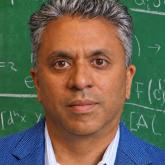
Rupak Chatterjee