
When technology meets the town square: A journey to the heart of public interest technology
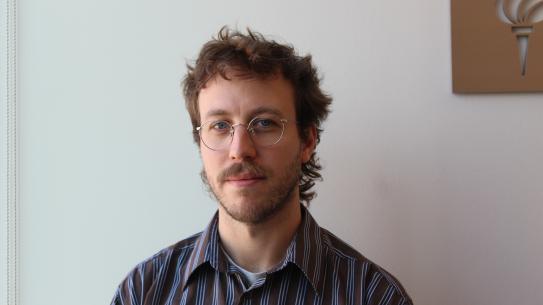
Industry Assistant Professor Manny Patole’s class immerses students in community-engaged research

Students in the project-based "City Immersion" course studied in Tulsa, Oklahoma
The students might not have expected live music or a pride parade. They came to Tulsa, Oklahoma, prepared for data collection and policy meetings — the typical fare of urban planning graduate work. But as they walked the streets of the Greenwood District, where Black Wall Street once thrived, sat in government meetings debating housing funds, and volunteered alongside residents at a community fair, something fundamental shifted. They began to see what their professor, Manny Patole, had been telling them all semester: a city is not just infrastructure; it's people.
The October immersion trip, facilitated by Kate Costello, the Research and Scholarly Programs Manager at NYU Tulsa, was part of Patole's course at NYU's Center for Urban Science + Progress (CUSP), aimed at showing them, firsthand, exactly what Public Interest Technology can mean and why community-engaged research and data collection are so important..
A Trust Deficit
All too often, technology can seem like a black box that regular citizens can't peer into, let alone influence. The terminology is impenetrable, and the explanations feel condescending. The decisions that shape our lives — from algorithmic hiring systems to predictive policing to how our neighborhoods are planned — are often made in rooms where community voices are notably absent.
But when technology is built for communities rather than with them — when data scientists and engineers speak only to each other, using jargon that excludes the very people their work will impact most — trust erodes. "When you want to engage with community members, policy and public officials, and industries that aren't tech-savvy, you have to understand how to do the code-switching," Patole has said. "You have to understand how to make information accessible, digestible, and equitable."
That is the heart of Public Interest Technology, which is often referred to by the acronym PIT: demystifying the black box, not by dumbing it down, but by genuinely translating its implications and inviting those affected into the conversation as equals.
A Network for Change
The NYU Alliance for Public Interest Technology (NYUA-PIT) exists to reimagine this relationship between technology, democracy, and society. As part of the national PIT University Network — supported by New America and connecting more than 50 institutions — the Alliance brings together scholars, practitioners, and community partners to design, develop, and deploy technology that advances the public good. It's a simple premise with profound implications: technology should serve and work with our communities in their different forms, not harm or exploit them.
As a Senior Fellow and Practitioner-in-Residence with NYUA-PIT, Patole extends this mission through his work in community-engaged data science, urban livability, data ethics, governance and privacy, and responsible AI. His role creates crucial bridges — linking technical and social perspectives, connecting students to real-world community-driven projects, advancing frameworks for ethical data use, and ensuring that innovation processes remain participatory and equitable.
Tulsa — Where Theory Turns into Practice
Which brings us back to Tulsa and those graduate students, who had spent a significant amount of time learning about qualitative analysis methods, data collection techniques, and urban planning theory from the safety of a classroom.
The trip, which was also taken by Industry Assistant Professor Anton Rozhkov, who directs Tandon's M.S. in Applied Urban Science and Informatics Program, was carefully designed as genuine community-engaged research — a process that incorporates input from people the research outcomes will impact and involves them as equal partners throughout. The students visited museums to understand the city's history and culture, met with the mayor’s housing officials (watching democracy's complex machinery up close), and learned not from dry datasets but from the residents and places the data represented. They stood in Greenwood, where one of America's most prosperous Black communities was destroyed in the 1921 massacre, a reminder that urban planning and technology are inextricable from histories of power and exclusion.
The Practitioner's Path
Patole's work extends well beyond any single course. He serves, for example, on the NYU Climate Initiative and sits on the board of the Municipal Art Society of NYC, to name just a couple of his roles, each of which reflects the interdisciplinary, collaborative approach that PIT requires.
Because here's what traditional tech education sometimes misses: the most sophisticated algorithm is useless — or worse, actively harmful — if it's deployed without understanding context, without community input, without considering who benefits and who bears the costs. Engineering students need more than technical skills. They must know how to co-design research questions with communities, how to influence policy, how to create programs and interventions alongside the people those programs will serve. They need to learn that a city is not just infrastructure; it's people. And that’s just what they’re learning at NYU Tandon and CUSP.
They’ll be graduating with a deep understanding of PIT’s promise: not to slow down innovation, but to redirect it toward human flourishing. Not to reject technical sophistication, but to deploy it with wisdom, humility, and accountability to democratic values.
As technology continues to reshape our cities, our governance, and our daily lives, we need more practitioners like Patole and the students he is helping to educate — people who understand both data science and the human stories behind the data.