
The Unconventional Kitchen: NYU Tandon's Answer to Food Insecurity
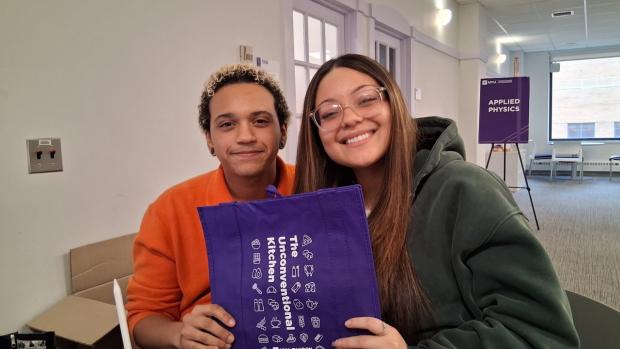
Aspen Woods (left) and Samantha Fiallos (right)
When dozens of students trekked through The Unconventional Kitchen on its first day of operation, Brittney Bahlman, Senior Director of Student Leadership & Engagement, couldn't help but feel a mix of emotions. "We knew food insecurity was a problem, but seeing that many people show up on day one really drove it home," she says. "That's the kind of turnout that well-established university pantries get, and we had just begun operating."
A Crisis Accelerates Action
The Unconventional Kitchen wasn't supposed to open quite as soon as it did. Originally planned for a later launch, the food pantry's timeline was moved up when concerns about the ongoing government shutdown and SNAP (Supplemental Nutrition Assistance Program) disruptions added urgency to the mission.
With over a decade of experience in higher education and student affairs, Bahlman understood that addressing basic needs couldn't wait for perfect timing. "Food insecurity isn't just about missing meals," she explains. "It's about students making impossible choices — between housing and groceries, between transportation and dinner. It’s about being able to focus, because engineering classes are challenging enough without being distracted by hunger. When we heard about potential SNAP issues, we had to push forward."
Earlier this semester, the Student Government Assembly had agreed to provide backing through its Initiative Fund, which prioritizes projects that demonstrate a clear and tangible benefit to the student body. That money would cover healthy staples, bulk goods, sustainable storage solutions, and critically, support for part-time student staff like Aspen Woods, an English major from NYU’s College of Arts and Science, and Samantha Fiallos, a Tandon Computer Science major, both of whom have a long history of social service and leapt at the chance to be involved.
More Than Just Food
Walk into The Unconventional Kitchen during its hours of operation, and you'll find something that sets it apart from typical emergency food resources: choice and dignity. The shelves are stocked not just with staples, but with options that reflect the diverse dietary needs of Tandon's student body.
"We have an incredible selection of vegetarian proteins," Fiallos notes, gesturing to shelves lined with beans, lentils, and plant-based alternatives. "A lot of students don't eat meat for religious, ethical, or health reasons. We wanted to make sure everyone could find something that works for them."
The supermarket chain Wegmans readily agreed to make a large donation of shelf-stable goods, and plans are now in the works for fresh produce pop-ups, bringing even more nutritious options directly to students at no cost. But the facility — whose name draws upon Tandon’s mission to educate unconventional engineers who think outside the box — goes beyond food. Hygiene products and household essentials line the shelves — items that are often overlooked but critically important for students' wellbeing and dignity.
Student-Led, Community-Minded
What makes The Unconventional Kitchen, which is easily accessible on the 10th floor of 2 MetroTech, particularly powerful is its student-centered approach. Fiallos and Woods aren't just filling shelves; they're creating a welcoming space where students can access resources without shame or stigma. "We understand because we're students too," says Woods. "We understand the pressure, the financial stress, the way food insecurity can affect your ability to focus in class or participate in campus life, particularly for commuters who don’t often have meal plans."
Both workers bring different perspectives to their roles. Fiallos, studying computer science, approaches operations with an engineer's eye for efficiency and systems. Woods, with a minor in political science and a stint volunteering with NYC Councilwoman Carlina Rivera, sees the pantry as part of a larger conversation about equity, access, and structural inequality.
The Road Ahead
The first-day turnout sent a clear message: The Unconventional Kitchen is meeting a real need, but this is just the beginning.
The pantry's model prioritizes sustainability — both environmental and operational. Reusable bags reduce waste. Bulk items maximize the budget. And the involvement of student workers ensures that the pantry remains responsive to student needs.
As word spreads through Tandon's community, Bahlman and her colleagues, including Alesha Gooden, Assistant Director in the Office of the Dean, and Molly Ritmiller, Design Lab Manager at the NYU MakerSpace, are thinking about scale. How do they serve more students? How do they maintain inventory? How do they ensure that the most vulnerable students know this resource exists? And at a school like NYU Tandon, which is known for the world-class caliber of its educational offerings, how can they make sure every student’s more basic needs are met?
"Food insecurity can be invisible," Woods reflects. "Students are good at hiding their struggles. Part of our job is making sure everyone knows that it's okay to need help, and that help is available."
For Fiallos, the mission is personal. "As a computer science major, I'm learning to solve complex problems. But some problems are simple: people need food. We can't solve every structural issue causing food insecurity, but we can make sure students on our campus can focus on their studies without worrying about where their next meal will come from."
Students can follow @tandonunconventionalkitchen on Instagram for hours and updates.