
A Robot That Shifts Its Own Weight to Cross Land, Steps, and Water
NYU Tandon researchers built an undulatory robot that pumps water between its head and tail to climb slopes, clear steps and swim, all while keeping the same basic gait
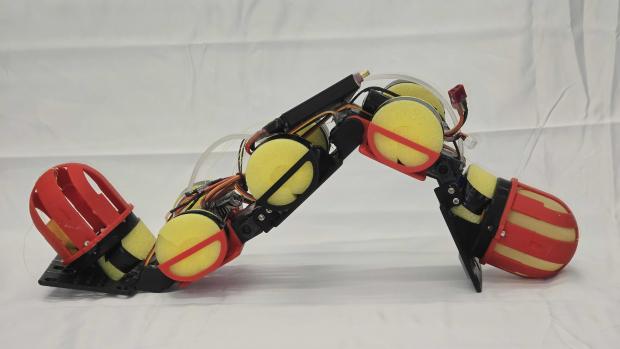
WorMa, an amphibious robot, shifts water between its head and tail to adapt to different terrain. Photo credit: Nana Obayashi
A robot meant to inspect a coastline, a flooded street or a wetland can't count on one kind of ground. It might need to crawl over a hard surface, climb a bank, scale a curb or a step, then slide into open water, often within the same few feet.
That combination is difficult for snake- or worm-like robots. Existing amphibious designs typically handle changing terrain by switching gaits, adding specialized appendages or mechanically reconfiguring themselves. Those approaches can add complexity and potential failure points at the boundaries between terrains.
NYU Tandon Assistant Professor Nana Obayashi and Daniil Filimonov, a Ph.D. student in Obayashi’s Prema Lab, built WorMa, a name that combines "worm" and "mass," to take a different approach. It keeps the same basic undulatory gait across the terrains it crosses. The key adaptation is where its weight sits.
"The mechanism itself isn't tied to any one job,” said Obayashi, who serves on the faculty of the NYU Center for Robotics and Embodied Intelligence. “What it gives you is a robot that doesn't need to be redesigned every time the terrain changes. That could matter for environmental monitoring or infrastructure inspection, where a robot may need to cross dry ground, obstacles and water during the same mission.”
As described in a paper in Advanced Robotics Research, WorMa is a five-link, four-joint robot, 50 centimeters long and just over a kilogram, with a latex balloon water tank in its head and another in its tail. A pump in its middle shifts about 300 grams of water, 28% of the robot's total mass, between the two.
Where the water sits determines what the robot can do.
On an incline, shifting water toward the head increases the force pressing the robot's front contact points against the surface, giving them more traction. Head-biased placement was the only configuration that successfully carried WorMa up the steepest incline tested, 19.5 degrees; every other configuration slid back down. It also reduced the robot's cost of transport by at least 33% compared with the other configurations.
In water, the advantage was reversed. With its weight shifted toward the tail, WorMa swam up to 26% faster and was 52% more efficient than when its weight was concentrated at the head.
Steps required something different. Neither a fixed head-heavy nor tail-heavy robot could clear a step on its own. The researchers instead had WorMa approach the step with water in its head for traction, then shifted the water to the tail and raised the head and neck so the tail could push the robot closer. Once the head anchored on the step's edge, the water shifted back to the head and the robot continued. That sequence got WorMa over steps as high as 15 centimeters.
Getting out of the water worked only with the weight concentrated at the head. The other configurations lacked enough force at the front of the robot to pull themselves onto the slope.
Strung together, those strategies let WorMa cross a single course combining flat ground, a step, a slope and open water by shifting where the water sat at each stage. The researchers say it is the first demonstration of an undulatory robot making amphibious terrain transitions, including both entering and exiting water.
That's the practical case for building it this way. Instead of carrying specialized parts for every environment it might encounter, the robot adapts to changing terrain by redistributing mass it's already carrying. The WorMa robot is continuously getting upgraded – faster pumps and sensor-driven controls for example, could eventually allow the robot to detect changing terrain and adjust its weight on its own and more dynamically.
The work follows Obayashi's recent development of ScaFi, a fish-inspired robot designed to be built at different sizes from a single blueprint for use in environments ranging from shallow creeks to open water. Together, the projects explore a similar problem from different directions: how to build robots that can adapt to the environments they encounter without having to design a different machine for each one.
Filimonov Daniil, Obayashi Nana, WorMa: An Undulatory Robot With Center of Mass Regulation via Internal Fluid Redistribution for Amphibious Locomotion, Advanced Robotics Research 2026, 0, e70163.