

A Robot That Grows Like a Fish, Not Like a Machine
Nana Obayashi develops a length-scalable robotic fish that can be adapted for studying shallow creeks to open water
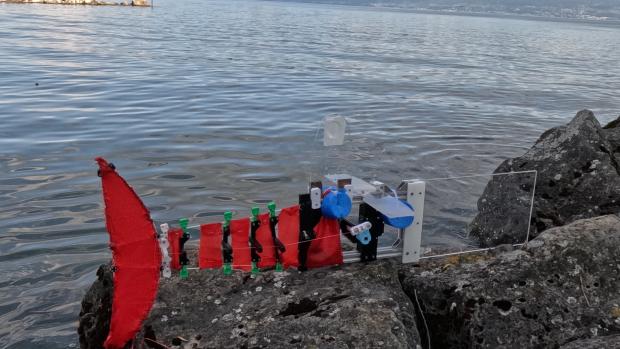
ScaFi, a robotic fish designed to be built at multiple sizes from a single blueprint, rests at the water's edge. Its red fabric tail and flexible fiberglass rod skeleton extend from a rigid, motor-driven front section.
Propeller-powered underwater vehicles have long helped scientists explore and monitor aquatic environments. But they're limited by their own mechanics: spinning blades can snag on vegetation, stir up sediment, and startle the wildlife they're often sent to study, making them poorly suited to shallow creeks, dense weeds, or close encounters with fish.
That's one reason roboticists have spent years building machines that swim like fish instead, bending their bodies rather than spinning a propeller. The catch is that most fish-inspired robots are built for one size and one job, so scaling them up or down usually means starting from scratch.
A team of engineers says it's found a way to solve that problem. They've unveiled ScaFi, a robot modeled on fish like cod and mackerel. These fish swim by concentrating most of their body bending toward the tail end, a style that, in nature, spans an unusually wide range of body sizes.
"Right now, if you want to monitor a creek and then monitor a lake, you basically need two different robots, built and tested from the ground up," said NYU Tandon’s Nana Obayashi, currently an assistant professor of mechanical and aerospace engineering and a faculty member of the NYU Center for Robotics and Embodied Intelligence, who led the project while a doctoral researcher at EPFL. "The environments we care about don't come in one size, so we don't think the tools should either."
As described in a paper in npj Robotics, ScaFi has a rigid front section and a flexible tail made of fiberglass rods. A single motor pulls two tendons that cross near the tail's end, producing the "S"-shaped bend required for fish-like swimming motion.
The diameter of the rods forming the tail are the only part that must change with the size of the robot. They grow proportionally thicker as the robot scales up, to preserve similar tail-bending behavior. The underlying motor mechanism and crossed-tendon system stay the same.
That matters because it could cut the engineering effort needed to build fish-like robots for different environments. It also gives researchers a platform for studying how swimming performance changes with scale, a question that's hard to study systematically in animals or custom-made robots alike.
The team built three robots — roughly 0.6, 1.1, and 2.9 meters long — and tested how well each swam. The smallest produced swirling water patterns similar to those left by real fish, and across all three sizes, swimming motion lined up closely once adjusted for body size, evidence the authors say that their scaling approach preserved the fish-like gait even as the robots grew nearly fivefold in length.
They also deployed the robots in the field: the medium-sized one in a Swiss stream, the largest on Lake Geneva, the smallest in creeks only 15–30 centimeters deep. During the stream test, the robot kept swimming even after a GPS dropout.
Energy efficiency proved harder to scale. The two smaller robots performed similarly, but the largest was consistently less efficient and needed a different, more powerful motor. The authors suggest drag and inertia may be to blame, though the exact cause is unresolved, meaning the team scaled the swimming motion itself more cleanly than the energy it takes to produce it.
A similar tradeoff showed up in disturbance tests. The smallest robot was most agile but recovered slowest after being knocked off course, while the larger robots were less nimble but more stable.
The researchers suggest the same approach — scaling around one key structural parameter — could apply to other compliant robots, including ones outside water. Whether energetic performance can be scaled as successfully as the swimming motion remains an open question.
The study adds to broader aquatic robotics efforts at NYU Tandon. Industry Professor Christopher Clark's research includes autonomous underwater robotic systems for exploration and environmental monitoring, while Institute Professor Maurizio Porfiri has pioneered the use of biomimetic robotic fish to study and influence animal behavior.
The co-authors on Obayashi's paper are Josie Hughes, Alexandros Anastasiadis, Karen Mulleners, Kai Junge, and Kyle L. Walker of EPFL, and Jessica Gumowski of Queensland University of Technology. The research was partially funded by the European Union's Horizon 2020 programme under Marie Skłodowska-Curie grant agreement No. 945363.
Obayashi, N., Anastasiadis, A., Gumowski, J. et al. ScaFi: length-scalable, compliant, parametric robotic fish design for operation in multiple environmental niches. npj Robot 4, 38 (2026).


