
Q&A: Gagandeep Pahuja on Going Global with NYU Tandon
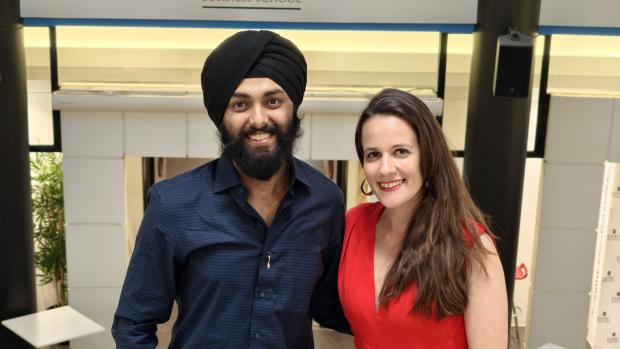
Gagandeep Pahuja, a second-year Management of Technology student at NYU Tandon, spent his first year of the program at NYU London before participating in the Global Manager in Europe summer program at ESSEC Business School in Paris, a program offered by the NYU Global Innovation Initiative. With an undergraduate degree in computer science engineering and three years of experience as a software engineer in India, Pahuja is interested in technology, entrepreneurship and leadership. He spoke about how studying in London and Paris has expanded his understanding of global business and prepared him to work across cultures.
What drew you to spend your first year at NYU London?
When I was applying, I only applied to American universities. I never thought about going to London. But then I saw there was a global program where, as part of an American university, you could spend one year in London. I thought, “Okay, let's give it a try.”
It was a new program, so nobody had done it before. There were no reviews, and nobody really knew how it would go. But instinctively, I felt like I should go. And when I went, it was really amazing.
What was your academic experience like in London?
We had six subjects across two semesters. Four were core courses and two were electives. The core courses were organizational behavior, fintech, global innovation and economics. My electives were statistics and data visualization.
It was a good balance of the kinds of skills a project manager should have. And because I completed all my core courses in London, I have much more flexibility now that I'm in New York to choose the courses I want.
Why did you choose Management of Technology and project management?
I like talking about technology, and I like working with people. I want to be a good leader. I've also been an entrepreneur twice, and I didn't succeed, so I wanted to understand what qualities make a good leader and how to get things started.
I remember watching an Apple product launch in 2024 and seeing the designation of the person overseeing the project. That really drew me in. He knew everything about the project, but he wasn't coding.
I realized coding isn't something I really enjoy. I want to be in the technology department, but I want to visualize things, make a roadmap and understand both hardware and software. I want that perfect blend of everything.
How did you become involved with the program at ESSEC Business School?
Aric Meyer [Deputy Director, Global Innovation Initiative] sent us an email about the summer module, and I thought it was a great program. At that point I was already in London, so Paris was very close. I also looked at the list of universities that had partnered with ESSEC, and I was expecting a strong cohort.
And it really was great. The people I met at ESSEC are gold for me. I met so many experienced people. We were around 40 students from 20 different schools and 17 different nationalities, with an average age of 31 and an average of 6 years of work experience. Most of the participants were pursuing EMBA programs, and the oldest participant was 45. I was among the youngest participants to have the opportunity to be part of the program. I found that especially valuable because I got to learn not only from the classes but also from the experiences and perspectives of people who had already built significant professional experience.
What did you study at ESSEC?
The program started with the basics, which was useful because there were subjects that were completely new to me. One was luxury. Coming from India, I hadn't really had much exposure to luxury brands, and France is obviously very famous for them.
We also studied geopolitics and current events, looking at what's happening in the world and how different organizations and countries are responding. We had marketing and AI in marketing as well.
A big part of the program was being able to apply what we learned through outings. For example, during a week focused on luxury brand management, we visited the Louis Vuitton museum. We also had experiences related to Champagne.
You've now experienced London, Paris and New York. What do you think you gain from studying in three different cities?
I asked the NYU Stern dean this question when he was in London. I asked what the goal was in giving students this kind of global exposure. He said one thing: “contextual intelligence.”
That means being able to read the room and communicate with different nationalities, because people's work priorities can be very different.
I've done a lot of networking in London and Paris, and I've noticed differences in how people work. In Paris, for example, there is more emphasis on work-life balance and long lunches. Now that I'm in New York, I've already noticed differences in how people communicate and work here.
I'm imagining myself someday leading a global team, with people in different cities. I want to understand what makes each team work and how to manage those differences.
How have you approached taking advantage of your time in London beyond the classroom?
My experience of college is that you shouldn't rely entirely on the college. You're there for maybe six hours a day, and in London we were only in class three days a week. That gives you four other days to do more.
When you're studying at a university in one of the world's biggest cities, you have to take advantage of your geographic location. You have to know where you are and see what the world is doing around you.
I went to more than 50 events in London. Maybe 20 percent were things I heard about through NYU. The other 80 percent I found myself, simply because I was in London. Our campus was right next to the London School of Economics and across from King's College, and there was also a student union that allowed NYU students to go into their campuses. So the location itself became an opportunity.
What are you looking forward to now that you're in New York?
There were many reasons I chose NYU: New York City, the program and the opportunity to spend one year in London. I was also excited about the Future Labs and the startup ecosystem.
Brooklyn is known as a home for startups, and I want to learn more about business and meet startup leaders here. I'm interested in how they think about the future while also considering politics, the environment and all these other factors.
For me, being at NYU isn't just about the classroom. It's about being in these cities and using that experience to understand how the world works.