
NYU Tandon’s Urban Future Lab holds an action-oriented forum focused on building blueprints for advanced energy implementation
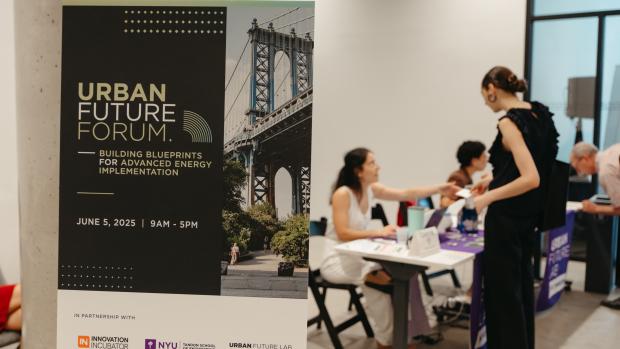
In 2023, when the Wells Fargo Innovation Incubator (IN2) — an energy technology program funded by the finance-industry giant and co-administered by the U.S. Department of Energy’s National Renewable Energy Laboratory (NREL) — announced that it would be funding a select group of projects driving advanced energy innovation, Tandon’s Urban Future Lab (UFL) threw its hat in the ring with an idea for holding an all-day forum for stakeholders from across the climate-tech ecosystem.
The idea caught the attention of IN2 officials, who ultimately tapped the UFL as one of the handful of programs to receive funding. Given the success of that inaugural event in 2024, it was perhaps no surprise that this year, IN2 granted UFL with another strategic award to host a second forum, this one aimed at providing interactive workshops to energy-solution startups, local organizations, academics, CEOs, and policy-makers.
Sarah Derdowski, the IN2 program manager at NREL, explained that this year’s selection committee evaluated applications based on the potential for capacity building, regional collaboration, knowledge-sharing, and action-oriented initiatives to strengthen the energy-tech ecosystem. “This year’s awardees embody the bold, collaborative spirit that fuels energy innovation,” she said. “By closing commercialization gaps and building partnerships that connect startups with prospective end users, these projects are not just advancing individual ventures — they're shaping a more resilient and adaptable energy future.”
This year’s Urban Future Forum kicked off with remarks from Linda Boyle, Tandon’s Vice Dean for Research, who addressed the crowd, saying: “As engineers, all our work is aimed at making a real-world impact. Hence, connections to industries and organizations are really important for ensuring that fundamental research is transferred into real-world applications. These collaborations between academic and industry leaders are key to accelerating research, innovation, and the development of scalable products and services that improve our overall health, well-being, and community.”
Those remarks were followed by a jam-packed schedule of fireside chats; case studies; and workshops that gave participants actionable, real-world strategies to leverage.
“Since 2020, the Urban Future Lab has made a concerted effort to bridge the gap between innovation and commercialization while bringing communities into the conversation,” Jeannette Williams, COO at the Urban Future Lab, said. “This year’s Forum, once again sponsored by Wells Fargo, emphasizes interactive workshops. In the past, we’ve heard questions like ‘What does this mean?’ or ‘What does it look like in practice?’ Now, attendees tested out some of these strategies and best practices — hands-on — with the guidance of experts in the field. These experts have generously offered their time and insights to lead attendees through key themes of the day. We explored questions like: What does it really look like to partner with communities? What are effective strategies for engaging the workforce? What criteria should we consider when evaluating advanced energy projects with communities in mind? And how can we build a capital stack that prioritizes community benefit? These are just a few of the topics we explored together at our second Urban Future Forum.”
The workshops included:
- “Partnering with Communities,” which explored how startups can embed authentic community engagement into every stage of their project strategy — even with limited resources and competing local priorities. Led by Rhea Quiñones, an environmental justice and climate equity leader, it taught participants practical frameworks for building trust, communicating climate goals effectively, and rethinking engagement as a foundation for long-term success.
- “Project Finance and Community Engagement,” which offered a roadmap to building capital stacks that reflect community priorities and blend federal, philanthropic, and private funding. Under the guidance of La-Toya Niles of the Sustainable Cities Fund (and a current Tandon Ph.D. candidate), participants examined a real-world case study and drafted a capital plan to navigate the 2025 funding landscape.
- “Project Development Tools,” which was led by Mark Reuss, P.E., AC, Principal of Portfolio Operations of Spring Lane Capital, who broke down the key phases of advanced energy project development, emphasizing both structure and scalability.
- “Partnering with Workforce,” which was led by Neil Padukone, Director of Green Economic Transformation at the New York Climate Exchange, who discussed effective approaches for partnering with workforce development organizations to help close training gaps and ensure that communities and employers are equipped for the demands of an advanced energy economy.
- “Countering Misinformation,” which offered strategies for countering misinformation during the critical early stages of advanced energy projects. Led by University at Buffalo Associate Professor Holly Buck, the session armed attendees with tools for myth-busting, shaping narratives, and ensuring that communities receive accurate, resonant information.
- “Peer-to-Peer Project Development,” led by Brian Asparro, who explained the best practices and lessons he learned as COO of the startup CarbonQuest, which evolved into an industry leader in Carbon Capture, Utilization, and Storage (CCUS).
- “Creating Criteria to Assess Projects,” during which Hannah Corn, a climate investor and growth strategist, offered tools for addressing technical, commercial, and financial risk, as well as risks related to community impact.
Case Study Presenters and Fireside Chat Participants
Greg Koumoullos (Department Manager, Thermal Energy Networks at Con Edison)
Jack Fritzinger (Founding Partner at Node)
Jeanne Bergman (Director of Thermal Energy Projects at SANE Energy Project)
Su Sanni (Founder and CEO at Dollaride)
Thomas Guest (Founder at Brym)
The participants weigh in
The Urban Future Forum is a really important initiative for us because it supports our Sustainability Engineering Initiative, which looks at embedding sustainability in all parts of the NYU Tandon curriculum. What we are seeing from a lot of entrepreneurs that we work with is that they don’t really have a good way to interact with communities in which the innovation will ultimately be deployed. So UFF is a really important gathering and forum for entrepreneurs to connect with the communities, and also have a space for researchers to connect with innovators.”
– Frederic Clerc, Interim Managing Director at the Urban Future Lab
The importance of community in deploying innovation can't be understated. I mentioned in my fireside chat that one way to look at it is simply as lowering the risk of your project's delivery. But it can also increase the adoption of novel technologies or even potentially invasive programs or services you're introducing. We see community engagement as a way to ensure that the community has a stake in our project by being involved in its design, implementation, and maintenance. That’s why it’s important, and why we really invest in it."
– Su Sanni, Co-Founder and CEO at UFL Startup Dollaride
It was interesting to see how far we've come on the climate journey. It makes me hopeful that we're taking the next steps, even amid the upheaval happening today. My favorite panel was the Climate is the New Economy conversation as it filled me with hope to see collaboration between groups you wouldn't normally expect — like ConEd and [SANE Energy] a clean energy-focused NGO — working together to drive change and move things forward."
– Yashvarya Goyal, Economics Student at NYU and Project Management Intern at UFL