
NYU Tandon's Urban Future Lab announces finalists for 2025 Urban Future Prize Competition
Eight innovative climatetech companies vie for $100,000 in prizes
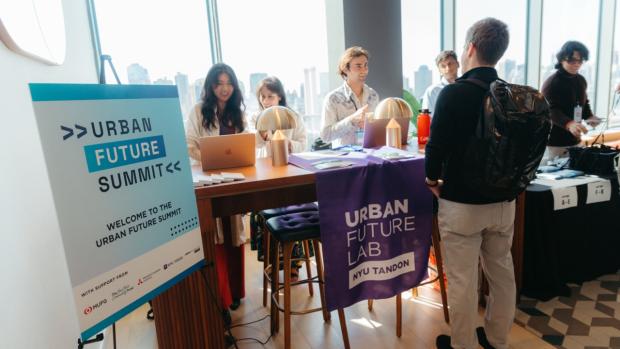
Urban Future Summit 2024. Photo credit: Ryan Rose Evanousky
Eight innovative climatetech companies have been selected to vie for $100,000 in prizes at the 2025 Urban Future Prize Competition, from a record-breaking 382 applications.
The finalists in the annual contest — run by NYU Tandon School of Engineering's Urban Future Lab, an incubator for climatetech startups — will pitch their businesses to a panel of judges at the Urban Future Summit in October. The panel will name two $50,000 winners, one for the Climate Adaptation Prize and another for the Climate Mitigation Prize.
Now in its ninth year, the Urban Future Prize Competition identifies and supports top climatetech startups, with sponsorship from MUFG Bank and Mitsubishi Corporation (Americas). This year the competition will award its millionth dollar in prize money since its inception.
In addition to funding, the winners along with several finalists receive admission into the ACRE Incubator, New York's longest-running and most successful climatetech incubator, housed within UFL. There they get mentorship, fundraising support, hiring assistance, and help with commercial pilots and design.
The competition advances NYU Tandon's Impact Area: Industrial, Urban & Environmental Sustainability. Tandon’s approach, which is exemplified by its Sustainable Engineering Initiative, focuses on technological advances that enhance both efficiency and resilience while supporting economic prosperity. NYU Tandon's SEI researchers and UFL companies are aligned in their mission to develop real-world climate solutions, creating opportunities for knowledge exchange between academic research and commercial innovation.
2025 Urban Future Prize Competition Finalists
Climate Adaptation Prize focused on solutions that help communities and ecosystems adapt to and build resilience against the impacts of climate change.
- Blue Planet Ecosystems — Closed-loop aquaculture systems for sustainable seafood production, enabling urban and inland fish farming.
- Eztia — Passive cooling material integrated into gear to reduce skin temperature and prevent heat-related injuries without electricity.
- Levitree — Biomass slurry injection tech for land elevation and carbon sequestration to reduce flood risk and remove atmospheric CO₂.
- Xatoms — Quantum chemistry and AI-based water purification photocatalysts that eliminate pollutants using visible light, not UV.
Climate Mitigation Prize focused on solutions that reduce greenhouse gas emissions and mitigate the impacts of climate change.
- Elastic Energy — Hardware and orchestration software connecting DERs like solar, batteries, EVs, and HVAC into grid-responsive systems.
- MetalLight — Metal-air generator providing zero-emission, cost-effective alternatives to diesel for heavy industry deployment.
- PopWheels — Urban battery-swapping infrastructure solving micromobility fire hazards and building scalable EV solutions for delivery workers.
- Zero Electric — Grid intelligence software that transforms grid data into searchable, real-time maps to optimize electrification.
The Urban Future Prize Competition attracts applications from various market-ready startups innovating across renewable energy, environmental justice, buildings, circular economy, transportation, electricity, and manufacturing. This year's finalists represent a sophisticated applicant pool of established businesses with paying customers and proven products, demonstrating how quickly innovative ideas can move from laboratory research to marketplace solutions.
"This year's record-breaking 382 applications show that, even in a challenging policy and funding environment, founders remain undeterred in tackling the climate crisis," said Austin Evarts, Director of the ACRE Incubator. "We're especially encouraged by the growth of our climate adaptation track, which saw a 33 percent increase in applications. These companies are delivering market-ready solutions to some of the most urgent challenges — from extreme heat and flooding to water contamination and climate-related food insecurity. The caliber of technologies we're seeing, many already generating revenue, is proof that the climatetech sector is maturing rapidly and scaling where it matters most."
The competition culminates with the Urban Future Summit on October 23 in New York City, where the two winners will be announced in front of the attending academics, innovators, nonprofits, investors, corporates, and government organizations.