
NYU Tandon School Of Engineering To Develop Integrated EV Charging and Power Grid Software
New AI software will coordinate EV charging networks with power grid upgrades.
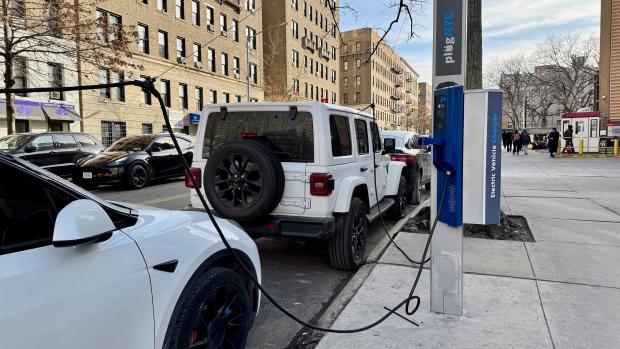
NYU Tandon School of Engineering is leading the development of a software solution that will coordinate EV charging station placement with power grid upgrades.
The project was announced by the New York State Energy Research and Development Authority (NYSERDA) as one of seven awarded funding through the Vehicle to Grid Integration Program to advance technologies for integrating electric vehicles into New York's electric grid.
"NYSERDA's support enables us to tackle one of the most complex challenges in transportation electrification," said Yuzhang Lin, assistant professor in the NYU Tandon Department of Electrical and Computer Engineering and the project's leader. "Their vision in funding research that bridges multiple sectors — transportation, power systems, and data analytics — is exactly what's needed to solve these interconnected infrastructure problems."
“NYSERDA’s investment in this innovative software to improve EV charging infrastructure deployment and power grid upgrades helps to close a market gap and bridges these two areas to integrate vehicles to the electric grid,” said Christopher Cheng, NYSERDA Program Manager of Power Grid Innovation. “This is an essential step to create a holistic environment for vehicle-grid planning that will improve coordination between utilities and cars and increase access to EV charging for consumers.”
Currently, utilities plan grid upgrades separately from transportation officials and charging station developers planning charging networks, leading to delays in integration and sometimes inefficient investments.
The software platform will use advanced data analytics to predict where and when vehicles will need charging — from passenger cars to transit buses and heavy-duty trucks — then optimize both charging station placement and grid upgrade timing.
The results of this project will model and optimize infrastructure at multiple scales, from neighborhood transformers to high-voltage transmission lines, reducing costs and cutting connection times by avoiding the retrofits and delays that result from uncoordinated planning.
The Tandon-led team includes researchers experienced in dealing with California’s EV-grid integration challenges who will now advance and customize their solutions for New York, including researchers from the University of California, Riverside, and the startup company AmpTrans, which will help commercialize the technology.
The tools developed through this project will provide granular, look-ahead forecasts of EV charging demand and optimized investment recommendations that are crucial for proactive grid planning.
The research team expects to produce a working prototype within two years. “We are very excited about the collaboration with the New York State utilities and look forward to helping our project partners accelerate transportation electrification with our technology,” said Lin.
The award adds to NYU Tandon's growing portfolio of power grid research. Last year, a Lin-led team received a $1 million U.S. Department of Energy (DOE) award to develop AI-powered grid monitoring technology with Con Edison. The year prior, NYU Tandon researchers received a DOE cybersecurity grant totaling $4.8 million to protect energy infrastructure from cyber attacks.