
NYU Tandon joins a global push for greener power transformers
Their work could help revolutionize how electrical transformers degrade — making them safer, more sustainable, and longer-lasting
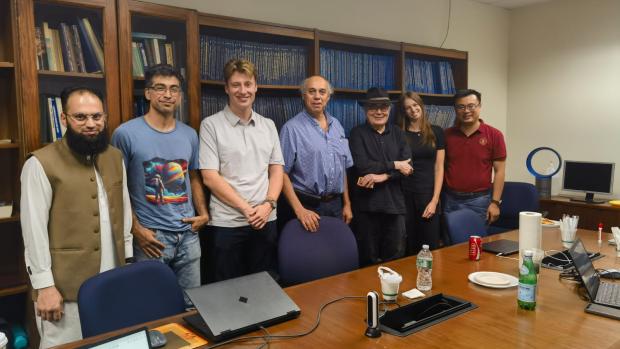
Professor Francisco de Leon (center) flanked by consortium members working towards more sustainable power infrastructure.
The massive steel structures looming behind substation fencing rarely catch the public eye, but these electrical transformers are the unsung heroes of our power grid. Some as large as small houses, transformers enable electricity to travel efficiently across vast distances — from power plants to homes and businesses. Without them, our modern electrical infrastructure would not work. But these critical components face a sustainability challenge that's reaching a tipping point.
The hidden environmental cost of power distribution
For decades, transformers have relied on refined mineral oil for cooling and insulation. This traditional solution offers good dielectric strength, low viscosity for heat dissipation, and chemical stability. However, it also presents significant drawbacks, including fire risks and poor biodegradability, which increase human health and environmental concerns. With many transformers now reaching the end of their 30-40-year operational lifespan, engineers worldwide are asking a crucial question: Can we do better?
The European Union believes the answer is yes. Through the ambitious RETROTRAFO project, funded by the Marie Skłodowska-Curie Actions program, an international consortium is working to replace mineral oil with biodegradable, less-flammable alternatives. The potential impact extends far beyond environmental benefits — these new fluids could enable transformers to handle higher electrical loads, effectively extending equipment life and deferring costly replacements.
NYU's Power Lab joins the global initiative
NYU Tandon School of Engineering was selected to join this prestigious international effort, thanks largely to the reputation of its Power Lab and the expertise of its leader, Professor Francisco de Leon. An IEEE Life Fellow with over 150 scholarly publications and nearly 20 patents, de Leon has spent more than 15 years editing IEEE Transactions on Power Delivery (currently its Editor-in-Chief) and solving some of power engineering's most persistent challenges.
"Just because mineral oil has been used traditionally doesn't mean that there aren't better alternatives," de Leon explains. "RETROTRAFO could present a true inflection point in how we approach transformer technology."
The project leverages not only de Leon's decades of expertise but also NYU's advanced supercomputing facilities — resources that are invaluable for the complex modeling and simulation work required to validate new insulating fluids.
International collaboration in action
The RETROTRAFO consortium exemplifies global scientific collaboration. Led by the University of Cantabria in Northern Spain — home to its own renowned Research Group in Electrical Power Transformers (GITEP) — the project brings together industry leaders and academic institutions from across continents.

This year, Ismael Antolín Maestre, a pre-doctoral researcher from Cantabria, is spending time at NYU Tandon, developing and analyzing sophisticated Finite Element Models (FEMs) to assess how new insulation systems perform under real-world thermal and electrical stress conditions.
Despite being early in his research career, Maestre has already made significant contributions to the field, presenting his work at prestigious venues including the IEEE International Conference on Dielectric Liquids and the CIGRE Paris Session. His current research at NYU represents a critical step in validating whether biodegradable ester fluids can truly replace mineral oil, perhaps even improving transformer performance.
A philosophy that empowers innovation
De Leon's approach to mentoring reflects a philosophy that has attracted young researchers from around the world to his lab. "My practice is to make sure my students have all the resources they need and then get out of their way," he says. "They've done impressive work, and Ismael is doing the same."
The road ahead
While RETROTRAFO shows immense promise, significant work remains. The project must thoroughly evaluate how retrofitting existing transformers with new fluids affects their operation, while also assessing the economic and technical feasibility of widespread adoption.
Success means multiple benefits. Safer, less-flammable transformer fluids could reduce fire risks at electrical substations. Higher load capacity could help utilities maximize their existing infrastructure investments. And biodegradable alternatives could significantly reduce the environmental impact of power distribution systems worldwide.
As our electrical grid faces increasing demands from renewable energy integration and electrification trends, innovations like those emerging from RETROTRAFO may prove essential to building a more sustainable and resilient power infrastructure for the future.