
From New York to Paris (and Beyond): Team Arkadia Wins Global Innovation Championship
Move over, Madison Square Garden. NYU Tandon has its own champion contenders, and they just took home a global title.
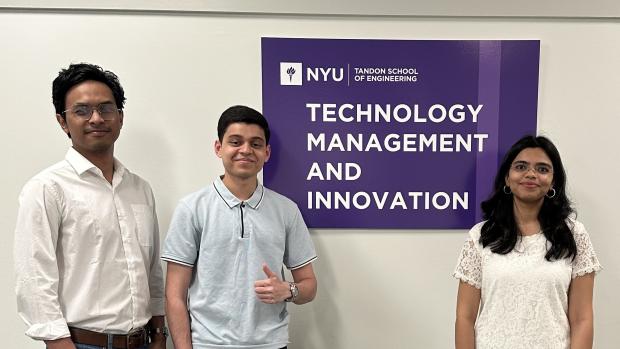
Technology Management and Innovation students Adiro Pradaya Gahana, Arnav Ambre, and Anushree Kulkarni
Just as the New York Knicks bring postseason magic to the city, a trio of NYU Tandon students prove that when it comes to global competition, Brooklyn knows how to win on the biggest stage.
Team Arkadia — composed of Technology Management and Innovation students Arnav Ambre, Adiro Pradaya Gahana, and Anushree Kulkarni — have been named the global winners of the prestigious Fondation Egis Team Up for Climate! 2026 Innovation Challenge. Their project, Kali Guard, is a community-run flood mitigation system built to protect 603 families in Depok, Indonesia, and designed to pay for itself by its second month of operation.
A Win, Twice Over
The Tandon trio beat out student innovators from a massive field of 460 schools, spanning 64 countries and representing 82 nationalities.
The competition ran from December 2025 through June 2026, a six-month global filter built in two distinct phases. In Phase One, teams submitted their project proposals before a March 28 deadline. Of the 385 teams that entered across 64 countries, only 15 advanced. Team Arkadia received that news on April 17.
Phase Two was where the real work began. Over the following seven weeks, the 15 finalist teams entered an intensive mentorship phase: social business model canvas workshops, technical mentoring sessions, pitch rehearsals, and multiple rounds of project refinement, all building toward a single three-minute pitch in front of an eight-member international jury on June 11. Final deliverables were submitted on June 2. Results were announced on June 15.
The road to that finish line was a masterclass in resilience, and it ended with not one recognition, but two. Alongside the jury's deliberations, Egis employees worldwide cast their votes for the project they believed in most. Team Arkadia won that vote, earning the Jury Coup de Cœur, the Employee Favourite award. Then the grand jury announced their verdict: the same team, first place overall. Because Team Arkadia had claimed the top prize, the Coup de Cœur was passed to the next deserving finalist team, a moment the team described with characteristic honesty. "We are grateful for both moments," they wrote.
"What stands out about Team Arkadia isn't just that they won, it's how they won," said Oded Nov, chair of the Department of Technology Management and Innovation. "They demonstrated the kind of ambition, persistence, and creativity that reflects what we mean when we talk about innovation here and that we aim to cultivate in our students from day one. We're enormously proud of them."
From Classroom to Competition
The team's entry point was a course: Professor Michael Driscoll's Global Innovation course, part of NYU Tandon's Management of Technology program. Since Fall 2022, MOT students in Driscoll's course have competed against hundreds of university teams in industry-sponsored innovation challenges — including past Egis Foundation rounds that produced a 4th-place finish and multiple Top 15 showings.
The inspiration was not abstract. Adiro Pradaya Gahana, the team's Indonesia-based member, grew up in Depok, near Kali Cabang Timur, a drainage channel running through Pancoran Mas, a low-income neighborhood. He had watched the same homes flood year after year, not from the rain itself, but from the plastic waste that accumulated in the channel and blocked the downstream drain. When the competition brief asked teams to design a local climate adaptation solution, the problem was already known. The question was whether a solution could be built that would actually last.
The initial concept was straightforward: a physical barrier across the channel to intercept floating waste before it reached the drain junction. But the team's early research revealed why previous attempts had failed. The city of Depok had installed a metal mesh net at this exact site. It was stolen, twice. Metal has scrap value. That single insight reshaped everything. The team switched to bamboo, a material with comparable tensile strength, abundant local supply thirty kilometers away in Bogor, and critically, zero scrap value. Nobody steals a bamboo trap. Through ongoing mentorship sessions with Laurent Perret, who critically validated each iteration of the design and pushed the team to stress-test every assumption, the solution evolved from a simple barrier concept into a fully engineered system: a bamboo-and-net trap spanning the full width of the channel, anchored to both banks, and designed for a planned replacement cycle using locally sourced materials that keeps long-term costs minimal.
The operating model underwent equal refinement. Early versions of the project assumed volunteer labour for waste sorting. Mentors and workshop facilitators pushed back: volunteer models collapse when enthusiasm fades. The team redesigned around paid community roles, a Trap Coordinator, a Recyclables Lead, and a Community Liaison, whose income is tied directly to the trap functioning. Sorted recyclables are sold to BSI Rumah Harum, the only fully operational central waste bank in Depok, at a verified market rate. At roughly $125 per trap in materials and approximately $30 per month to run, the system reaches break-even at just 80 kilograms of waste collected per month, against a planned 500 and a benchmark range of 300 to 800 from comparable river barriers across Indonesia. From month two, the trap pays for itself and the surplus stays entirely within the community. To track performance and build the evidentiary record required to unlock the conditional €5,000 Boost Prize, the team built and deployed a live monitoring dashboard at kaliguard.vercel.app, updated monthly with kilograms of waste intercepted, revenue generated, flood-free days recorded, and sorter income paid. The trap requires no electricity, no sensors, and no internet connection to function. The dashboard exists not to run the system, but to prove that it works.
"This is exactly what Program Director Pavlos Mourdoukoutas has developed in the TMI MOT Program, where students take the frameworks from their courses and apply them to industry,” Driscoll says. “Team Arkadia treated this like a real, meaningful engagement from day one: researching community needs, pressure-testing their ideas, and rehearsing the pitch until it held up under questioning. That is the difference between a class project and a deployable plan, and that is why they won.”
For the team, the shift in stakes was immediate. "The moment I heard about it, this stopped feeling like an academic exercise," they wrote, crediting Tandon's Department of Technology Management & Innovation for building a curriculum "where students don't just study innovation, they participate in it."
To survive a multi-stage global filter, the team leaned heavily on a network of mentors, advisors, and industry partners. They credit technical mentor Laurent Perret, Energy Engineer at Egis Nuclear in Lyon, France, who served as the backbone of the project, for carving out time to champion their concepts and push their engineering assumptions.
The team also underwent rigorous communication and storytelling preparation through a series of structured workshops. Kenia Jiménez, Alejandra Campos Torres, and Samantha from Make Sense Americas led two sessions on the Social Business Model Canvas and risk assessment methodology. Carine Paquier, Head of the Egis Foundation, hosted the pitch and storytelling workshop, and it was Paquier who gave the team the framing line that guided every late-night rehearsal before facing the grand jury: "You don't need a cape to stand out, just a story worth telling." Maya Deniaud, coordinator of the Team Up for Climate challenge at the Egis Foundation, guided the team through every stage of the process from first submission to jury day.
Next Stop: Depok, Indonesia
The prize package is built around follow-through rather than recognition. It includes a study trip to Paris, incubation support from makesense, a photography commission that will be exhibited at the Biennale Photoclimat Festival in Paris in 2027, and a conditional €5,000 Boost Prize, payable only if the team delivers on what they pitched.
"This is not a trophy," the team wrote. "It is an accountability structure."
That structure now points to Depok, Indonesia, where Team Arkadia will spend the coming months building Kali Guard for the 603 families it was designed to protect.
"The most complicated part has arrived," the team wrote. "We are ready."
Team Arkadia Acknowledgments:
The team extends its deepest gratitude to the grand jury — François Lanavère, Martine Jauroyon, Jean-Baptiste Perrin, Sandrine MAISANO, Jennifer Pauc, Yohann Melamed, Mika RAKOTOMANANA, and Henrike Stahl — as well as the peer finalists who raised the standard of competition, and dedicated advisors Saketh AEKKA, Tomás Laranjo, and Niranjana NJ (Tandon ‘26)