
The New Commons Challenge proves the power of data collectives
The inaugural competition draws upon Tandon’s longtime efforts to promote responsible data-collaboration
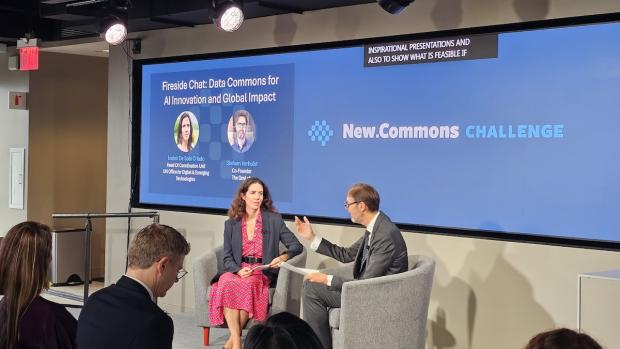
Isabel De Sola Criado of the UN Office of Digital and Emerging Technologies speaking with Co-Founder of the GovLab, Stefaan Verhulst
In today's data-driven world, artificial intelligence holds tremendous promise for addressing society's most pressing challenges — from disaster response to environmental conservation. Yet this promise remains unfulfilled, not only because of insufficient computing power or inadequate algorithms, but due to a more fundamental problem: the right data, particularly diverse and high-quality datasets, often remains locked away, fragmented across systems, or completely inaccessible to those who need it most.
The inaugural New Commons Challenge — a competition organized in early 2025 by the Open Data Policy Lab — set out to address the issue. (The Open Data Policy Lab is a resource hub for decision-makers as they work to responsibly re-use and share open data for the benefit of society; it was established five years ago, thanks to a partnership between The Governance Lab at NYU Tandon and Microsoft.)
The Case for Data Commons
The concept is straightforward yet powerful: data commons are collaboratively governed ecosystems that pool diverse, high-quality datasets and provide responsible access to them.
Stefaan Verhulst, Co-Founder and Chief Research and Development Officer of The Governance Lab, who is also a research professor at NYU’s Center for Urban Science + Progress, describes data commons as the "missing infrastructure" for Public Interest AI — essential to scaling solutions for humanitarian response, local decision-making, and other pressing societal needs. "Data commons provide both the governance and technical frameworks to make high-quality, context-specific data available in ways that respect community expectations," he explains. "Without such commons, the promise of 'AI for good' risks being limited or unsustainable."
The need is particularly acute in humanitarian contexts. When disasters strike, when public health crises emerge, or when communities need to make critical planning decisions, the right data can enable faster, fairer, and more accountable responses. Yet too often, this information remains siloed within government agencies, private companies, or research institutions — each holding pieces of a puzzle that could save lives if assembled.
Consider the private sector alone, which holds vast troves of valuable data — web clicks, online purchases, sensor readings, mobile phone usage patterns — that could illuminate solutions to challenges ranging from climate change to achieving the United Nations’ Sustainable Development Goals. The question isn't whether this data exists, but how to create frameworks that allow it to be shared responsibly and used effectively for public benefit.
An Overwhelming Response
When the New Commons Challenge opened for applications, the response exceeded all expectations. From 51 countries around the world, 170 proposals poured in, each proposing innovative approaches to creating or enhancing data commons. After rigorous review, two winners emerged — each receiving $100,000 in funding, mentorship, technical support, and access to a global network of experts.
The diversity and quality of applications demonstrated something crucial: the concept of data commons is not theoretical or academic. They are already being built by a growing global community of practitioners who recognize that collaborative data is essential to solving some of the world’s most intractable problems.
One Winning Idea — Eyes on the Amazon
The CERTI Amazônia Institute's Amazon Rainforest Evolution Index addresses one of our planet's most urgent environmental challenges: deforestation in Brazil's Legal Amazon, a vast region covering nine states, 772 municipalities, and more than 60% of the country's territory.
Currently, understanding what's happening in this critical ecosystem requires navigating complex statistical data from multiple government agencies — a task demanding expertise in agriculture, statistics, and biology. Local communities and decision-makers who need this information most often can't access or interpret it effectively.
The Amazon Rainforest Evolution Index transforms this landscape by converting complex environmental data into AI-ready tools and user-friendly visualizations. The platform already processes information from authoritative sources like the Brazilian Institute for Geography and Statistics and MapBiomas, tracking critical indicators such as the expansion of soybean and corn cultivation, cattle ranching encroachment on native forests, and overall forest health.
What makes this data commons particularly powerful is its focus on localized information. Rather than presenting only broad regional statistics, the enhanced platform is aimed at enabling citizens in specific cities and affected communities to understand what's happening in their own neighborhoods — to see how their local environment is evolving through clear, interactive indices that don't require specialized training to comprehend.
This democratization of environmental data has profound implications. When communities can see and understand the changes affecting their immediate surroundings, they're empowered to participate meaningfully in decisions about sustainable development, conservation priorities, and land use policies.
Giving Voice to the Voiceless
The second winner of the New Commons Challenge addresses a different but equally critical issue: ensuring that the world's most vulnerable populations can access life-saving emergency services during disasters.
Imagine a farmer in rural Malawi, watching floodwaters rise. She doesn't speak English, can't read text messages, and owns only a basic phone. Under current systems, she has no way to alert authorities. Her isolation could prove fatal not just for her, but for her entire village.
This isn't a hypothetical scenario. When Cyclone Idai devastated Malawi in 2019, affecting nearly a million people, communication failures cost lives. Rural communities couldn't report their situations, leaving them isolated for critical days while help remained unaware of their desperate need.
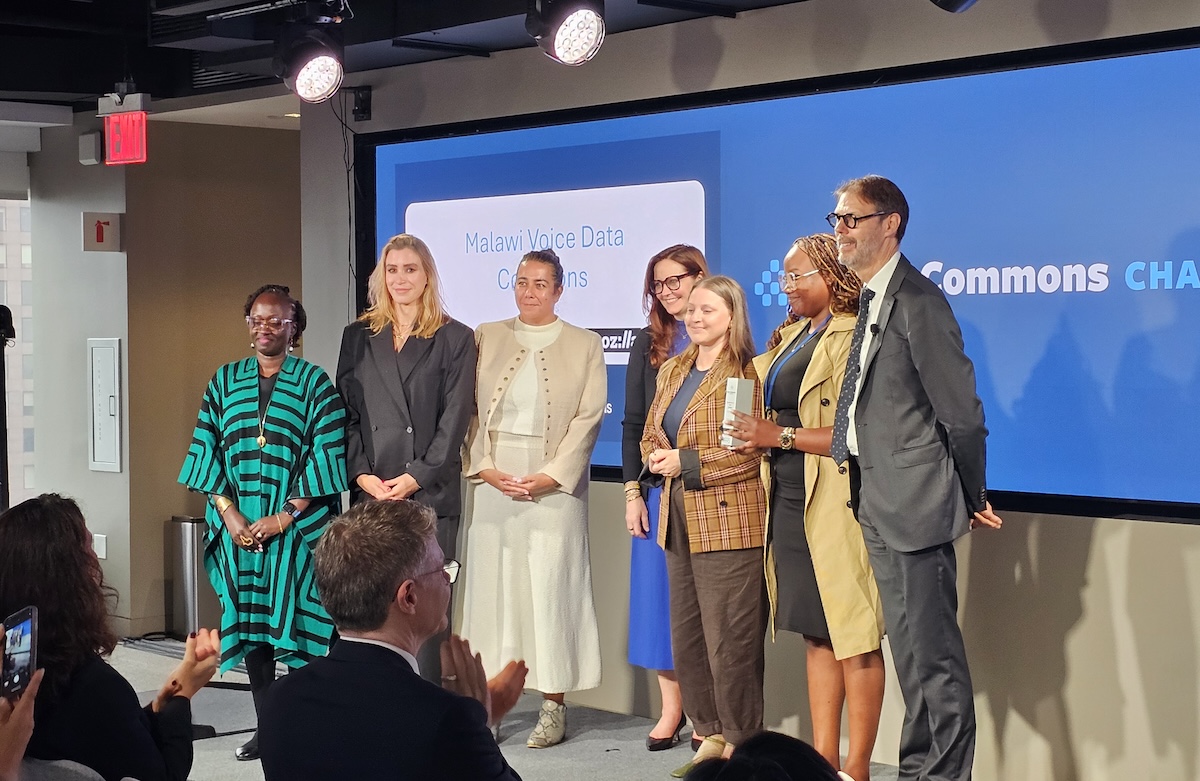
The Malawi Voice Data Commons, co-developed by the NYU Peace Research and Education Program, together with the nonprofit Ushahidi and the government of Malawi, bridges this deadly gap. The system allows any of Malawi's 17.2 million rural residents to dial a toll-free number from any phone and report emergencies in their native language.
The technical architecture is ingenious in its practicality. A hybrid processing system provides immediate keyword detection on local servers for urgent alerts, while more advanced speech recognition processing happens via NYU's computing infrastructure during off-peak hours. When the system identifies urgent keywords, it immediately alerts appropriate responders through customized dashboards integrated with Malawi's existing emergency response networks.
But this data commons achieves something beyond immediate crisis response. Collecting and processing voice data in indigenous languages creates multilingual, AI-ready datasets that serve dual purposes: improving humanitarian response systems while simultaneously supporting language-preservation efforts. These datasets can train future AI systems to better serve underrepresented linguistic communities across Sub-Saharan Africa, where the pilot project plans to scale.
Building a Better Future
The two winning projects exemplify what becomes possible when we move beyond viewing data as a proprietary asset to be hoarded and instead embrace it as a shared resource to be governed collaboratively. One empowers communities to understand and protect their environmental heritage. The other ensures that language and literacy barriers never again prevent vulnerable populations from accessing life-saving help during emergencies.
Together, they demonstrate that the infrastructure for public interest AI isn't something we need to imagine—it's something we can build, one data commons at a time. And with 168 other compelling proposals from around the world waiting in the wings, this is clearly just the beginning of a movement toward more open, collaborative, and equitable approaches to data and AI.
The question facing us now isn't whether data commons can work, but how quickly we can scale these models to address the countless other challenges where better data sharing could transform outcomes for communities worldwide.
Other Noteworthy Projects
- Advancing Climate Justice: the Climate Mobility Case Database — Created by the Global Strategic Litigation Council, this live, open-access platform empowers frontline lawyers, advocates, and community leaders with critical knowledge to protect the rights of displaced people.
- Know Your City Academy — Conceived by the nonprofit Slum Dwellers International, the project asks what if the most sophisticated AI technologies could serve the most marginalised communities without extracting their knowledge or compromising their autonomy? The answer involves "Living Libraries" — community knowledge bases that integrate qualitative "warm data" (oral histories, images, voice notes) with structured datasets, enabling dynamic peer learning while ensuring that communities retain complete sovereignty over their knowledge.
- PLACE Hub — In partnership with national governments, PLACE collects local aerial and street-level imagery using advanced UAV and mobile mapping systems, drawing upon it to facilitate a wide range of applications, including urban planning, property taxation, flood modeling, solar panel placement, insurance, and infrastructure development.
- Querido Diário — Access to Brazil’s official government gazettes remains heavily restricted due to issues such as the use of closed, machine-unreadable formats, lack of standardization, and the absence of text search mechanisms. To address these challenges, the group Open Knowledge Brazil created a platform that leverages data intelligence to enable systematic access to and tracking of information within these documents, making it possible, for instance, to analyze how a city is using facial recognition technologies, examine the application of AI in school administration across municipalities, or monitor publications related to climate and the environment.