
Meet Andrea González: Computer Engineer, Future Lawyer, and Skilled Debater
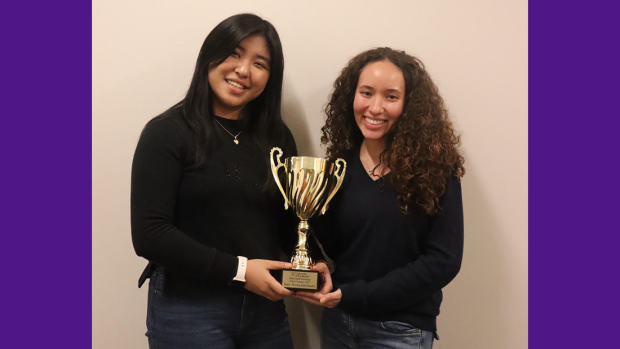
Left to right: Grace Cheng (CAS '26) and Andrea González (Tandon '26)
Andrea González, now a senior computer engineering major at NYU Tandon, didn't take the most direct path to her current field — but that detour through political science might be her secret weapon.
After founding a women's empowerment group in high school and entering NYU with plans to study political science, González discovered a passion for robotics that led her to switch majors after her first year. Now, she's channeling that early interest in advocacy into competitive debate as a member of the NYU chapter of the Cross Examination Debate Association (CEDA), the primary national association promoting intercollegiate policy debate. (Each year, the group chooses a theme, and this year, participants focused on topics related to labor.)
Recently, she and her partner, Grace Cheng (CAS '26), advanced to the semifinals of the Brad Smith Memorial Tournament at the University of Rochester — arguing that farm workers need access to collective bargaining. (When a too-tight bus schedule forced them to forfeit their berth in the finals and return to Brooklyn, there were audible sounds of relief among opponents.)
In her classes and labs — and in her post as Software Technology Lead for the NYU Robotic Design Team — González has found that her debate experience is no mere extracurricular activity; it's become integral to how she approaches engineering, communication, and her future career in patent law.
Below, she provides a window into the world of competitive debate and how it meshes with STEM.
What argument or debate strategy are you most proud of?
Active listening! It sounds simple, but in debate, you're processing so much information in real time — your opponents' arguments, your partner's input, the judge's reactions. Being able to truly hear what the other side is saying, not just waiting for your turn to talk, makes all the difference. It's how you find the gaps in their logic and respond in ways that actually address their points rather than just talking past each other.
How has competitive debate shaped the way you approach problems outside of competition?
I've learned the importance of reason and nuance. When you're debating complex issues like labor rights and collective bargaining, you realize pretty quickly that nothing is black and white. There are always competing interests, valid concerns on multiple sides, and unintended consequences to consider. That mindset carries over into everything, whether I'm debugging code, working on a robotics project, or even just having conversations with friends about difficult topics. I'm less likely to jump to conclusions now.
How do you handle high-pressure situations now, compared to when you started debating?
I'm admittedly not always zen-like, but I do handle things better. Even when things go wrong — like when we had to leave before finals in Rochester — I can keep it in perspective. You just have to focus on what you can control and do your best with that.
Do you have a debate coach? What have you learned from them?
Our coach, Wil Baker, is the best. At that recent debate in Rochester, I got sick and had to go to the ER, and he waited up for me until 3 a.m. He didn't have to do that; he could have just made sure I got there and gone to bed. But he stayed because he genuinely cares about us as people, not just as debaters. That says something important about leadership and community. I think people perform better when they know you actually care about their well-being.
How do you see debate skills applying to your field of study or career goals?
I want to go into patent law, so debate will definitely help in law school. It's already helping me now as an engineer. Even if I wasn't planning on law school, engineers need to be able to speak about their work to the public and pitch ideas to funders. You can have the most brilliant technical solution in the world, but if you can't explain why it matters or convince people to support it, it's not going anywhere.
Does analytical thinking from debate complement your technical studies?
It's actually a really good match. In debate, you learn to construct logical arguments, anticipate counterarguments, and support claims with evidence. In engineering, you're essentially doing the same thing: you're problem-solving, testing hypotheses, and justifying your design choices. On the Robotics Design Team, I do a lot of documentation. Debate prep has trained me to organize complex information and write clearly. All these skills overlap more than you'd think.