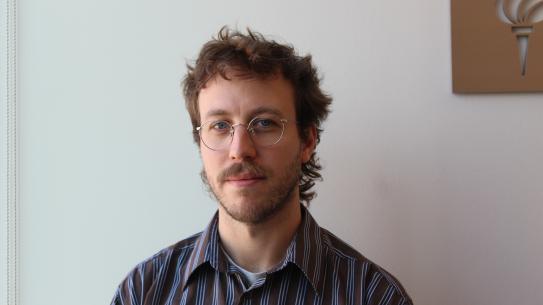

Meet Amy Moreno, Ph.D. Candidate in Chemical Engineering

For this month's NYU Tandon Ph.D. Pulse, we caught up with 4th year Ph.D candidate Amy Moreno, who is under the advisement of Assistant Professor of Chemical & Biomolecular Engineering Nathalie Pinkerton.
Moreno started her academic journey earning a BS in biochemistry from UCLA and then came to Tandon to earn a master's in chemical engineering. It was during her master's that she was inspired to pursue a Ph.D. to further study drug delivery and bonded with her future advisor through their shared field of study. She's currently a member of the Pinkerton Research Group, which focuses on developing responsive soft materials for bio-applications ranging from controlled drug delivery to medical imaging.
Read the full interview with Moreno, where she describes her inspiration to pursue a Ph.D., what she's hoping to solve for, her advice for new Ph.D. students and more.
What inspired you to get your Ph.D.?
I've been fortunate to have had amazing professors during my MS program who saw my potential as a student and as a researcher. I had always gravitated towards research while I was in school but the thought of getting a Ph.D. seemed unattainable for some reason. I think I still had this notion that to get a Ph.D. you needed to be an absolute genius, and it wasn't until I started my MS degree that I realized that to get a Ph.D. you just need to keep asking questions. So, when my professor (shout out to Dr. Miguel Modestino) asked me if I ever considered a Ph.D., something in me clicked. I realized visibility & diversity in higher education played a large role in my career aspirations. I had the drive-I wanted to make a difference in cancer therapy on a scientific scale-the other part I needed was the encouragement. And hearing those words coming from someone of the Latine community (Latines hold 7% of all doctoral degrees, mind you) was all the push I needed.
Why did you choose your field of study? How did your undergraduate and graduate experience inform this choice?
I obtained my undergraduate degree in Biochemistry because I was interested in chemistry, biology, and pharmaceuticals. More specifically, I was interested in how drugs were designed to interact with the body. I thought that with such a foundational knowledge, I would be able to understand how to design new drugs to make them more efficient. It wasn't until I began my MS in Chemical Engineering that I realized this was the correct route. Even though I may not have started in Chemical Engineering, my undergraduate career was still a great boon to my knowledge, and allows me to approach research in an interdisciplinary fashion.
Why Tandon? Who is your faculty advisor and what type of research goes on in their lab?
I came to Tandon to complete my MS degree with the goal to learn about tissue engineering and/or drug delivery. Coincidentally, my future faculty advisor, Dr. Nathalie Pinkerton, Ph.D., began her position in the department at the same time. During our first meeting, we realized that our research interests perfectly overlapped, so I was able to conduct my Master's Thesis (and eventually my Ph.D.) in her lab.
Currently, the lab has focused on developing responsive soft materials for bio-applications for innovative drug delivery to studying nano-bio interactions. It's been incredibly redeeming to conduct research in a field that I'm passionate about.
What research project(s) are you currently working on? What are you hoping to solve for?
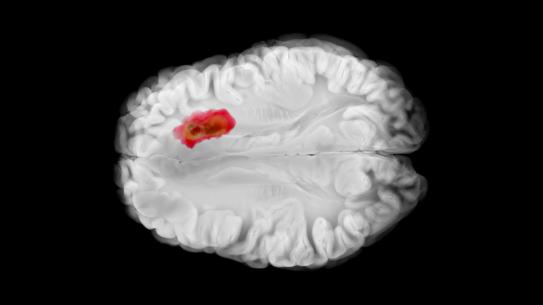
My projects have a central theme of controlled drug delivery using light. My main project was born out of an interest in designing a drug delivery system with precision spatiotemporal control for very potent cancer treatment drugs. Something like 90% of clinical drug developments fail due to potency, selectivity, toxicity... the list can go on. So, as an engineer, I'm interested in how we might take some of those drug candidates and make them more efficient by using nanomedicine, and more specifically, light-activatable polymeric nanoparticles.
How has your research evolved since you began your Ph.D.? What have you learned from going through this process?
For the most part, my research plan has stayed fairly consistent since I began my Ph.D. This is not usually the case for most Ph.D. students. The reality of research is that it evolves as you evolve because you're developing your skills as a researcher. I've learned that research can't be perfected, there's bound to be mistakes in everything you do. But sometimes those mistakes are the next big question that reinvigorates your drive for research.
What impact do you hope your work has in your field/ the world at large?
I recognize that my work is just a small drop of water in the larger picture of the ocean. But I like to think that someday we'll be treating cancer patients with light-activatable devices in the clinical setting. If I can contribute even a small part of fundamental knowledge to this field, I'll feel like my work has been done.
What advice would you give to new Ph.D. students?
I could go on and on about what a new Ph.D. student should know before taking on this journey. And there's a myriad of challenges with getting your Ph.D. But I think what it mainly boils down to is resilience. No matter how much you get proven wrong, how many times you may fail, how you may have to sacrifice your time--if you can just manage to get into the lab and do one thing at a time, it's possible. That, and introspection. Every so often you have to sit down with yourself and re-evaluate what is important, how you can achieve it, and what resources you need to look for to achieve those goals.
What’s been your favorite part about being in Brooklyn?
My favorite thing about being in Brooklyn is the mesh of cultures, which means that you can find flavors from all over the world in this city. For anyone moving here soon, or are just looking for new places to try, some of my go-tos include (but not limited to): Ix Restaurant (Guatemalan - Mayan), Lakou (Haitian - American), Buka (Nigerian), SYKO (Syrian - Korean), La Flor de Izucar (Mexican).
What would you tell prospective Ph.D. students considering Tandon?
Get in touch with anyone and everyone you can. People from different labs, different departments, even different buildings! Not just because you are potentially going to work with these people, but because you'll get so many more opinions this way (about work, about living in Brooklyn, about NYU in general). Also, spend some of your weekends exploring the city in your first year before the grind starts!
Do you have a sense of what you would like to do after completing your Ph.D.?
I would love to stay in drug delivery. One of my lifelong goals is to improve patient quality of life through advancing cancer treatments. I am fortunate to have focused a portion of my thesis to this topic, hopefully (what the current funding situation in the US) I am fortunate enough to obtain a position continuing such a goal.
If you had to describe your Ph.D. experience in three words, what would they be?
Resilience, Perseverance, Introspection.