

Industry and Academic Leaders Herald the Dawn of a New Quantum Era — And NYU Is Poised to Play a Major Role
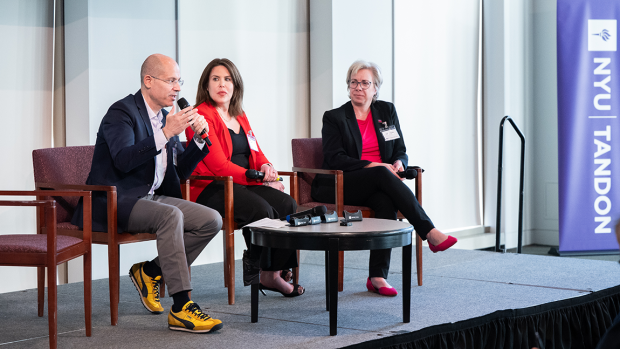
Noel Goddard, CEO of Qunnect, Amanda Stein, Ph.D., CEO of Quantum Catalyzer (Q-Cat), and Dmitry Green, Chief Science Officer of Quantum Coast Capital discuss the future of Quantum at NYU.
“Quantum Conversations: From Fundamentals to Futures,” co-hosted by Quantum Coast Capital and NYU, provided attendees with the chance to learn about what many are calling the most transformative technology of our day. We are at an inflection point similar to the start of the Internet Era, presenters asserted, and the evidence they provided was riveting.
Juan de Pablo — who serves as NYU’s Anne and Joel Ehrenkranz Executive Vice President for Global Science and Technology, as well as Executive Dean of the NYU Tandon School of Engineering — generated much of the evening’s excitement when he announced the formation of the NYU Quantum Institute (NYUQI), a bold move that positions the university as a global leader in the fast-growing field.
A Starship without a Map
Professor Javad Shabani, who will lead the new Institute as its director, captured the essence of quantum's promise with a personal anecdote. While watching a science fiction film with his son, the young boy expressed excitement about riding in a starship — but when asked where he'd fly, he had no answer. He had no inkling, he admitted, what galaxies existed to explore.
"Quantum is like that," Shabani explained. "It’s exciting, and it presents untold possibilities we're only beginning to discover."
That sense of limitless possibility permeated the event, as leaders from IBM, IonQ, Qunnect, and Q-Cat joined in to paint a picture of a technology that's no longer theoretical — it's here, it's being leveraged, and it's about to change everything.
The New Frontier
The presentations made clear that quantum computing represents a fundamental leap beyond the constraints of classical computing. While traditional computers operate in binary — ones and zeros, on or off — quantum bits (qubits) exist in superposition, simultaneously exploring multiple states. As one speaker described it, if binary computing represents the poles of a globe, qubits are every other point on Earth, forming a vastly expanded computational landscape.
And if the computational advances weren't revolutionary enough, as panelists pointed out, quantum computers require dramatically less power than classical systems — a crucial advantage as industries grapple with sustainability challenges.
What made the evening particularly compelling to many was the revelation that quantum applications are already commercially available. The technology excels, for example, at simulating molecular structures — a capability with profound implications for drug discovery, materials science, and climate modeling, to name just a few sectors — and enhanced medical imaging powered by quantum technology has proven to be just the beginning.
Attendees also learned that quantum infrastructure is already operational in New York City. Qunnect CEO Noel Goddard commented that the company, in collaboration with NYU, has deployed metro-scale, entanglement-based quantum networks on commercial fiber right in Manhattan and Brooklyn, the first deployment of its kind.
NYU's Quantum Leap
The formation of the NYUQI represents more than just institutional ambition: it's a recognition that quantum breakthroughs require something that would have been unheard of in decades past: true cross-disciplinary collaboration spanning physics, engineering, materials science, computer science, biology, chemistry, and medicine.
"Quantum information sciences and engineering have the potential to revolutionize a wide range of industries," de Pablo explains. "However, realizing their promise requires moving beyond fragmented collaboration to an integrated ecosystem that can translate discoveries into deployable systems. That is what the Quantum Institute aims to do."
As the evening concluded, attendees left with the sense that they'd witnessed something historic: New York City — now home to NYUQI, operational quantum networks, and major industry players — is poised to be the locus of a quantum revolution.
In other words, the starship is set to take off, and NYU is helping to map the galaxies ahead.

