
I know what you did this summer: NYU Tandon educates hundreds of city middle and high school students in free summer STEM program

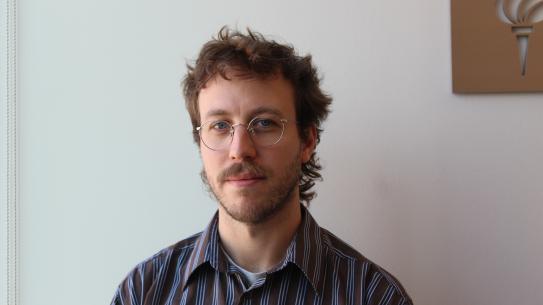
SONYC student working on model city. Photo credit: Michael Duong
Hundreds of New York City middle and high school students will unveil engineering inventions, research discoveries, and innovative urban solutions as the culmination of free summer programs offered by The NYU Tandon Center for K12 STEM Education.
From AI-powered smart city technologies to sophisticated research in urban modeling, biochemistry, sustainable design, and more, these young innovators will showcase work that tackles real-world challenges at the program’s finale events in early August.
The Center now hosts six full-time summer course tracks for NYC students, most lasting a month or longer, that all come with full-tuition scholarships thanks to partners including The Pinkerton Foundation, The Winston Foundation, DTCC and the Institute of Electrical and Electronics Engineers (IEEE).
The programs are running at unprecedented scale, with 65 high schoolers currently contributing to ongoing research as members of NYU science labs, via the Applied Research Innovations in Science and Engineering (ARISE) track alone.
The programs also expanded beyond the Tandon campus for the first time, with two new Brooklyn middle school partner sites this year: STAR Early College School in East Flatbush and I.S. 240 Andries Hudde Junior High School in Midwood.
This expansion builds on more than a decade of impact. Since NYU Tandon's Center for K12 STEM Education launched in 2011, thousands of motivated young people ages 12 to 17 from all five boroughs have completed free rigorous programs covering topics including cybersecurity, urban engineering, sustainability, machine learning, and applied research innovations.
"These full-scholarship programs are going strong this summer, with more students than ever participating alongside our incredible team of 70-plus instructional and support staff," said Elizabeth Waters, Interim Director of NYU Tandon's Center for K12 STEM Education. What's especially exciting is our expansion to two new middle school partner sites, bringing high-quality STEM education directly to students in their neighborhoods. We're building pathways for young people to see themselves as future engineers, researchers, and innovators, helping prepare a new generation to solve challenges from climate change to urban sustainability to cybersecurity."
Middle school students will display their final projects at showcase events on August 1, with the high school students presenting at a showcase and research colloquium on August 8.
The six course tracks are:
Applied Research Innovations in Science and Engineering (ARISE)
High school students contribute to high-level academic research by joining NYU faculty labs, working under the mentorship of graduate and postdoctoral students. This year, about 65 ARISE students, all of whom had completed 10th or 11th grade as of this spring, work in more than 30 labs across Brooklyn and Manhattan. The program concludes at its August 8 research colloquium presentation. The Pinkerton Foundation supports ARISE.
Innovation, Entrepreneurship and the Science of Smart Cities (ieSoSC)
Forty-eight high school students learn how to solve real-world urban challenges by marrying entrepreneurship and engineering ingenuity. Using microcontrollers, sensors, circuitry, coding, and cloud computing, students — who have just completed grades 9, 10 and 11 — team up to invent new technologies intended to improve urban life. The program concludes with students displaying their inventions at an August 8 expo on NYU Tandon’s campus. Winston Foundation supports ieSoSC.
Science of Smart Cities (SoSC)
In this middle-school version of ieSoSC, 110 students who completed 6th or 7th grade this spring explore science, technology, and engineering through real-world applications. The program runs at the STAR Early College School and I.S. 240 Andries Hudde Junior High School. Students will present their model smart cities at an August 1 showcase at each of the two new middle school sites. Winston Foundation supports SoSC.
Sounds of New York City (SONYC)
Thirty-six middle school students learn about noise pollution and develop technologies that can monitor sound in urban environments. Students who completed grades 7 or 8 this spring participate in hands-on STEM learning. Sessions are running at the partner school sites and conclude with the final August 1 showcase. Winston Foundation supports SONYC.
Computer Science for Cyber Security (CS4CS)
With NYU Tandon leading research and education in cybersecurity for over a decade, CS4CS teaches the fundamentals of cybersecurity and computer science by delving into such topics as "white hat" hacking, online privacy, and digital forensics. Ninety-six students who completed either 8th, 9th, 10th, or 11th grade this spring gain hands-on experience in tech-focused learning. The program runs thanks to the longtime support of DTCC, the premier post-trade market infrastructure for the global financial services industry.
Thirty-five students entering 9th grade this fall are learning about the physical properties and behavior of magnets and magnetic fields, followed by hands-on projects focused on the applications of electromagnetism in various environmental sustainability projects. Debuting this year, the program runs from July 28 to August 8 and is offered at no cost thanks to support from IEEE.
The summer programs also include learning experiences with various partner organizations. Students participate in field trips with DTCC, tours and training with the NYU MakerSpace (a workspace lab for collaborative design projects) and college advising sessions with the admissions office. This year, the Center is also introducing its ieSoSc students to the current cohort of start-ups in the NYU Tandon Future Labs, an incubator for early-stage tech companies.
NYU Tandon's commitment to K12 education extends to offering 10 tuition-based summer courses for high school students from around the world in machine learning, robotics, emerging media, and other topics. This enables the Center to educate more than 600 students in total this summer.