
The Gunter Georgi Award: Building the Future While Honoring the Past
At NYU Tandon School of Engineering, first-year students don't just learn engineering — they live it. Through hands-on projects that demand creativity, collaboration, and countless hours of problem-solving, they discover what it truly means to be an engineer. This semester, that spirit of innovation shone bright in the work of four exceptional students whose robotic arm design earned them the General Engineering program’s prestigious Gunter Georgi Award.
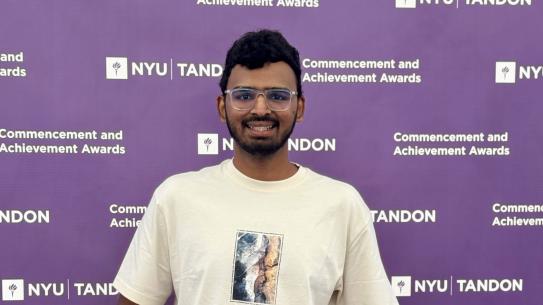
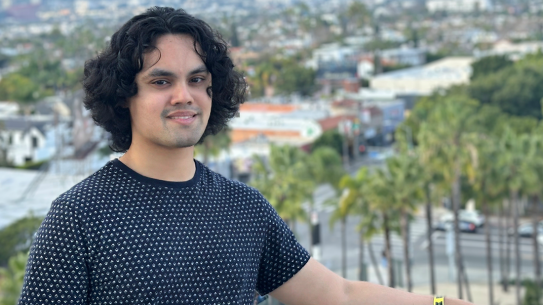
Weier Bao, Kevin Chen, Adria Farha, and Amanda Tao emerged victorious from a field of 100 competing teams in the Fall 2025 competition. Their achievement embodies the core mission of NYU Tandon's first-year experience: teaching students how to learn through doing, preparing them for a rapidly changing world.
The Gunter Georgi Award honors the memory of a beloved faculty member who exemplified the best of engineering education. Professor Georgi, who taught at NYU Tandon for over three decades, was known for his infectious enthusiasm and unwavering commitment to student success. His approach to teaching — hands-on, collaborative, and always grounded in real-world applications — lives on in the award that bears his name.
From Brainstorm to Breakthrough
The journey to creating an award-winning motion-detecting robotic arm wasn't straightforward. As project manager Amanda Tao recalls, the team went through multiple iterations before landing on their final working prototype. "I learned that sometimes you have to accept that your ideas may not work and that being able to adapt to new solutions is just as important as creativity," Tao explains. "Being open to change allowed our project to evolve."
Kevin Chen, the design lead on the project, concurs. “One valuable thing I learned this semester was how important iteration and failure are in engineering,” he says. “Coming into Tandon, I thought good engineering meant getting things right the first time. However, EG-1004 taught me that real progress comes from testing ideas, finding flaws, and improving designs through collaboration and persistence. It's cliché, but you have to be willing to learn from your mistakes to improve.”
The inspiration for the robotic arm came during a group brainstorming session. "I am fascinated by future technology, artificial intelligence, and how we can use technology to improve a variety of fields, such as research labs, manufacturing, or medical facilities," Tao says. "I also just think robotic arms are insanely cool and it would have been incredible if our team was able to design and build something like that."
The Power of Teamwork
For Tao, one lesson emerged above all others: the importance of teamwork. "I know it might sound very generic and cliche, but it is a key component for a good, successful project," she notes. The team's collaborative spirit transformed what could have been a stressful semester into something far more meaningful. "Our team had excellent communication skills and we were all very motivated to contribute to the development of our robotic arm," Tao says. "We were all aware of our tasks and completed them before every single deadline, and if any one of us were struggling, we would always help. Because of that, working on this project, for me, just turned into a fun and enjoyable hangout session with friends."
Learning by Doing
The winning team's experience exemplifies NYU Tandon's distinctive approach to first-year engineering education: learning by doing and applying new concepts and skills in practical situations of increasing complexity. Led by program director Ingrid Paredes, a team of engineering and writing faculty and a veritable army of TAs mentor individual students, encourage team collaboration on real professional problems, and model what it takes to be a working engineer.
This semester's competition, with its 100 participating teams, demonstrated that the future of engineering is in capable hands. From robotic arms to sustainable solutions, from medical innovations to manufacturing improvements, Tandon’s first-year students are already imagining and building the technology of tomorrow.
As Chen explains: “Incoming students should not be intimidated if they don’t feel that they are ‘engineer enough’ at the start, because that is certainly how I felt when starting the course. EG-1004 is designed to help you think like an engineer, not to test how much you already know. Moreover, you need to be humble, ask questions, lean on your teammates, stay determined, and not be afraid of failure. I remember my team spending countless hours in the open lab; however, not once did we feel like giving up because we saw the light at the end of the tunnel, no matter how far away it might've been. This course genuinely shapes how students see engineering, not just as mathematical equations or designs, but as a way of thinking critically and responsibly about the world around us to improve it.”
Completing the CIRCUIT
Behind every successful first-year engineering student at NYU Tandon stands a dedicated team. As Adria Farha, who developed and wrote the code for the Georgi Award-winning robotic arm, asserted, “For every issue or roadblock that we faced, our TAs and professors always helped guide us in the right direction, encouraging us to keep pushing.”
Now, that dedicated team is about to get the additional support it deserves. The General Engineering program has been awarded an NYU Caring Culture Grant to launch the CIRCUIT Series, an innovative initiative designed to cultivate inclusive reflection, collaboration, understanding, and impactful teaching among the General Engineering educators and administrators.
For a program that teaches hundreds of first-year students each year, creating a culture of care isn't just good practice: it's essential. The CIRCUIT Series recognizes that to carry the values of collaboration and communication into the classroom, those values must first be embedded in the workplace itself.
Meeting the Moment
The General Engineering program is home to EG-1004 Introduction to Engineering and Design, the largest undergraduate course at NYU Tandon and a required class for hundreds of students each year. Like all staff and faculty members, those in GE are busy, so CIRCUIT (Cultivating Inclusive Reflection, Collaboration, Understanding, and Impactful Teaching) was designed with time constraints in mind.
"Faculty and staff time is already extremely limited," Paredes and program administrator Colleen Kelsey noted in their winning proposal. "By incorporating these practices into our existing meeting structure, we seek to establish sustainable, reflective, and collaborative structures that will overall support the well-being of all members of our team."
The initiative consists of three major Community Reflection retreats throughout the year, complemented by brief monthly "Spark Sessions" built into regular meetings. Each component of the year-long program focuses on a different aspect of workplace well-being and professional development:
- Powering the Circuit (January) kicks off the semester by establishing expectations in a collaborative, supportive environment, combining practical workshops with team-building activities that promote trust and belonging.
- Recharging the Circuit (April) shifts focus from day-to-day administrative tasks to personal and professional development. Team members share their professional journeys, discuss career opportunities aligned with their interests, and engage in mentorship exchanges.
- Closing the Circuit (August) serves as both celebration and reflection, recognizing program accomplishments while setting the tone for the coming year.
The hope is that CIRCUIT will become not just a one-time initiative, but a way of working: one that can serve as a model for other departments.
Carrying Care Into the Classroom
The ultimate beneficiaries of the CIRCUIT Series won't be just the faculty and staff who participate: it will be the hundreds of first-year students they teach and mentor each year. When educators feel supported, connected, and valued, they bring that energy into the classroom. When workplace culture prioritizes well-being and professional growth, it creates a ripple effect that touches every student interaction.
As the General Engineering program continues its mission to teach students how to learn, the CIRCUIT Series ensures that the people doing the teaching also have opportunities to grow, reflect, and thrive. It's a recognition that great education doesn't just happen — it's cultivated through intentional practices, meaningful relationships, and a commitment to care that begins with caring for educators themselves.