
First-Year Ph.D. Student Yingrui Wei Awarded Lynford-Chudnovsky Fellowship for AI-Hardware Research
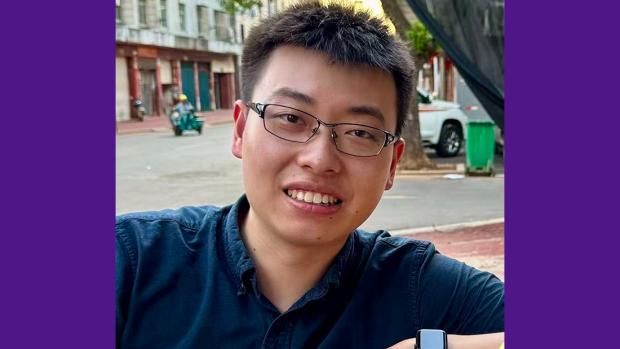
Yingrui Wei, a first-year doctoral candidate in the Research in Advanced Integrated Systems and Electronics (RAISE) Lab, has been awarded the inaugural Lynford-Chudnovsky Fellowship.
The Fellowship, funded by longtime Tandon supporters Jeffrey and Tondra Lynford, recognizes exceptional doctoral students whose research bridges AI and hardware — a critical frontier as the world demands more intelligent yet energy-efficient computing systems.
A Journey From Physics to Cutting-Edge Circuit Design
Wei's higher-ed journey began in his native China, where he earned his B.S. in Physics with honors in 2023. After working for a time at a renewable energy lab, developing expertise in semiconductor and device physics, he pursued his M.S. in Electrical Engineering at Columbia University, where his focus shifted decisively toward analog integrated circuit design.
At Columbia, Wei helped design and manufacture an ultra-low-power humidity and temperature sensor chip that operates on less than 5 microwatts — roughly the power needed to illuminate a single LED on a circuit board. His contributions included developing a linear model for the frequency feedback loop, designing a chopper-stabilized amplifier, and creating a high-linearity voltage-controlled oscillator. The breadboard prototype achieved 8-bit resolution, a technical accomplishment that caught the attention of Assistant Professor of Electrical and Computer Engineering Hamed Rahmani, who heads the RAISE Lab.
Standing Out in a Competitive Field
"Yingrui joined my group in Fall 2025 after finishing his master's at Columbia, and he stood out right away," says Rahmani, who went on to praise Wei’s participation in the final stages of a chip design project and his published work. "He already had tapeout experience and a paper in a strong IEEE venue, which is rare at that stage. In the past few months, I've seen that he really knows his circuits and systems, and he's comfortable thinking across electrical engineering, microwave work, and even the new AI-assisted design approaches. That mix makes him an up-and-coming researcher for future low-power, energy-efficient systems."
Real-World Impact: From Subway Sensors to Brain Interfaces
Wei's current research focuses on developing ultra-low-power wireless data links — technology with applications ranging from the mundane to the transformative. Consider the hundreds of sensors monitoring conditions throughout a subway system. Each one requires power, and collectively they represent a significant energy cost. Wei's work aims to dramatically reduce that consumption.
But the most compelling applications may be in healthcare. Brain-computer interfaces and medical wearables face a fundamental challenge: they can't require frequent charging or battery replacements. Wei envisions fully wireless, programmable neural interfaces that eliminate batteries entirely — advancing safety by removing potential points of failure, improving economics by eliminating the need for additional hardware purchases, and promoting sustainability through dramatically reduced power consumption.
"It is my dream to devote myself to this field, carry out further innovation, design faster analog-to-digital and digital-to-analog converters, and solve engineering problems," Wei explains. His commitment extends beyond the lab: he maintains a technical blog where he shares his insights on analog circuit design with a growing community of engineers and students.
A Legacy of Innovation
The award's name honors both the Lynford family's long-standing commitment to the institution and the Chudnovsky brothers, Gregory and David, world-renowned mathematicians who worked at Tandon and are celebrated for being the first to calculate pi to over a billion decimal places in 1989, using a home-built supercomputer. (By the early 1990s, they had reached more than four billion places.)
As AI systems grow more complex and ubiquitous, the need for researchers who can bridge the gap between algorithmic sophistication and hardware efficiency becomes ever more critical. Wei's combination of theoretical grounding, practical tapeout experience, and vision for real-world impact positions him to make significant contributions to this vital field.
For Wei, the fellowship thus represents validation of his past work and fuel for the ambitious research still ahead of him.