

Finding Calm in the Chaos — How NYU Tandon Students Built a Pop-Up Sensory Haven
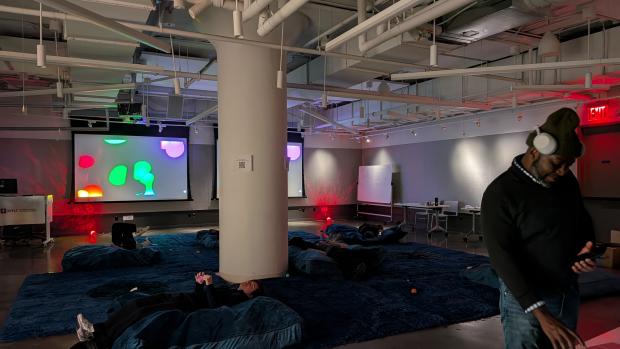
The MakerSpace at NYU Tandon is typically buzzing with the sounds of 3D printers, laser cutters, and excited engineering students bringing their prototypes to life. But for a few transformative hours, something entirely different was on offer: quiet, comfort, and calm.
Industry Assistant Professor Bertha Jimenez and her students had transformed the MakerSpace Event Space into a pop-up sensory room — a carefully designed refuge for anyone feeling overwhelmed by the relentless stimulation of college life.
From Big Ideas to Bigger Impact
Jimenez is no stranger to turning ambitious concepts into reality. Over a decade ago, as a Ph.D. student at Tandon, she reached the finals of New York City's BigApps competition with an idea for reducing industrial waste. She went on to launch RISE, a company that transformed breweries' spent grain into nutritious flour for commercial bakeries. After years consulting for major brands like Budweiser and Corona during the pandemic, she returned to Tandon in 2024 as an industry assistant professor in the Department of Technology Management and Innovation.
But this project was personal in a different way. "I had always loved mentoring, even as a graduate student," Jimenez recalls. And she wanted her students to understand something fundamental: technology and inclusivity aren't separate pursuits — they're most powerful when intertwined.
Everyone Gets Overwhelmed
The inspiration for the sensory room came from a simple but profound truth: everyone can get overwhelmed at times. For students on the autism spectrum or those with ADHD, sensory issues — difficulties processing sounds, sights, touch, taste, smell, or movement — can make daily life exponentially harder. And college, with its sudden independence, crowded dorms, and constant social navigation, can feel like sensory overload on steroids.
But Jimenez recognized that sensory issues aren't limited to neurodivergent students. Everyone can benefit from a space designed to help them reset and recharge.
Learning by Doing
Thanks in large part to one of Jimenez’s teaching assistants, Adelaida Kim, who had the idea to apply for support from the university’s Initiative Fund — which prioritizes projects demonstrating clear benefits to the student body and broader NYU community — her class was able to get to work. With leadership from teaching assistants Soorer Bulhan and Kunal Saluja, the research was hands-on and thorough. They visited the Space Club, an indoor sensory-friendly playground in Brooklyn, to understand what elements create a calming environment. They consulted with occupational therapists to ensure their design choices were grounded in therapeutic best practices. (One key lesson: avoid strong smells that some people react badly to. Every detail mattered, from lighting choices to texture selections.)
This pop-up sensory room was real-world proof of how thoughtful design can break down barriers.
A Space That Works
When the pop-up sensory room opened, the response was immediate and powerful. Students and faculty members who'd never heard the term "sensory room" found themselves drawn in, curious. Others — those who understood their own sensory sensitivities — stayed longer, visibly relaxing as they experienced the carefully calibrated environment. (Later, one professor approached her to tell her about a sensory room he had discovered at an airport; he would never have thought to try it had he not already been introduced to the concept at the MakerSpace.)
The space offered what so many students desperately needed: permission to step away from the chaos, to regulate their nervous systems, to simply be without the constant pressure to perform, socialize, or produce. Some even related that they had been moved to create a piece of art with the materials provided (despite not thinking of themselves as artistic) or that answers to difficult homework problems had come to them suddenly. Others later found that they felt sharper and more productive in classes they attended after their visit.
What Comes Next
For Jimenez, the pop-up was proof of concept. "Everyone can benefit," she emphasizes, and now she’d love to find a permanent space for a sensory room at Tandon.
The project exemplifies her vision for what education should be: "There are few things as gratifying as seeing a good idea blossom into a thriving enterprise, and I'd like as many people as possible to experience that," she has said. But Jimenez is building something larger than a single room. She's creating a culture where supporting different ways of experiencing the world isn't an afterthought — it's foundational.