
An expert in the dynamics, control, and optimization of mechanical systems is elected a Fellow of the American Society of Mechanical Engineers
NYU Tandon’s Joo H. Kim is recognized for his wide-ranging research in robotics, biomechanics, and their intersections

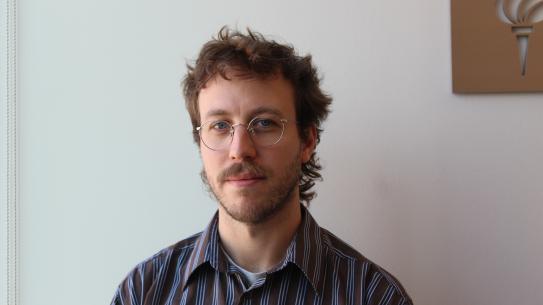
Joo H. Kim, an associate professor of mechanical and aerospace engineering at NYU Tandon, has been elected a Fellow by the American Society of Mechanical Engineers (ASME). The Fellowship recognizes exceptional engineering achievements, along with contributions to the engineering profession and to ASME. ASME Fellows have achieved the highest level of distinction accorded to the organization’s members: of the more than 100,000 worldwide, only about 3% have become Fellows.
Kim — who heads Tandon’s Applied Dynamics and Optimization Laboratory and is also a faculty member of the school’s Center for Urban Science + Progress (CUSP) — is internationally renowned for his innovative research and education on dynamics, control, and optimization to inform critical applications in both robotics and biomechanics.
He and his team of students have recently focused on establishing theories, predictive models, and algorithmic foundations to generate significant new insights into stability, energetics, and their complex interactions within robotic and human mobility.
In particular, his rigorous and fundamental approaches promote generality, opening new avenues of research for comparative analyses across various systems and tasks. His work has, for example, fully extended the notions of balance stability of legged systems, which are applicable for both locomotion (e.g., walking, jumping) and non-locomotion (e.g., standing, lifting) tasks. One of the unique outcomes has been a comparative evaluation of walking motions, which holds the potential to advance the design and control of robots that can walk like humans. Kim’s models quantitatively showed the overly balanced and energetically inefficient walking done by a typical biped robot, in contrast to unbalanced, but efficient, human walking. These contrasting gait characteristics had previously been understood only qualitatively, through experimental observations in the literature, and his results were the first ever to offer a systematic explanation, using rigorous physics-based models. The study was also extended to the gait of a powered lower-limb exoskeleton, unveiling the specific roles of crutches in balancing, which have great utility in various sectors, including assistive technologies and medical rehabilitation.
Another of Kim’s projects aims to increase the sustainability and energy efficiency of robotic systems: to that end, he and his team have employed a revolutionary approach that enables engineers to accurately predict power consumption in a servomotor thanks to a multi-domain framework that takes into consideration the switching power converter circuits required for directional, speed, and torque control, rather than just the motor as had been the norm in the past. (The approach could also be applied to general electromechanical systems with switching-based control, such as those used in electric vehicles, and Kim’s ultimate goal is improved energy efficiency in all high-mobility systems designed for complex tasks.)
Kim’s group has also introduced a hybrid modeling approach that integrates thermodynamics and multibody system dynamics, allowing for the evaluation of instantaneous metabolic energy expenditure in human motions. The predictive model circumvents the limitations inherent in experimental measurements and is being adopted by many research groups in both the U.S. and worldwide due to its immediate practicality.
Kim’s other recent research involves theoretical and algorithmic advancements in trajectory optimization and integration of dynamics/control with physical AI, among other topics.
In addition to being elected a Fellow, his body of work has earned him various other awards and honors from ASME, including the Advanced Modeling and Simulation Best Paper Award, the Freudenstein / General Motors Young Investigator Award, and the Journal of Mechanical Design Associate Editor Award.
“I’m proud to see ASME bestow this fellowship on Joo H. Kim, who is richly deserving of that distinction,” said Juan de Pablo, Executive Vice President for Global Science and Technology and NYU Tandon’s Executive Dean. “He has helped make NYU Tandon a fast-growing hub of robotics research, and I offer him my deepest congratulations.”
“Professor Kim is a valued member of Tandon’s Mechanical and Aerospace Engineering faculty,” Department Chair Katsuo Kurabayashi added. “It is extremely fitting that ASME has recognized the caliber of his research and its impact, and I’m thrilled that he now joins the Department’s roster of Fellows.”