
From Classroom to Creek: A Field Trip That Matters
Assistant Professor Bridger Ruyle and his students embark on a study of Superfund site, Newtown Creek
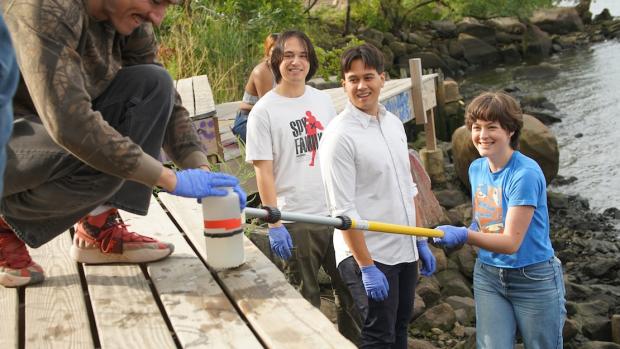
Assistant Professor Bridger Ruyle (left) led a field expedition with undergraduate and graduate students to collect samples and assess the contamination of Newtown Creek.
Newtown Creek, a 3.8-mile waterway between Brooklyn and Queens, bears the scars of more than 150 years of industrial activity. Designated in 2010 as a federal Superfund site (a polluted location requiring a long-term cleanup), the creek that flows into the East River near Roosevelt Island represents one of the nation's most visibly ravaged waterways.
Once called "the world's most important waterway," the creek became a dumping ground for refineries, chemical plants, and manufacturing operations throughout the nineteenth and twentieth centuries. Today, it hosts New York City's largest wastewater treatment facility—a sprawling 54-acre complex that processes water for over a million residents across multiple boroughs. The irony is stark: the very infrastructure meant to protect public health sits amid one of the city's worst pollution zones.
The creek's sediment and waters contain a toxic mixture of pollutants from years of legacy industrial activity and ongoing wastewater discharges. Toxic chemicals in the creek include heavy metals, petroleum hydrocarbons, and per- and polyfluoroalkyl substances (PFAS)—colloquially known as "forever chemicals" because they resist breakdown in the environment and in the human body.
For Assistant Professor Bridger Ruyle of NYU Tandon's Department of Civil and Urban Engineering, Newtown Creek represents both a crisis and an opportunity. His research focus on PFAS contamination has led him, in collaboration with the Newtown Creek Alliance (a community nonprofit), to organize a field expedition with undergraduate and graduate students to collect samples and assess the contamination's scope.
What drives his urgency is a dangerous paradox. Mechanical aeration systems were installed in the creek to prevent hypoxia (the lack of adequate oxygen to support aquatic life) due to excessive nutrient pollution from the wastewater facilities. But there's a critical problem: aeration can actually be dangerous if PFAS are aerosolized in the process and released into the air. In attempting to solve one problem, the very solution can spread contaminants into communities already struggling with pollution. Ruyle's mission is to determine how widespread this risk is and identify ways to mitigate it.
Noel Seagroves, a first-year doctoral candidate who came to Tandon after earning his master's degree from UC Berkeley, embodies the energy driving this research. "Collecting samples was just the first early step," he says. "I can foresee working on this issue throughout my graduate program. I'd like to eventually explore leveraging constructed wetlands as a vehicle to process and filter contamination." For him, the fieldwork connects to larger questions about environmental remediation and community health.
Sanjana Iyer, an NYU Gallatin undergraduate studying with Ruyle, concurs. “Field sampling is the basis of any future work,” she says. “Scientific exploration and analysis help both identify the current state of affairs and what problems there are to be addressed, in addition to serving as the foundation for engineering projects like resilience or remediation plans. After graduation, I hope to work on building climate-resilient infrastructure, particularly in underprivileged communities that are disproportionately affected by climate change.”
They have their work cut out for them: the pace of cleanup remains frustratingly slow. Since the 2010 Superfund designation, meaningful remediation efforts have been sparse. Ruyle attributes this to systemic barriers: "Money is always an issue, and with much of the industrial runoff tracing back more than a century, it's not as though you can approach the perpetrators to contribute," he says, pointing out that the industries that originally created the crisis are long gone, leaving others to bear the burden.
Another research group, this one based at NYU Langone, is examining the related problem of harmful microplastics in the same area. If these parallel investigations accumulate enough evidence and raise a sufficient public outcry, that could generate the momentum needed to force action.
"One of my goals in getting involved in the project is to spread awareness of the problem," Seagroves emphasizes. "People should know how pervasive PFAS are and the effects they could have on human health and the health of the planet." In a creek where the very infrastructure meant to protect the public could be spreading contaminants, awareness may be the first step toward accountability.