
Building Smarter, Safer AI: Ph.D. Student Minghao Shao Earns Prestigious Google Fellowship
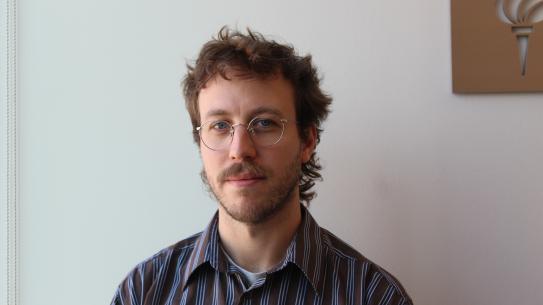
Minghao Shao has been awarded the prestigious 2025 Google Ph.D. Fellowship in Privacy, Safety, and Security — a recognition that places him among a select group of graduate students identified by the tech company as representing the future of research.
The fellowship, awarded annually to outstanding doctoral candidates worldwide, acknowledges Shao's groundbreaking contributions to Generative AI-based cybersecurity, particularly his work developing intelligent agent systems for both attacks and defenses. Nominated by his advisor, Professor Muhammad Shafique of NYU Abu Dhabi, and supported by recommendations from co-advisor Professor Ramesh Karri at NYU Tandon, Shao's selection reflects the caliber of research emerging from NYU's global network.
Making AI Agents More Capable — and More Secure
Shao's primary research focuses on agentic systems — advanced autonomous AI workflows that can plan, execute, and adapt for complex tasks. While this might sound abstract, the implications are remarkably practical. His work involves creating novel datasets and benchmarks that test how well large language models can handle real-world cybersecurity challenges, from identifying vulnerabilities to executing offensive security tasks.
Among his notable contributions are several pioneering projects: NYU CTF Bench, a scalable benchmark for evaluating AI in offensive security; EniGMA: an offensive security agent with advanced tool enhancements; D-CIPHER, a dynamic multi-agent system with specialized planners and executors; and CRAKEN, a cybersecurity agent that leverages knowledge-based execution. These aren't just theoretical exercises: they're building blocks for the next generation of AI-powered security tools.
"In the short term, my research can lead to smarter AI tools that help developers, scientists, and engineers work more efficiently and securely, for example, through assisted code and design generation, automated task planning, and a more secure AI workflow," Shao explains. "In the long term, it aims to both advance the development of AI systems and their underlying foundation models, fostering trustworthy and efficient AI, and to extend the application of AI across diverse domains."
A Journey Across Continents
Shao's path to this achievement reflects his commitment to pushing boundaries — both intellectual and geographical. After completing his master's degree at NYU Tandon, he chose to travel to NYU Abu Dhabi for his doctoral studies..
"NYU Abu Dhabi provides an open and flexible environment that greatly supports collaborations," Shao notes, highlighting his ongoing work with the NYU Tandon team. But beyond the academic advantages, he values the cultural dimension of his choice. "Having completed my master's degree in the United States before starting my doctoral program, I value the opportunity to experience a new environment. It's not only enriching from an academic and professional perspective but also offers a chance to engage with a different culture and community."
Building Bridges Between Academia and Industry
For Shao, the Google Ph.D. Fellowship represents more than personal recognition; it's an opportunity to explore the synergy between academic research and industry innovation. "I believe that maintaining strong connections with both academia and industry is essential for professional growth and collaboration," he says. (The fellowship includes mentorship from a Google Research expert, providing direct access to one of the world's leading technology companies.)
Looking ahead, Shao's research interests encompass AI for Science, with emerging applications in quantum computing, robotics, healthcare, and LLM-aided electronic design automation. He is also doing research in fields such as VLM Alignment, LLM Jailbreak, and Model Optimization.
As AI systems become increasingly autonomous and powerful, researchers like Shao are ensuring they're also trustworthy, secure, and aligned with human values. His Google Ph.D. Fellowship is not just recognition of past achievements — it's an investment in the safer, smarter AI systems of tomorrow.