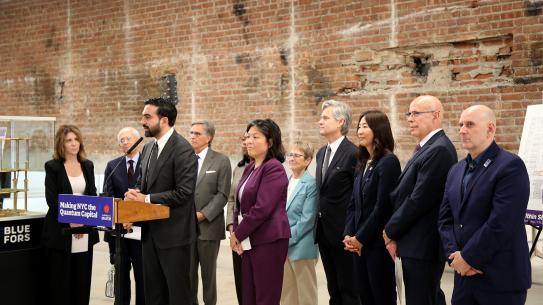
Brooklyn Chamber's Energy Summit: From Lab to Market
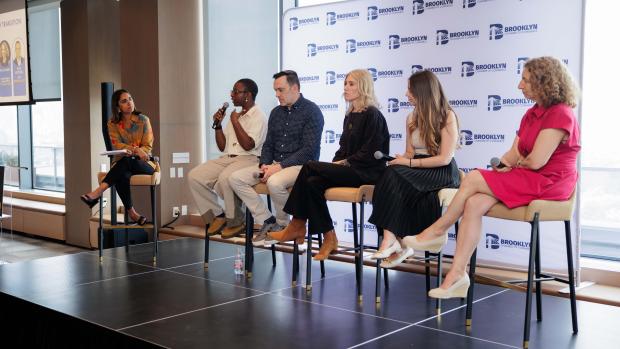
UFL's Steph Jones (second from left) speaking on the "Startups Accelerating the Energy Transition — From Lab to Market" panel at the Brooklyn Chamber of Commerce's 2026 Energy Summit & Expo, June 18, 2026. Photo credit: Christelle Torres.
On June 18, the Brooklyn Chamber of Commerce convened its fifth annual Energy Summit & Expo at the Brooklyn Navy Yard, bringing together leaders in business, government, utilities, and innovation to grapple with the defining infrastructure challenges of our moment.
NYU Tandon, an event sponsor, was represented throughout the day by both faculty members and founders and staff from its Urban Future Lab (UFL), a non-profit innovation hub for climatetech startups focused on clean energy and sustainable urban infrastructure.
Together they contributed to the full arc of the day's programming — from conversations on grid resilience and EV infrastructure to AI-driven load growth and climate tech commercialization.
Doreen Harris, president and CEO of the New York State Energy Research and Development Authority, a keynote speaker, set the stakes early.
Harris touched on grid resilience — the ability of the electric power grid to withstand, adapt to, and recover quickly from disruptions such as storms, heat waves, cyberattacks, and equipment failures — calling it "one of the defining challenges of where we sit today." She also noted that a completed state energy plan projects electricity demand to grow by more than 20% overall, underscoring the urgency.
Semiha Ergan, associate chair of the Civil, Urban, and Environmental Engineering Department, moderated "Powering Resilient Cities in the Age of AI: Grid Readiness & Data Center Coordination" alongside panelists from AECOM, Orenda, Inc., and Schneider Electric, a session that tackled the compounding pressures AI-driven load growth is placing on existing infrastructure.
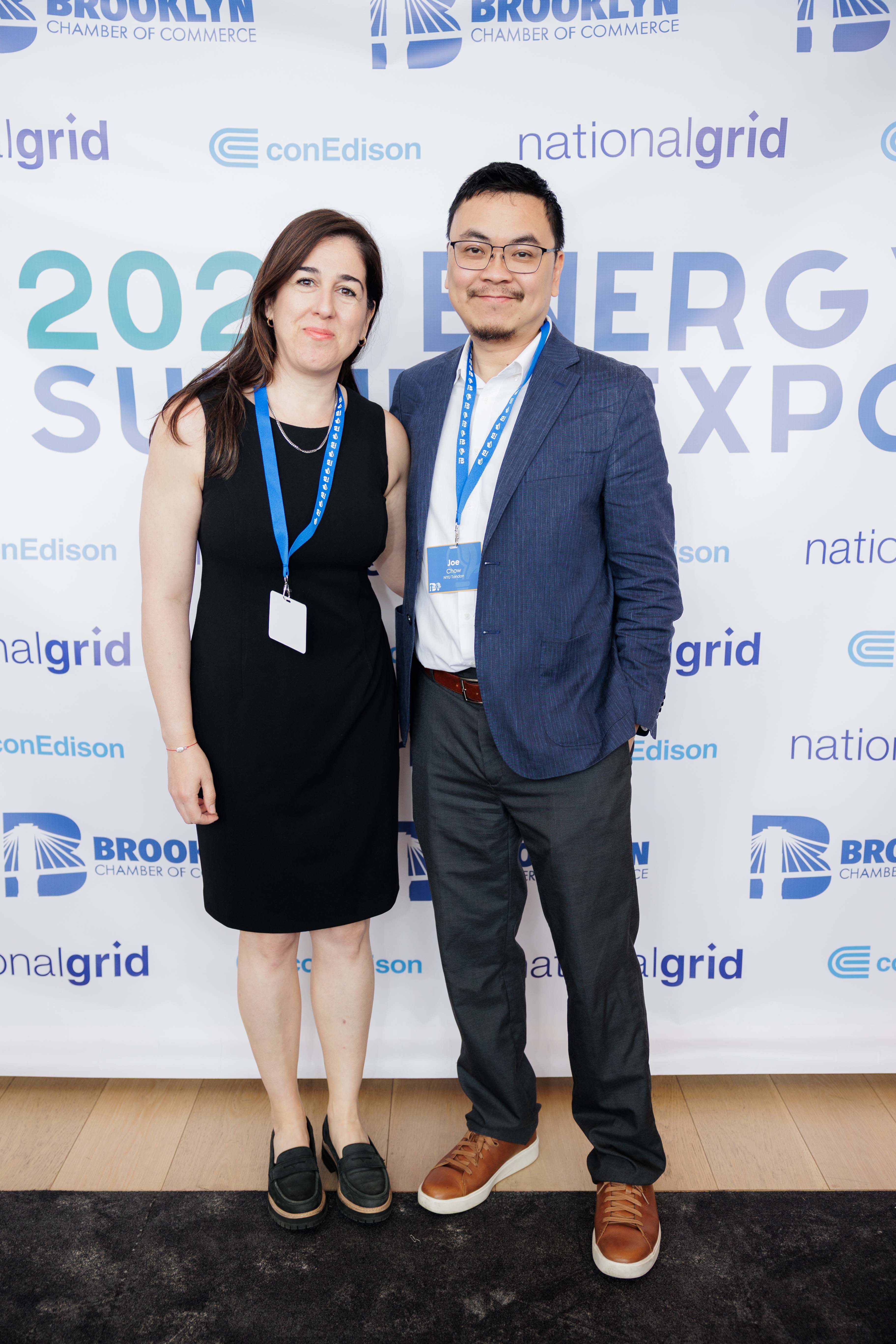
Joseph Chow, Institute Associate Professor and Deputy Director of C2SMART, joined "NYC Lens: Future of EV Charging Infrastructure: Deployment, Equity, and Grid Coordination," contributing his transportation systems expertise alongside founders from It's Electric, Popwheels, and Voltpost.
From the UFL startup portfolio, Adam Cohen, Co-Founder & CTO of NineDot Energy, participated in the plenary on "Generation & Distribution: Scaling Clean Energy Technologies to Build a Resilient Grid", a natural stage for a company that has become one of the most active community-scale battery storage developers in New York City.
David Hammer, Co-Founder of Popwheels, appeared on the EV infrastructure panel, bringing his perspective on last-mile EV charging deployment in dense urban environments.
Tom Fenton, CEO of Senze, joined "Real Estate as a Catalyst: Incentives, Marketing, and Markets for Clean Energy Adoption", representing a generation of founders rethinking how the built environment participates in the energy transition.
Rounding out the UFL presence, Steph Jones, UFL's Program Manager, joined the panel most central to the lab's mission: Startups Accelerating the Energy Transition: From Lab to Market.
That panel brought together a practitioner-heavy group to cut through the theory and talk about what commercialization actually demands. Jones was joined by Megha Mehdiratta of The New York Climate Exchange, Michelle Brechtelsbauer of Newlab, Lara Croushore of SecondMuse, Nyla Mabro of The Clean Fight, and Alex Mitchell of LACI / BATWorks.
What does it take to move from idea to market? The panel's consensus: readiness isn't a technology question, it's a customer question. Customer discovery remains underused in cleantech. UFL's Innovate UK program was cited as a model, using boots-on-the-ground support, active listening, and real storytelling to help founders break into the US market.
Brechtelsbauer added regulatory and permitting readiness, a layer innovation conversations often skip but one that Newlab uses to evaluate technologies for placement with city or corporate partners. In a dense environment like New York State, where fire and building codes vary by neighborhood and multiple agencies must coordinate on things like battery energy storage, understanding operational conditions before a pilot begins isn't optional.
"The most important thing is to ensure you're actually structuring the engagement itself as a true engagement - not just innovation theater where the offtaker doesn't have skin in the game,” said Brechtelsbauer.
Mitchell emphasized the importance of returning to customers with a specific question: what outcomes would actually matter to you? His framing of "welcoming regulation", proactively working with regulators to design pilots that hold up, was illustrated by Popwheels’ Hammer, who has leaned into that approach.
Mabro raised one of the most pointed questions of the panel: “How do we get past death by pilots?” Her argument for comparative deployment – well-proven solutions tested side by side, with zero upfront cost structures that reduce barriers – reframed the pilot conversation from innovation showcase to procurement strategy.
The funding conversation was frank. Croushore noted that capital is still flowing in the energy transition but the shape has changed: fewer deals, larger checks, later stage. That's a sign of market maturation, but it creates a particular squeeze for what she called the "missing middle."
The panelists also called out the growing necessity to lead with affordability, infrastructure reliability, and resilience rather than leaning on climate as the primary value proposition. Climate, as one panelist put it, works best as a force multiplier, not the opening argument. AI's role as a capital magnet was acknowledged too, with energy startups increasingly finding that AI-adjacent positioning opens doors that pure climate framing may not.
The throughline across all of it: connections need to happen earlier. The gap between a promising technology and a signed contract isn't just technical or regulatory. It's relational, and it closes faster when the right intermediaries are in the room from the start.