

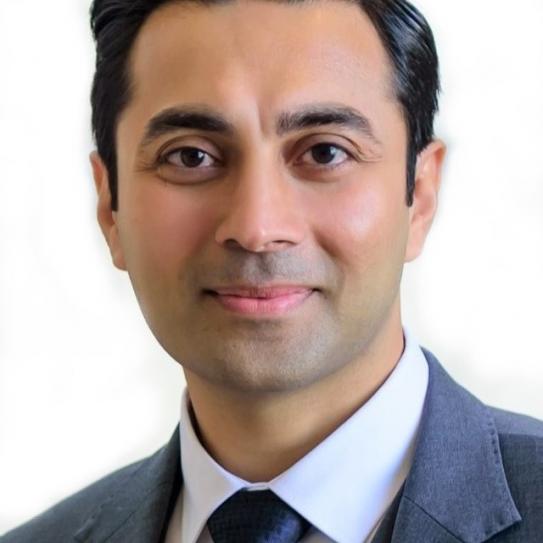
Muhammad Shafique received his Ph.D. degree in computer science from the Karlsruhe Institute of Technology (KIT), Germany, in 2011. Afterwards, he established and led a highly recognized research group at KIT for several years as well as conducted impactful R&D activities in Pakistan. Besides co-founding a technology startup in Pakistan, he was also an initiator and team lead of an ICT R&D project. He has also established strong research ties with multiple universities in Pakistan, where he has been actively co-supervising various R&D activities and theses since 2011, resulting in top-quality research outcome and scientific publications. Before KIT, he was with Streaming Networks Pvt. Ltd. where he was involved in research and development of video coding systems several years. In Oct.2016, he joined the Institute of Computer Engineering at the Faculty of Informatics, Technische Universität Wien (TU Wien), Vienna, Austria as a Full Professor of Computer Architecture and Robust, Energy-Efficient Technologies. Since Sep.2020, he is with the Division of Engineering, New York University Abu Dhabi (NYUAD) in UAE, and is a Global Network faculty at the NYU Tandon School of Engineering in USA.
Dr. Shafique has demonstrated success in leading team-projects, meeting deadlines for demonstrations, motivating team members to peak performance levels, and completion of independent challenging tasks. His experience is corroborated by strong technical knowledge and an educational record (throughout Gold Medalist). He also possesses an in-depth understanding of various video coding standards. His research interests are in brain-inspired computing, AI & machine learning hardware and system-level design, autonomous systems, wearable healthcare, energy-efficient systems, robust computing, hardware security, emerging technologies, FPGAs, MPSoCs, and embedded systems. His research has a special focus on cross-layer analysis, modeling, design, and optimization of computing and memory systems. The researched technologies and tools are deployed in application use cases from Internet-of-Things (IoT), smart Cyber-Physical Systems (CPS), and ICT for Development (ICT4D) domains.
Dr. Shafique has given several Keynotes, Invited Talks, and Tutorials at premier venues. He has also organized many special sessions at premier venues (like DAC, ICCAD, DATE, IOLTS, and ESWeek) and served as the Guest Editor for IEEE Design and Test Magazine (D&T), IEEE Transactions on Sustainable Computing (T-SUSC), and MICPRO. He has served as the TPC Chair of ISVLSI, PARMA-DITAM, RTML, ESTIMedia and LPDC, General Chair of DDECS and ESTIMedia, Track Chair at DATE, IOLTS, DSD and FDL, and PhD Forum Chair of ISVLSI. He has also served on the program committees of numerous prestigious IEEE/ACM conferences including ICCAD, ISCA, DATE, CASES, ASPDAC, and FPL. He is a senior member of the IEEE and IEEE Signal Processing Society (SPS), and a member of the ACM, SIGARCH, SIGDA, SIGBED, and HIPEAC. He holds one US patent and has (co-)authored 6 Books, 10+ Book Chapters, and over 300 papers in premier journals and conferences.
Dr. Shafique received the prestigious 2015 ACM/SIGDA Outstanding New Faculty Award (given world-wide to one person per year), the AI-2000 Chip Technology Most Influential Scholar Award in 2020, six gold medals in his educational career, and several best paper awards and nominations at prestigious conferences like CODES+ISSS, DATE, DAC and ICCAD, Best Master Thesis Award, DAC'14 Designer Track Best Poster Award, IEEE Transactions of Computer "Feature Paper of the Month" Awards, and Best Lecturer Award. His research work on aging optimization for GPUs featured as a Research Highlight in the Nature Electronics, Feb.2018 issue.
Education
Karlsruhe Institute of Technology (KIT), 2011
Ph.D., Computer Science, Magna cum Laude
Pakistan Institute of Engineering and Applied Science (PIEAS), 2003
M.Sc., Information Technology, 2 Gold Medals, Best Thesis Award
University of Engineering and Technology (UET) Lahore, 2000
B.Sc., Engineering, 4 Gold Medals
Experience
Vienna University of Technology (TU Wien), Austria
Full Professor (Univ.-Prof.) of Computer Engineering, Faculty of Informatics
Head of the Computer Architecture and Robust Energy-Efficient Technologies (CARE-Tech.) group
Oct. 2016 – Aug. 2020
Karlsruhe Institute of Technology (KIT), Germany
Research Group Leader, at the Chair for Embedded Systems, Informatics
Jan. 2011 – Sep. 2016
National University of Science and Technology (NUST), Pakistan
Collaborative Research Lead and Co-Advisor, at SEECS
2011 – to date
University of New South Wales (UNSW), Australia
Visiting Research Fellow, at the School of Computer Science and Engineering
Aug. 2013 – Sep. 2013
Federal University of Rio Grande do Sul (UFRGS), Porto Alegre, Brazil
Visiting Research Fellow, at the Informatics Institute (INF)
Apr. 2012
Karlsruhe Institute of Technology (KIT), Germany
Research Assistant at the Chair for Embedded Systems, Informatics
Oct. 2006 – Dec. 2010
Streaming Networks Pvt. Ltd., www.streaming-networks.com/
Senior Embedded Systems Engineer, at the Video Group
2003-2006
WorldCall Multimedia Pvt. Ltd., www.worldcall.com.pk
Planning and Coordination Engineer, Cable-TV Project on Hybrid Fiber-Coaxial Network
2001
Publications
A nearly complete list of my publications can be found on my DBLP website or via my Google Scholar page.
Awards
Career Awards
- ACM/SIGDA Outstanding New Faculty Award, 2015
- AI2000 Most Influential Scholar Award, 2020
- Best Elective Lecturer Award, at KIT, Germany.
- Ph.D. with magna cum laude
- Best Master Thesis Award
- 1st Position Holder in M.Sc. Information Technology with 2 Gold Medals
- 1st Position Holder in B.Sc. Engineering with 4 Gold Medals
Best Paper Awards and Nominations
- DAC 2017 Best Paper Award Nomination for the paper “Low-overhead Aging-aware Resource Management on Embedded GPUs” in ACM/IEEE 54th Design Automation Conference, June 2017.
- Two DATE 2017 Best Paper Award Nominations for the papers “Scalable Probabilistic Power Budgeting for Many-Cores” and “Embracing Approximate Computing for Energy-Efficient Motion Estimation in High Efficiency Video Coding” in ACM/IEEE Design Automation and Test in Europe Conference, March 2017.
- IEEE Transactions on Computers “Feature Paper of the Month” Award for the January 2017 for the paper “Thermal safe power (TSP): Efficient power budgeting for heterogeneous manycore systems in dark silicon”.
- DAC 2016 Best Paper Award Nomination for the paper “Improving Mobile Gaming Performance through Cooperative CPU-GPU Thermal Management” in ACM/IEEE 53rd Design Automation Conference, June 2016.
- IEEE Transactions on Computers “Feature Paper of the Month” Award for the November 2016 for the paper “Scalable Power Management for On-Chip Systems with Malleable Applications”.
- CODES+ISSS 2015 Best Paper Award for the paper “R2Cache: Reliability-Aware Reconfigurable Last-Level Cache Architecture for Multi-Cores” in IEEE International Conference on Hardware-Software Codesign and System Synthesis, 2015.
- CODES+ISSS 2014 Best Paper Award for the paper “TSP: Thermal Safe Power – Efficient Power Budgeting for Many-Core Systems in Dark Silicon” in IEEE International Conference on Hardware-Software Codesign and System Synthesis, 2014.
- DAC 2014 Designer Track Best Poster Award for “Application-Specific Hierarchical Power Management for Multicast High Efficiency Video Coding” in ACM/IEEE 51st Design Automation Conference, 2014.
- CODES+ISSS 2011 Best Paper Award for the paper “Reliable Software for Unreliable Hardware: Embedded Code Generation aiming at Reliability” in IEEE International Conference on Hardware-Software Codesign and System Synthesis, 2011.
- MaXentric Technologies AHS 2011 Best Paper Award for the paper “Concepts, Architectures, and Run-time Systems for Efficient and Adaptive Reconfigurable Processors” in NASA/ESA 6th Conference on Adaptive Hardware and Systems, 2011.
- ICCAD 2010 Best Paper Candidate for the paper “Selective Instruction Set Muting for Energy-Aware Adaptive Processors”, in IEEE/ACM International Conference on Computer-Aided Design, 2010.
- DATE 2008 Best Paper Award for the paper “Run-time System for an Extensible Embedded Processor with Dynamic Instruction Set”, in IEEE/ACM Design Automation and Test in Europe Conference, 2008.
- IEEE Transactions on Computers paper “Aging-aware Workload Management on Embedded GPU Under Process Variation” featured in Research Highlights of “Nature Electronics”, February 2018 issue.
- Several Paper Awards by the European Network of Excellence on High Performance and Embedded Architecture and Compilation for my papers at DAC and FCCM between 2008 and 2020.
Research News

NYU Tandon researchers develop AI agent that solves cybersecurity challenges autonomously
Artificial intelligence agents — AI systems that can work independently toward specific goals without constant human guidance — have demonstrated strong capabilities in software development and web navigation. Their effectiveness in cybersecurity has remained limited, however.
That may soon change, thanks to a research team from NYU Tandon School of Engineering, NYU Abu Dhabi and other universities that developed an AI agent capable of autonomously solving complex cybersecurity challenges.
The system, called EnIGMA, was presented this month at the International Conference on Machine Learning (ICML) 2025 in Vancouver, Canada.
"EnIGMA is about using Large Language Model agents for cybersecurity applications," said Meet Udeshi, a NYU Tandon Ph.D. student and co-author of the research. Udeshi is advised by Ramesh Karri, Chair of NYU Tandon's Electrical and Computer Engineering Department (ECE) and a faculty member of the NYU Center for Cybersecurity and NYU Center for Advanced Technology in Telecommunications (CATT), and by Farshad Khorrami, ECE professor and CATT faculty member. Both Karri and Khorrami are co-authors on the paper, with Karri serving as a senior author.
To build EnIGMA, the researchers started with an existing framework called SWE-agent, which was originally designed for software engineering tasks. However, cybersecurity challenges required specialized tools that didn't exist in previous AI systems. "We have to restructure those interfaces to feed it into an LLM properly. So we've done that for a couple of cybersecurity tools," Udeshi explained.
The key innovation was developing what they call "Interactive Agent Tools" that convert visual cybersecurity programs into text-based formats the AI can understand. Traditional cybersecurity tools like debuggers and network analyzers use graphical interfaces with clickable buttons, visual displays, and interactive elements that humans can see and manipulate.
"Large language models process text only, but these interactive tools with graphical user interfaces work differently, so we had to restructure those interfaces to work with LLMs," Udeshi said.
The team built their own dataset by collecting and structuring Capture The Flag (CTF) challenges specifically for large language models. These gamified cybersecurity competitions simulate real-world vulnerabilities and have traditionally been used to train human cybersecurity professionals.
"CTFs are like a gamified version of cybersecurity used in academic competitions. They're not true cybersecurity problems that you would face in the real world, but they are very good simulations," Udeshi noted.
Paper co-author Minghao Shao, a NYU Tandon Ph.D. student and Global Ph.D. Fellow at NYU Abu Dhabi who is advised by Karri and Muhammad Shafique, Professor of Computer Engineering at NYU Abu Dhabi and ECE Global Network Professor at NYU Tandon, described the technical architecture: "We built our own CTF benchmark dataset and created a specialized data loading system to feed these challenges into the model." Shafique is also a co-author on the paper.
The framework includes specialized prompts that provide the model with instructions tailored to cybersecurity scenarios.
EnIGMA demonstrated superior performance across multiple benchmarks. The system was tested on 390 CTF challenges across four different benchmarks, achieving state-of-the-art results and solving more than three times as many challenges as previous AI agents.
During the research conducted approximately 12 months ago, "Claude 3.5 Sonnet from Anthropic was the best model, and GPT-4o was second at that time," according to Udeshi.
The research also identified a previously unknown phenomenon called "soliloquizing," where the AI model generates hallucinated observations without actually interacting with the environment, a discovery that could have important consequences for AI safety and reliability.
Beyond this technical finding, the potential applications extend outside of academic competitions. "If you think of an autonomous LLM agent that can solve these CTFs, that agent has substantial cybersecurity skills that you can use for other cybersecurity tasks as well," Udeshi explained. The agent could potentially be applied to real-world vulnerability assessment, with the ability to "try hundreds of different approaches" autonomously.
The researchers acknowledge the dual-use nature of their technology. While EnIGMA could help security professionals identify and patch vulnerabilities more efficiently, it could also potentially be misused for malicious purposes. The team has notified representatives from major AI companies including Meta, Anthropic, and OpenAI about their results.
In addition to Karri, Khorrami, Shafique, Udeshi and Shao, the paper's authors are Talor Abramovich (Tel Aviv University), Kilian Lieret (Princeton University), Haoran Xi (NYU Tandon), Kimberly Milner (NYU Tandon), Sofija Jancheska (NYU Tandon), John Yang (Stanford University), Carlos E. Jimenez (Princeton University), Prashanth Krishnamurthy (NYU Tandon), Brendan Dolan-Gavitt (NYU Tandon), Karthik Narasimhan (Princeton University), and Ofir Press (Princeton University).
Funding for the research came from Open Philanthropy, Oracle, the National Science Foundation, the Army Research Office, the Department of Energy, and NYU Abu Dhabi Center for Cybersecurity and Center for Artificial Intelligence and Robotics.