


My lab for Advanced Neuroengineering and Translational Medicine develops innovative approaches for the modulation of neural activity throughout the body. We combine mechanical, electrical, materials, and bio-engineering toolkits towards designing minimally invasive technologies for neuromodulation. Our goal is to develop novel therapies for neurologic, metabolic, and immune disorders.
Research News
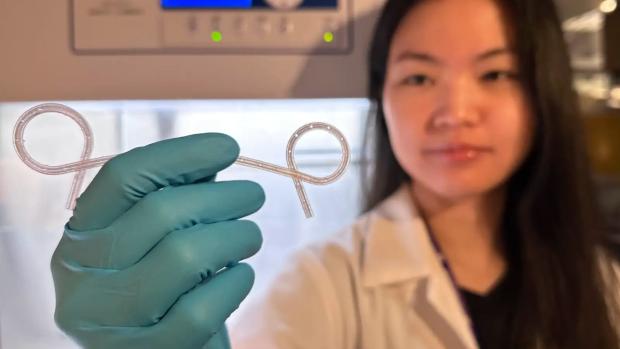
A 3-D Printed Stent, Shaped Like a Lily, Could Speed Recovery After Weight-Loss Surgery
Each year, about 250,000 Americans undergo sleeve gastrectomy, one of the most common weight-loss operations in the United States. For most patients, recovery is uneventful.
But for a small share — between one and three percent in routine cases, and as many as one in ten in revision surgeries — the procedure can leave behind a gastric leak, in which fluid escapes from the stomach and forms an abscess.
Treating those leaks can be a long process. Doctors usually rely on endoscopic internal drainage, threading a small plastic tube called a double-pigtail stent through the stomach wall so the fluid can drain. But the devices typically used are built for bile ducts, not for the oddly shaped cavities created by gastric leaks.
That mismatch matters. The stents can slip, drain slowly and require repeated procedures before the leak resolves.
Now, researchers at New York University say they have found a better approach by changing the shape of the stent itself. Their findings have been published in Advanced Healthcare Materials.
Their prototype, called the Lily stent, is the first product of a design framework the researchers named PETALS, for Personalized Endoscopic Transmural Abscess Leak Solution, a mathematical approach to optimizing drain shape for complex biological fluids that the team says could be applied beyond gastric leaks to other drainage challenges in the body.
Using computer simulations and mathematical modeling, the researchers found that length and inner diameter mattered most, while the curled anchoring ends had little effect on fluid flow. Counterintuitively, a wider tube does not drain better. Increasing the inner diameter shrinks the gap around the outside of the stent, where most of the fluid actually travels. That means exterior topography, not interior volume, is the primary driver of drainage performance.
That insight is the foundation of the PETALS framework. By mathematically optimizing the outer surface geometry for the viscosity and pressure of gastric fluid, the team arrived at their new stent, a six-part structure that creates more effective routes for fluid to move around the device.
“The key insight is that the geometry of the tube’s cross-section, especially the exterior surface, fundamentally determines how fast fluid moves through and around it,” said Khalil Ramadi, an assistant professor at NYU Abu Dhabi and NYU Tandon School of Engineering and the study’s senior author. “We’re not just making it out of a different material. We’re changing the shape to make it work better.”
If the results hold up beyond the lab, the payoff could be meaningful. Roughly 2,500 people in the United States require treatment each year for gastric leaks after bariatric surgery. Faster drainage could shorten recovery and reduce the need for repeat procedures, easing both the burden on patients and the cost of care.
The device is still early in development. So far it has been tested only in simulations and benchtop models. Animal studies will be needed before it can move closer to clinical use.
The Lily stent also proved more flexible than the commercial polyethylene device it is meant to replace, an attribute surgeons associate with better patient tolerance and reduced tissue damage. In short-term animal studies, tissue surrounding the implanted material showed no significant difference from tissue around standard polyethylene, an early indicator of biocompatibility.
The researchers note that the Lily design's constant cross-section geometry would allow it to be manufactured by conventional extrusion methods, without requiring hospitals to invest in 3-D printing infrastructure.
"Our work shifts the focus from just placing a stent to engineering its function at a structural level," said Parima Phowarasoontorn, a research assistant in Ramadi’s NYU Abu Dhabi lab and the paper’s first author. "Instead of simple tubes, we introduce cross-sectional designs that improve drainage while remaining compatible with existing endoscopic delivery procedures."
The Lily stent research follows Ramadi's lab's announcement of the CORAL capsule, an ingestible pill whose coral-like structure traps bacteria from the small intestine, enabling researchers to study microbial communities that contribute to certain diseases. Both devices draw on nature's own geometry to solve medical problems that conventional tools have struggled to address.
Phowarasoontorn P, Ko Y, Barajas-Gamboa JS, Pantoja JP, Al-Ketan O, Ali M, Sohn S, Naser HT, Dabbour AH, Khlaifat B, AlZubaidi A, Vega CA, Rodriguez J, Kroh M, Ramadi KB. Enhanced Endoscopic Internal Drainage of Gastric Abscess Through Additively Manufactured Stents. Adv Healthc Mater. 2026 Apr 2:e05860. doi: 10.1002/adhm.202505860.
Coral-inspired pill offers a new window into the hidden world of the gut
In the depths of the ocean, marine corals have evolved intricate, porous structures that shelter diverse microbial communities.
Now, researchers have borrowed this biological blueprint to create an ingestible pill that can sample bacteria from one of the most inaccessible regions of the human body: the small intestine.
The CORAL (Cellularly Organized Repeating Lattice) capsule, developed by Khalil Ramadi – assistant professor of bioengineering at NYU Tandon School of Engineering and NYU Abu Dhabi (NYUAD) – and NYUAD collaborators, promises the first passive, non-invasive way to collect microbes from the upper digestive tract. Once swallowed, the device physically traps bacteria as it travels naturally through the digestive system before exiting the body.
In a study published in Device, the team demonstrated that their coral-inspired device provides a more comprehensive picture of the small intestine's bacterial landscape than traditional stool samples, the current gold standard for microbiome research.
"Fecal samples, though easy to collect, do not accurately represent the microbial communities in distinct regions of the gut," said Ramadi, who directs the Laboratory for Advanced Neuroengineering and Translational Medicine at NYUAD.
While the gut microbiome has been linked to everything from immune disorders to mental health, most stool-sample studies primarily reflect bacteria from the large intestine and miss the unique microbial communities of the small intestine. This matters because the small intestine is where much of the critical action occurs. As the body's largest mucosal surface, it hosts a high density of receptors, immune cells, and neurons, making it a crucial site for host-microbiome interactions.

Recent research suggests that various diseases — including immune disorders, metabolic diseases, and endocrine diseases — may actually originate in the gut, with distinct microbial populations in the small intestine playing essential roles in metabolism and immunity that differ significantly from those in the colon.
"The CORAL capsule captures bacteria that are otherwise not accessible, addressing a significant blind spot in microbiome science," said Aashish Jha, Assistant Professor of Biology at NYUAD and the paper’s co-senior author. "Understanding these upstream microbial communities could be key to early disease detection and developing more targeted therapeutic interventions."
The capsule's design mimics marine corals using mathematically defined structures called Triply Periodic Minimal Surfaces (TPMS). These create a maze-like network of channels with pore sizes optimized to trap bacteria while allowing safe passage through the digestive tract.
Unlike existing microbiome sampling devices that rely on magnets, mechanical actuators, or electronic components, CORAL operates entirely passively. The capsule is fabricated in a single 3D printing step and contains no moving parts, making it potentially scalable for widespread use. A special coating ensures the device only begins sampling once it reaches the small intestine, avoiding contamination from stomach acid.
"We designed CORAL to be as simple as possible, no batteries or electronics, just a mathematically precise structure that uses the gut's natural movement to sample bacteria," said Hanan Mohammed, lead author of the study and Research Associate at NYUAD. "It gives us access to bacterial communities that have been invisible to researchers until now."
In animal studies, CORAL successfully captured distinct bacterial populations from the small intestine that differed significantly from fecal samples. The capsule samples collected higher levels of beneficial bacteria like Lactobacillus, which thrives in the upper gut's lower pH environment, while intentionally missing bacteria typically found in the large intestine.
This work represents part of Ramadi's broader mission to change how we can diagnose and treat diseases through the gut. His work involves developing "electroceuticals" — ingestible electricals rather than pharmaceutical interventions — that can diagnose and treat conditions from immune disorders to metabolic diseases by leveraging the body's natural neural pathways.
The team envisions translating CORAL to eventual human use by scaling the capsule from its current tiny dimensions to standard pill size. Before human trials could begin, researchers would need to develop reliable retrieval methods (potentially using magnetic detection or other identification techniques) and conduct extensive safety testing to ensure the device poses no risk to patients. The team is continuing this work in the lab and actively working to commercialize this technology through the HealthX program at StartAD and the Abu Dhabi Department of Health.
In addition to Ramadi, Jha, and Mohammed, the paper's co-authors are Sadaf Usmani, Brij Bhushan, Anique Ahmad, Oraib Al-Ketan, Ahmed A. Shibl, Maylis Boitet, and Heba Naser, all at NYU Abu Dhabi, and Devjoy Dev at both NYU Abu Dhabi and NYU Tandon.
Comments on CORAL:
This study makes a major contribution to microbiome research. By allowing precise and minimally invasive access to the small intestine, the CORAL capsules enable characterization of microbial communities that have until now remained largely out of reach. This breakthrough provides an essential tool for advancing basic science and for shaping the next generation of microbiome-based diagnostics and therapies.”
María Rodríguez Aburto, Ph.D.
Senior Lecturer, ERC-funded investigator
Dept. of Anatomy & Neuroscience, APC Microbiome Ireland
University College Cork
The relationship between the small intestinal microbiome and immune and digestive function is woefully understudied due to difficulties in sampling the environment in situ. The CORAL device is a key technological advance that enables sampling of the small intestinal microbiome to probe its importance in health and disease.”
Mark Mimee, Ph.D.
Assistant Professor of Microbiology
Committee on Molecular Metabolism and Nutrition
The University of Chicago
Passive intestinal microbiome sampling using an ingestible device with tortuous lattices
Mohammed, Hanan et al. Device, Volume 0, Issue 0, 100904
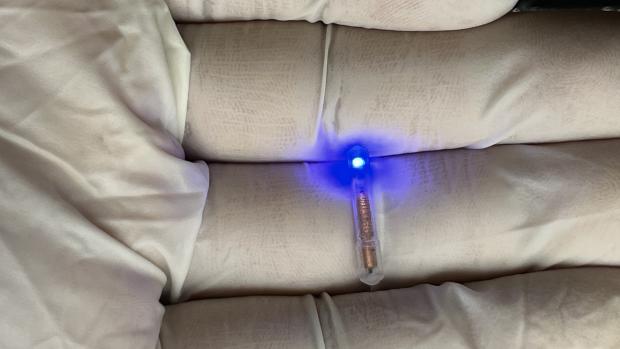
Light pills could transform understanding of how the gut controls the body
Scientists have long struggled with how to study the gut's vast nervous system — often called the body's 'second brain' — without damaging it. Current research methods are invasive and often require complex surgeries that make it difficult to study normal gut function.
"If you look at how we do any study trying to map neural function in the gut, it is all extremely crude," said Khalil Ramadi, a NYU researcher who has developed a new approach to this challenge. "We just don't have good tools for it."
A team led by Ramadi — assistant professor of bioengineering at NYU Tandon School of Engineering and Director of the Laboratory for Advanced Neuroengineering and Translational Medicine at NYU Abu Dhabi (NYUAD) — has created ingestible devices called ICOPS (Ingestible Controlled Optogenetic Stimulation) that deliver targeted light stimulation directly to the gut.
The technology allows researchers to precisely illuminate specific regions of the intestinal tract, activating specific nerve cells. It could be used to observe how those cells control digestion, for example, and reveal new targets for treating conditions like gastroparesis, where the stomach empties too slowly, or metabolic diseases and eating disorders. The approach represents a dramatic improvement over current methods, which typically involve invasive surgical procedures to implant optical fibers .
The device enables optogenetics, a technique that makes specific cells light-sensitive. Scientists first modify target neurons to respond to light stimulation, then the patient swallows the LED-equipped pill.
"You can go in, transfect a certain subset of cells to be light sensitive, and then swallow this light pill whenever you want to activate those cells," Ramadi explained.
In a paper published in Advanced Materials Technologies, the researchers demonstrate how these devices could control the enteric nervous system — the network of neurons that governs gut function — without surgery.
While optogenetics has been used for brain research since the early 2000s, this marks the first non-invasive platform for wireless optical stimulation of the gut, opening new possibilities for mapping neural circuits that were previously inaccessible to researchers.
ICOPS represents the latest in Ramadi's portfolio of ingestible technologies, which includes FLASH, a capsule that uses electrical stimulation to activate gut neurons, and IMAG, a magnetic field-based device for tracking pill location in the gut. While these other devices have shown that neural activation can lead to hormonal changes affecting metabolism, ICOPS adds optogenetic control for greater precision.
A key innovation is that ICOPS operates without a battery, instead receiving power wirelessly through magnetic induction from an external transmitter. This battery-free design was necessary for the device to be small enough for testing in rats.
"What makes this capsule unique is that it was entirely fabricated in-house using 3D printing, without the need for cleanroom facilities,” said Mohamed Elsherif, a Postdoctoral Associate in Ramadi’s lab and the paper’s lead author. “This allowed us to integrate micro-LEDs and custom coils in a scalable way, making it the first rodent-scale ingestible capsule for non-invasive optical stimulation. Crucially, it can operate wirelessly in freely moving animals, enabling studies that were not possible with traditional tethered or invasive approaches."
The implications extend beyond research. The technology could lead to new treatments for gut motility disorders. "We don't really have very good prokinetic or antikinetic agents," Ramadi said, referring to drugs that speed up or slow down gut movement. "We have stuff that overall slows or accelerates motility, but not targeted ones."
Neural activation in specific gut regions can also trigger hormonal changes affecting metabolism, potentially offering new approaches to treating metabolic diseases and eating disorders.
The devices travel through the digestive system naturally over one to two days. Beyond light therapy, the platform could enable electrical stimulation and targeted drug delivery. While clinical applications likely remain a decade away, the research represents a significant step toward understanding the gut's complex neural networks.
In addition to Ramadi and Elsherif, the paper's authors are Rawan Badr El-Din, Zhansaya Makhambetova, Heba Naser, Rahul Singh, Keonghwan Oh, and Revathi Sukesan from NYUAD's Division of Engineering; Maylis Boitet from NYUAD's Core Technology Platforms Operations; and Sohmyung Ha from NYUAD's Division of Engineering and NYU Tandon.
Funding for the ICOPS research came from NYUAD and Tamkeen under the NYUAD Research Institute Award to the Research Center for Translational Medical Devices (CENTMED).
Elsherif, Mohamed, et al. “Wirelessly powered ingestible capsule for optical stimulation of the gastrointestinal tract in rodents.” Advanced Materials Technologies, 20 Aug. 2025