
Accelerating the Discovery and Scalable Manufacturing of 2D Covalent Organic Frameworks for Green Technologies
Speaker
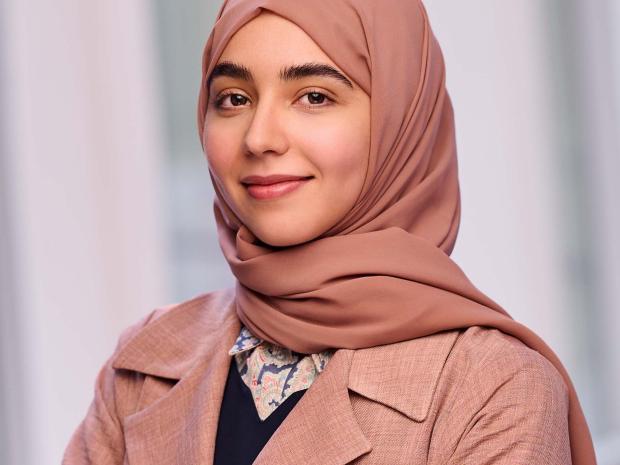
Safiya Khalil
NYU Abu Dhabi
Abstract
Accelerating the Discovery and Scalable Manufacturing of 2D Covalent Organic Frameworks for Green Technologies
With the rising global reliance on Artificial Intelligence (AI), surging computational demands threaten to overwhelm water and energy infrastructures, fueling record fossil fuel consumption and CO₂ emissions. The long-term goal of my research program is to develop green technologies harnessing Covalent Organic Frameworks (COFs) tailored for water security, quantum technologies, and climate change mitigation. COFs are highly tunable, crystalline porous materials with significant potential in applications ranging from membrane separations and photocatalysis to electrochemical energy conversion. However, their broader adoption is hindered by data fragmentation and persistent challenges in synthesis scalability, processability, and device integration, creating a fundamental disconnect between basic and applied research. This talk outlines an integrated engineering framework that addresses these challenges by leveraging AI and high-throughput screening to accelerate COF discovery. This approach bridges the critical gap between identifying the highest-performing COF for a specific application and engineering a scalable, functional device to harness their potential.
Bio
Safiya Khalil is an Assistant Professor Emerging Scholar of Mechanical Engineering at NYU Abu Dhabi. She received her Ph.D. in Chemical and Biomolecular Engineering from Rice University in 2023 and her B.S. in Chemical Engineering from Khalifa University in 2019. During her doctoral studies at Rice, pursued as a scholar of the UAE Ministry of Higher Education and Scientific Research, she established a pipeline to translate 2D COFs into functional devices. This work spanned material design, synthesis, processing, characterization, and device engineering for applications in photocatalytic water remediation and the electrochemical conversion of carbon dioxide to useful chemicals. This research was recognized with an honorable mention for the Kobayashi Fellowship for Distinguished Thesis Proposal by Rice University. She also contributed to projects funded by the National Science Foundation, the U.S. Department of Energy, and the Welch Foundation.
In September 2024, Dr. Khalil established the Khalil Research Group at NYU Abu Dhabi. Her interdisciplinary lab integrates AI and high-throughput synthesis to accelerate the discovery and design of smart reticular materials. The mission of the group is to pioneer a pipeline empowered by data for breakthroughs in sustainability, specifically targeting decarbonization, water security, and quantum technologies.
Dr. Khalil is a co-investigator of the Center for Smart Engineering Materials (CSEM) and the Center for Quantum and Topological Systems (CQTS). She is also a recipient of the 2024 NYU Research Catalyst Grant. Recently honored on the Forbes 30 Under 30 and MIT Innovators Under 35 (Middle East) lists, she is known for developing patent-pending PFAS degradation technology, now licensed by a US startup.