
Transforming Scientific Innovation with AI
Part of the Special ECE Seminar Series
Modern Artificial Intelligence
Title:
Transforming Scientific Innovation with AI
Speaker:
Max Welling, University of Amsterdam
Abstract:
We are witnessing the emergence of new powerful tools in the molecular sciences based on AI, such as Machine Learned Force Fields and AlphaFold. In this talk I will report on some interesting progress the field has been making in replacing some traditional (quantum) chemistry methods with accelerated “ML surrogate” models, and reversely, how principles from physics and mathematics have transformed the field of ML. These new tools, including generative model, have the potential to usher in an era of "precision materials”. I will report on the platform we are building at CuspAI to use these tools to accelerate materials design. Using generative models for materials, a multi-fidelity stack of AI accelerate (surrogate) evaluation tools, LLMs to search through scientific literature and an AI agent to orchestrate and optimize the search process, we transform the entire pipeline of materials design
Bio:
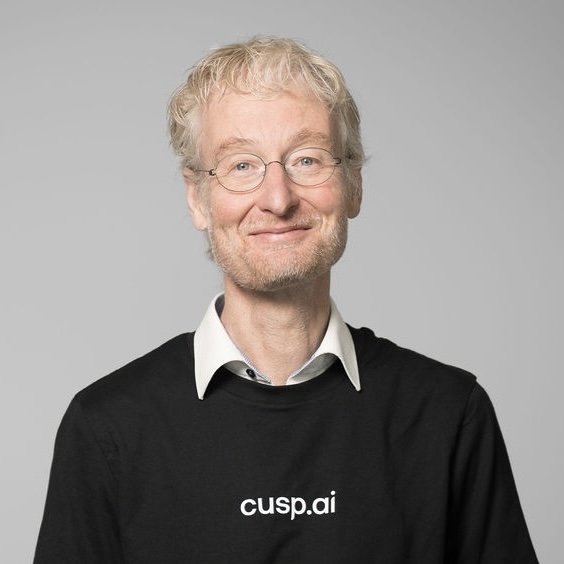
Prof. Max Welling: Max is a globally recognized leader in AI and machine learning, holding a full professorship and research chair at the University of Amsterdam, as well as serving as a Merkin Distinguished Visiting Professor at Caltech. He is the co-founder and Chief AI Officer of CuspAI, focusing on AI-driven materials design.
With a PhD in theoretical high-energy physics from Utrecht University under Nobel laureate Prof. Gerard 't Hooft, Max transitioned to AI during postdoctoral work at Caltech and later with Geoffrey Hinton. He co-founded Scyfer, acquired by Qualcomm in 2017, where he led AI research for four years before joining Microsoft Research as Vice President and Distinguished Scientist.
Max is one of the most cited AI researchers globally, known for his pioneering work in generative models and variational autoencoders, which have influenced large language models. He co-founded ELLIS and served on the NeurIPS advisory board, among other key roles. His numerous accolades include the ECCV Koenderink Prize and Test of Time awards at ICML and ICLR.