
Environmental Engineering, B.S.
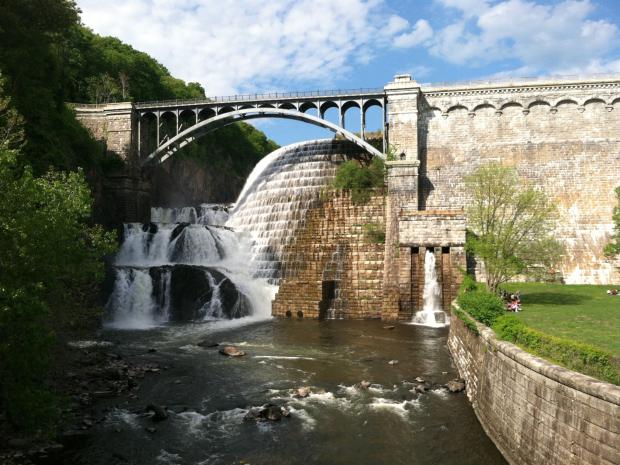
Humanity must find sustainable ways to provide food, water, and energy; combat and adapt to climate change; eliminate pollution and waste; build efficient, healthy, and resilient cities; and understand how the environment, well-being, and prosperity are interconnected to guide wise decision-making. Environmental engineering plays a vital role in achieving these goals and securing a future that supports, nourishes, and inspires generations to come.
Simply stated, environmental engineering applies mathematical, chemical, physical, and biological principles to solve problems related to the air we breathe, water we drink, food we eat, and the soil that sustains our forests and fields. It is a professional discipline that is intimately related to human health and well-being, as well as to the health and vitality of ecosystems. Environmental engineering plays a vital role in the success (or failure) of our local, national, and global communities.
Why Choose NYU Tandon?
What makes NYU Tandon’s program unique is the combination of a rigorous, traditional curriculum in water/wastewater, air pollution, and solid waste management, with courses in climate science, artificial intelligence (AI), and big data. Our award-winning professors will challenge you in the classroom to assimilate the fundamental knowledge of the field, and they will also provide you with ample opportunity to push the boundaries of what we can learn, do, and be.
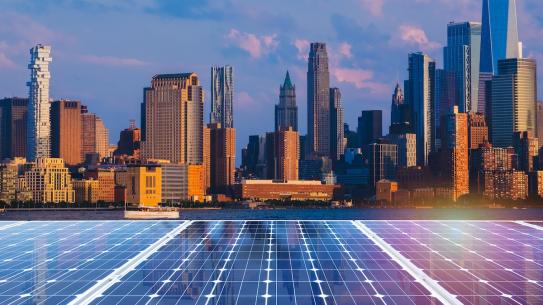
In addition, we are located in New York City; one of the most dynamic, vibrant places in the world that connects our students to renowned engineering consulting firms, some of the largest public agencies in the country, and practically limitless employment opportunities. Strong affiliations with large companies such as WSP Global and Langan Engineering and Environmental Services, mid-size and small consulting firms like Mcrit and Ecosystem Energy, as well as the New York State Energy Research and Development Authority (NYSERDA), provide our students with unique opportunities for some of the most sought-after and competitive internships in the city.
Program Information
Program Educational Objectives
Program educational objectives (PEOs) establish broad, overarching goals for the Bachelor of Science in Environmental Engineering program and are statements of what the program expects of its graduates within 3-5 years after graduation. During the initial stages of their careers, environmental engineering graduates from NYU Tandon will:
- Distinguish themselves as practicing environmental engineers within prominent companies, government, non-government organizations, and other ventures, or pursue graduate education and research in environmental engineering and related fields at national laboratories and major research institutions;
- Demonstrate leadership in professional careers, pursue continuous and lifelong learning, and progress towards professional licensure; and
- Collaborate locally, regionally, and globally in service to the profession of environmental engineering.
Student Outcomes
Student outcomes for the Bachelor of Science in Environmental Engineering program as presented in the NYU Bulletin are those abilities and skills that graduates are expected to have upon graduation with a BS in Environmental Engineering degree. Our program outcomes are consistent with ABET student outcomes 1-7. Graduates of the undergraduate environmental engineering program will have the following:
- An ability to identify, formulate, and solve complex engineering problems by applying principles of engineering, science, and mathematics;
- An ability to apply engineering design to produce solutions that meet specified needs with consideration of public health, safety, and welfare, as well as global, cultural, social, environmental, and economic factors;
- An ability to communicate effectively with a range of audiences;
- An ability to recognize ethical and professional responsibilities in engineering situations and make informed judgments, which must consider the impact of engineering solutions in global, economic, environmental, and societal contexts;
- An ability to function effectively on a team whose members together provide leadership, create a collaborative and inclusive environment, establish goals, plan tasks, and meet objectives;
- An ability to develop and conduct appropriate experimentation, analyze and interpret data, and use engineering judgment to draw conclusions; and
- An ability to acquire and apply new knowledge as needed, using appropriate learning strategies.
Transfer Students and Credit
The BS in Environmental Engineering degree is fulfilled by combining transfer credits, credits by examination and courses taken at Tandon. Transfer credits in mathematics, chemistry, physics, humanities and social sciences are evaluated by the Office of Academic Affairs with faculty guidance from specific departments. Transfer credits in environmental engineering and other technical areas are evaluated by the faculty of the Department of Civil, Urban, and Environmental Engineering. The length of time for a transfer student to complete the BS in Environmental Engineering depends upon 3 factors:
- The total number of transfer credits awarded;
- The particular courses required to complete degree requirements; and
- Enrollment status (part-time or full-time).
Transfer students should understand that they can be awarded transfer credits for courses with a C grade or better and then only for courses that are applicable toward the BS in Civil Engineering curriculum.
More information on Transfer Credits from other Institutions.
Part-Time Students
You may register as a part-time student (fewer than 12 credits a semester), though the department does not offer many undergraduate courses in the evening. If you are enrolled as a part-time student, you should maintain close contact with your academic advisor to work out the details of course sequencing.
Curriculum
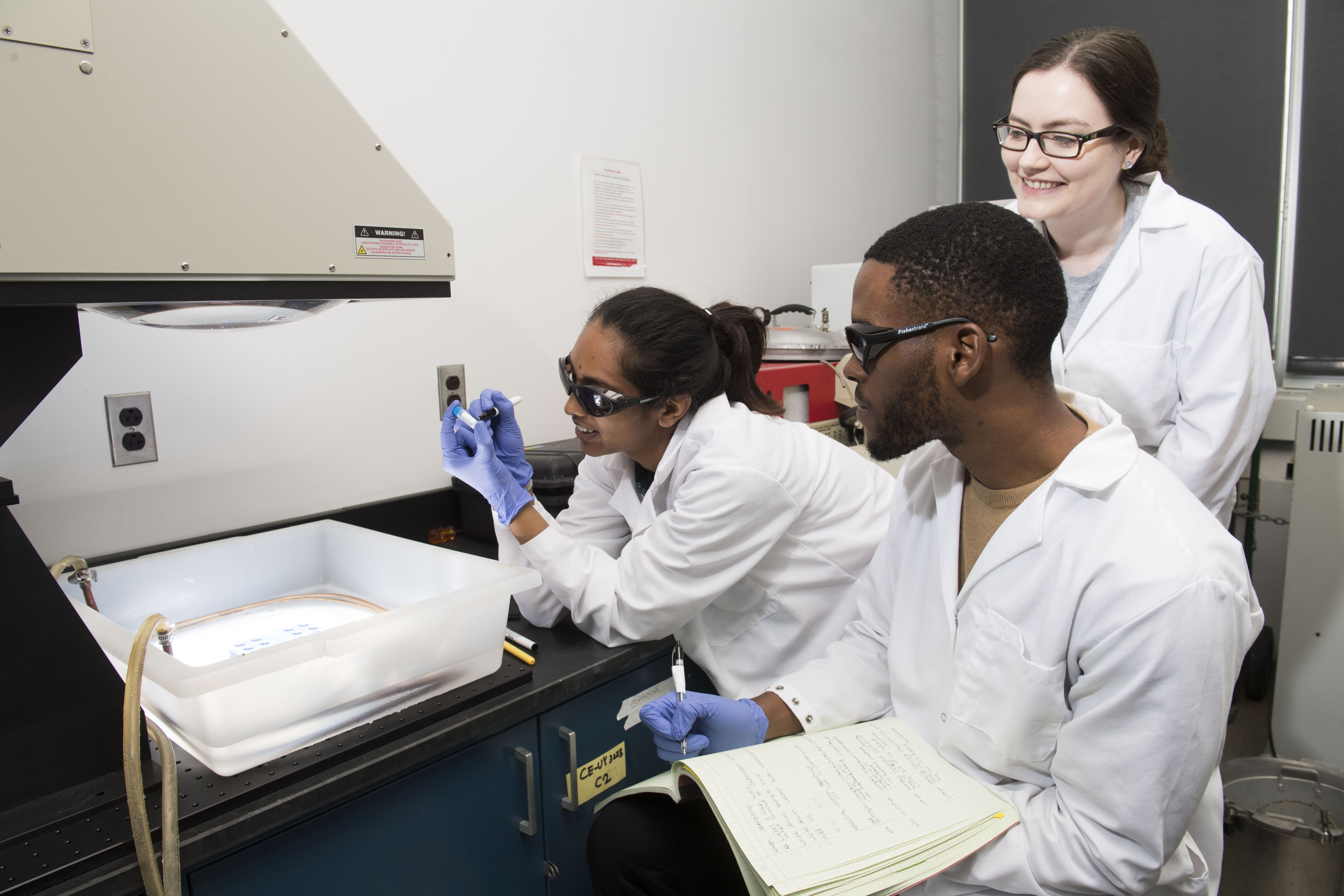
Our curriculum is designed to make you well-rounded in all the major traditional and state-of-the-art aspects of environmental engineering that will allow you to thrive after you graduate. Whether you choose to pursue employment in the private or public sectors, or to continue your formal education in graduate school, you will be prepared to succeed and flourish.
During your matriculation, you will learn to communicate effectively in written and verbal form, as you develop your understanding of all aspects of environmental engineering projects, design, and technical reports. Coursework in the humanities and social sciences will not only expand your horizons beyond STEM topics, but will also further hone your writing and oral skills through written assignments, class discussions, and oral presentations.
After a student completes four semesters or 64 credits at NYU (whichever is earlier), the student must have a combined GPA of at least 2.333 in the following four required CE courses, all of which must be completed by this point: CE-UY 1002 Introduction to Civil and Environmental Engineering, CE-UY 2112 Structural Statics, CE-UY 2213 Fluid Mechanics and Hydraulics, and CE-UY 3223 Fundamentals of Environmental Engineering.
Sample Course Schedule
|
1st Semester/Term |
Credits |
|
|---|---|---|
|
Calculus I for Engineers |
4 |
|
|
General Chemistry for Engineers |
3 |
|
|
General Chemistry for Engineers Laboratory |
1 |
|
|
Writing as Inquiry |
4 |
|
|
Introduction to Engineering and Design |
4 |
|
|
Credits |
16 |
|
|
2nd Semester/Term |
||
|
Calculus II for Engineers |
4 |
|
|
Mechanics |
3 |
|
|
Advanced Writing for Engineers |
4 |
|
|
Problem Solving and Programming I |
3 |
|
|
Introduction to Civil and Environmental Engineering |
2 |
|
|
Credits |
16 |
|
|
3rd Semester/Term |
||
|
Linear Algebra and Differential Equations |
4 |
|
|
General Physics Laboratory I |
1 |
|
|
Electricity, Magnetism, & Fluids |
3 |
|
|
BMS-UY 1003 |
Intr to Cell and Molec Bio |
3 |
|
Structural Statics |
2 |
|
|
URB-UY 2334 |
Intro to Env Sciences |
4 |
|
Credits |
17 |
|
|
4th Semester/Term |
||
|
MA-UY 2224 |
Data Analysis |
4 |
|
PH-UY 2033 |
Waves, Optics, & Thermodynamics |
3 |
|
CE-UY 2213 |
Fluid Mechanics and Hydraulics |
3 |
|
CE-UY 3223 |
Fundamentals of Env Engr |
3 |
|
URB-UY 3834 |
Sust., Soc., and Tech |
4 |
|
Credits |
9 |
|
|
5th Semester/Term |
||
|
CE-UY 2253 |
Environmental Chemistry |
3 |
|
CE-UY 3013 |
Computing in Civ Engr |
3 |
|
CE-UY 3243 |
Water Resources Engr |
3 |
|
CE-UY 3263 |
Air Poll Gen and Control |
3 |
|
Humanities and Soc. Sci. Elective |
4 |
|
|
Credits |
16 |
|
|
6th Semester/Term |
||
|
CE-UY 3233 |
Advanced Project in Computer Science (elective) |
3 |
|
CE-UY 3273 |
Advanced Project in Computer Science (elective) |
3 |
|
Environmental Engineering Elective |
3 |
|
|
Humanities and Soc. Sci. Elective |
3 |
|
|
Free Elective |
3 |
|
|
Credits |
6 |
|
|
7th Semester/Term |
||
|
CE-UY 4092 |
Leadership, Business Principles, Policy and Ethics |
2 |
|
CE-UY 4221 |
Sr Envir Engr Design Lab |
1 |
|
CE-GY 5213 |
Micro and Bio Treat Proc |
3 |
|
CE-GY 5223 |
Waste Mgmt and Resource Recovery |
3 |
|
Humanities and Soc. Sci. Elective |
4 |
|
|
Free Elective |
3 |
|
|
Credits |
16 |
|
|
8th Semester/Term |
||
|
CE-UY 4863 |
Env. Engineering Capstone |
3 |
|
CE-GY 5233 |
Sustainable Systems Engr. |
3 |
|
Environmental Engineering Elective |
3 |
|
|
Free Elective |
3 |
|
|
Free Elective |
3 |
|
|
Credits |
15 |
|
|
Total Credits |
129 |
|
If a student has a combined GPA below 2.000 in the above four classes, the student may not be allowed to remain in the major. If a student has a combined GPA of at least 2.000 and below 2.333, the student will be required to re-take at least one of the aforementioned courses to raise the GPA to 2.333 before being allowed to enroll in some junior-level required CE courses.
Career Outcomes
The B.S. in Environmental Engineering program prepares students for successful careers in a wide variety of job sectors, including industry, consulting firms, and municipal, state, and federal government agencies. Students develop skills to become environmental engineers, environmental remediation engineers, water resources or water treatment engineers, air quality engineers, environmental planners, sustainability consultants, and more.
Since the 1990s, NYU’s Wasserman Center has conducted the Life Beyond the Square Survey to track NYU graduates’ career trajectories. Visit the Tandon Graduate Employment Dashboard and select “Bachelors” and “Tandon School of Engineering” for insights on recent alumni outcomes.