
UN Sustainability Goals
- Decent Work and Economic Growth
- Good Health And Well-Being
- Peace, Justice and Strong Institutions
Areas of Impact
- Quantum Science & Technologies
- Engineering Health
Global Challenge: How can scientific and technological breakthroughs be accelerated to improve the human condition?
Bio:
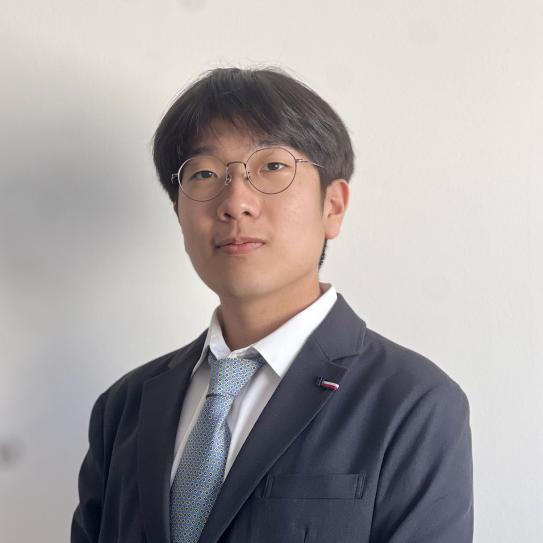
Ryan Kim is a Junior studying Electrical Engineering, specifically focusing on semiconductors and nanomaterials for sustainability. His work sits naturally at the intersection of electrical engineering, materials chemistry, and device physics, a combination that has shaped both his coursework and his research direction. One thing that might be surprising is that he is an EE student spending most of his time in a chemical and biomolecular engineering lab, a gap he has learned to see as an advantage rather than an obstacle.
Ryan is an undergraduate researcher in the Hybrid Nanomaterials Laboratory at NYU Tandon, where he works on colloidal quantum dot devices for near-infrared optoelectronic applications. His work covers the full pipeline from solution-phase ligand exchange and electrophoretic deposition to optical and electrical characterization using UV-vis spectroscopy, profilometry, and lock-in amplifier setups. He is currently working on two manuscripts, with his primary focus on a paper he is leading on low-cost maskless photolithography using an LCD resin 3D printer as an accessible method for printed circuit board fabrication, aimed at making microfabrication teachable outside of a cleanroom setting. He also served as Project Manager on a NASA L'SPACE NPWEE proposal developing a Bayesian multi-sensor fusion pipeline for detecting subsurface water ice on the Moon, work that connected directly to his research interest in building quantitative, data-driven approaches to real engineering problems. Through these experiences he has developed skills in thin-film fabrication, device characterization, scientific writing, and cross-functional project coordination. In the short term he is working toward submitting his first manuscript and attending AIChE and IEDM this year. Long term he hopes to contribute to the development of low-cost, scalable technologies that make advanced materials and devices more accessible, whether in research, industry, or education.
During his sophomore spring Ryan studied abroad in London, an experience that broadened how he thinks about engineering practice and research culture outside of the American university context. The following summer he participated in a special program in Korea focused on consulting for companies working on UN Sustainable Development Goal projects. One of the companies he worked with was DOT, which develops tactile braille display technology for accessibility, an experience that connected his technical background to a real-world social impact context in a way that stuck with him.
Being part of GLASS has given Ryan a framework for thinking about his work that goes beyond the technical. It has pushed him to ask not just whether something works but who it works for and whether it is accessible to the people who need it most. The global challenge that resonates most is in between affordable clean energy and quality education, specifically the question of how advanced materials and fabrication technologies can be made accessible outside of well-resourced institutions. His photolithography work is a small example of that thinking in practice: taking a process that normally requires tens of thousands of dollars of equipment and making it workable with a $200 printer and basic chemistry. He hopes to keep applying that same instinct, finding the places where a technical solution can remove a barrier that should not exist, in whatever context his career takes him.
Outside the lab and classroom, Ryan enjoys running, playing golf, and experimenting with new recipes in the kitchen. Through GLASS, he’s looking forward to collaborating with students from different backgrounds and exploring how global perspectives can shape more effective solutions to real-world problems.