
New Assistant Professor Justin Bui is Pioneering Autonomous Chemical Engineering
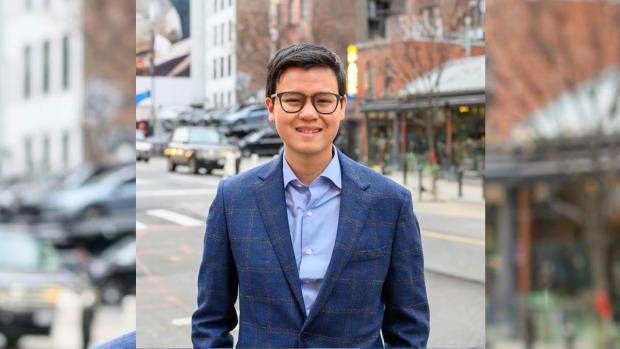
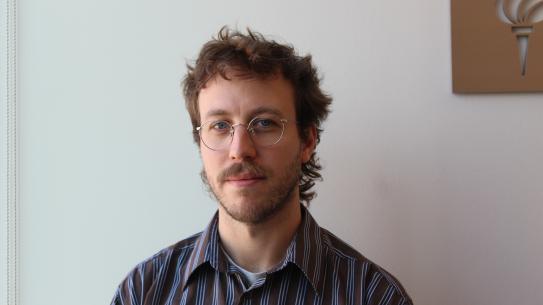
Justin Bui arrives at NYU Tandon as an assistant professor with an unusual combination of interests: electrochemistry, machine learning, robotics, and sustainability. His goal is to use them together to rethink how chemicals are produced and how valuable resources are recovered.
Bui grew up in Fairfax, Virginia, and initially enrolled in Columbia University intending to study physics. But during an undergraduate research experience in chemical engineering professor Dan Esposito’s lab, he began to see the field as a way to combine his interests in mathematics and physics with practical problems.
“I saw all the things that I really liked, and in a much more applied context than what I was doing in physics,” he says.
In Esposito’s lab, Bui worked on devices that used seawater to produce hydrogen fuel. The experience helped set the direction for his research career, which has remained focused on sustainability and electrochemistry. He went on to earn his Ph.D. at the University of California, Berkeley, where he used computational models to uncover how coupled transport and reaction processes govern electrochemical systems for applications including carbon capture and conversion.
After Berkeley, Bui spent a year at Caltech developing additively manufactured electrochemical reactors for nitrogen reduction, an alternative approach to the Haber-Bosch process used to manufacture ammonia, a key ingredient in fertilizer. He then received a Schmidt Science Fellowship, which allowed him to make a significant change in direction. He moved to MIT, where he began integrating machine learning with autonomous chemical laboratories.
The idea behind an autonomous laboratory is relatively straightforward, even if the technology is not. Chemical reactions can depend on hundreds of variables, from the reactants and reaction time to the geometry of a device. Finding the best combination can require hundreds or thousands of experiments. Robots can perform those experiments automatically, generating large amounts of data that machine learning models can use to identify patterns and predict how a chemical system will behave. By incorporating an understanding of physics and chemistry into these models, Bui aims to improve their predictions and reduce the number of experiments the robots need to run, further accelerating scientific progress.
In Bui’s research, robots can control the flow of different reactants into an electrochemical reactor, systematically changing experimental conditions and learning from the results. He compares the setup to “a margarita machine, but for chemical reactants.”
The ultimate aim, however, is not simply to make experiments faster. Bui wants these computational tools to help scientists discover new and more sustainable ways of making chemicals.
He sees three major directions for his research. One is converting waste into useful products, such as turning carbon dioxide into fuels. Another is developing electrochemical alternatives to conventional chemical manufacturing, potentially allowing industrial reactions to run using renewable electricity rather than large amounts of heat. The third is resource recovery, including extracting lithium from brines and valuable minerals from mining waste.
“Can we build alternative electrochemical processes to recover resources and decarbonize the chemical industry?” he says. “That’s the goal in short.”
At NYU, Bui will join a growing community of researchers working at the intersection of electrochemistry and sustainability. He is already collaborating with Professors Miguel Modestino and Dharik Mallapragada on projects related to decarbonization and plans to work with other faculty and students across the university. He sees particular potential in collaborating with researchers at NYU’s Courant Institute, whose expertise in artificial intelligence and machine learning could complement his work in chemical engineering.
New York itself is another attraction. Bui previously spent four years in the city as a Columbia undergraduate and says the region’s concentration of electrochemists and climate-tech researchers makes it an especially productive place to work. He is also interested in translating research into startups, following the example of Captura, a company whose direct ocean carbon-capture technology grew in part from research related to his doctoral work.
With his NYU lab already taking shape, Bui is poised to bring together chemistry, computation and automation in pursuit of a larger goal: making the chemical industry more efficient, more intelligent and less dependent on fossil fuels.