

Meet Saman Khazaei, Ph.D. Candidate in Biomedical Engineering
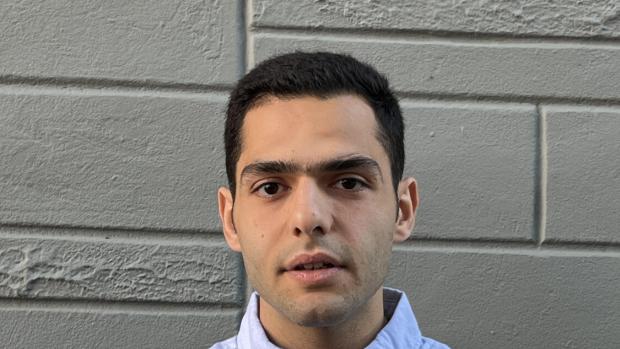
For this month's NYU Tandon Ph.D. Pulse interview, we sat down with Saman Khazaei, a 4th year doctoral candidate under the advisement of Associate Professor Rose T. Faghih of the Department of Biomedical Engineering.
Khazaei previously earned a bachelor's degree in mechanical engineering from Sharif University of Technology in Tehran and then traveled to Texas to earn a master's in electrical & computer engineering from the University of Houston. Then, in January 2022, Khazaei came to Tandon to work in Faghih's Computational Medicine Lab — which focuses on designing control, optimization, estimation, and signal processing algorithms for biomedical and neural engineering applications.
Take a look at our full interview with Khazaei and learn about his inspiration to pursue a Ph.D., how his research has evolved since coming to Tandon, his advice for new doctoral students, and more.
What inspired you to get your Ph.D.?
I found the Ph.D. program to be a path that offers both learning and problem-solving, which are both highly aligned with my personal goals, and meeting them inspired me to enter this journey.
Why did you choose your field of study? How did your undergraduate and graduate experiences inform this choice?
The field of biomedical engineering, with a research focus on biomedical signal processing, modeling, and state estimation, has a tangible impact on human health. During my master’s degree in ECE, I became more familiar with the applications of state-space modeling and estimation in biomedical engineering, which has significantly influenced my current research focus.
Why Tandon? Who is your faculty advisor, and what type of research goes on in their lab? How were you introduced to their work?
Tandon School of Engineering offers cutting-edge research labs led by brilliant faculty members. It is genuinely my honor to be advised by Dr. Rose T. Faghih, whose research interest includes wearable technologies, medical cyber-physical systems, and neural & biomedical signal processing. I completed my master's thesis under her supervision and took her state-space control system course as a master's student.
What research project(s) are you currently working on? What are you hoping to solve for?
Currently, I am working on a model and decoder design for multiple hidden health and brain states that can be implemented in future wearable and portable devices; my aim is to provide a safe and practical closed-loop architecture that can improve overall human health in everyday life settings.
How has your research evolved since you began your Ph.D.? What have you learned from going through this process?
My research mainly evolved from designing linear and isolated models and decoders for hidden states towards developing non-linear and concurrent frameworks that may resemble the real-world settings more closely. Along the way, I have obtained a Ph.D.-level perspective and related technical skills.
What impact do you hope your work has in your field and the world at large?
The main idea of my research can be implemented in a future non-invasive closed-loop brain-machine interface that regulates hidden brain and health states to improve the overall health status. Particularly, the designed algorithms are independent of training data, which makes them suitable for daily life implementation.
What advice would you give to new Ph.D. students? What are the biggest challenges that come with getting your Ph.D., and how do you handle them?
I think being positive, intentional, proactive, and persistent are critical characteristics for a Ph.D. student. For me, being positive and persistent after receiving unfavorable comments in top-tier venues was challenging, but I realized that those experiences were helping me to improve my research and thrive.
What’s been your favorite part about being in Brooklyn? What are some of your favorite local spots?
The pace and energy of Brooklyn are optimal for me. My favorite spots in Brooklyn are Brooklyn Bridge Park and the neighborhoods around it.
What would you tell prospective Ph.D. students considering Tandon?
I would say Tandon is a fantastic place to consider, given the cutting-edge research that high-profile and distinguished faculty members conduct here.
Do you have a sense of what you would like to do after completing your Ph.D.?
At this point, I am more open to industry and would prefer a career in an R&D type position where I can fulfill my goals through research. However, the other options (e.g., academia, entrepreneurship) are still being considered.
If you had to describe your Ph.D. experience in three words, what would they be?
Phenomenal, transformative, euphoric!

