

Expanding the Surface of AI: Wireless Touch, Radar Sensing, and Edge Intelligence
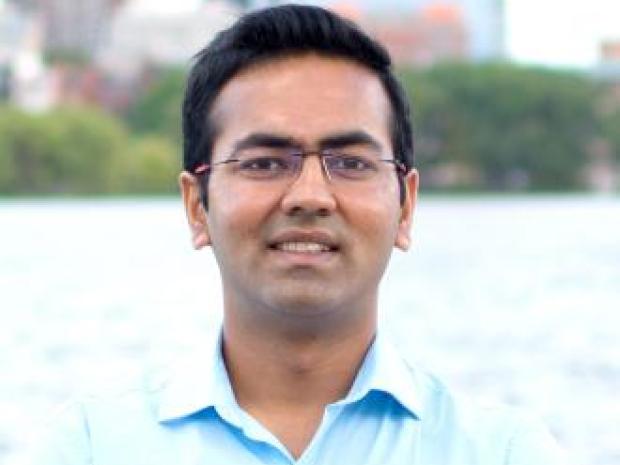
Speaker
Dinesh Bharadia
Associate Professor in the Electrical and Computer Engineering Department and the Klein Gilhousen Chancellor’s Endowed Chair at the University of California, San Diego (UCSD)
Title
"Expanding the Surface of AI: Wireless Touch, Radar Sensing, and Edge Intelligence "
Abstract
AI systems are becoming increasingly interactive, but their physical interfaces remain narrow. Today’s systems reason well over text, audio, and video, yet many high-impact applications in healthcare, robotics, and physical AI depend on signals that are harder to capture and act on: contact force, oral activity, spatial context, latency, and reliability, to name a few. This talk presents my work on building the Sense-Network-Compute fabric that allows AI to move from passive interpretation to real-time physical interaction.
I will begin with a unique sensing -- ForceSticker, a thin, flexible, battery-free force-sensing platform that embeds contact-force information into RFID/backscatter links. ForceSticker shows how touch can become a wireless sensing modality without adding batteries, wires, or bulky interface electronics. I will discuss how this principle extends to a smart pacifier, where force sensing inside the pacifier can measure infant oral activity and open new pathways for nutrition-related monitoring, neonatal care, and medical robotics. This first part motivates a broader question: once we can sense new physical signals continuously, where should intelligence run, and how quickly can it act?
The next part of the talk focuses on EdgeRIC, a real-time edge-control platform for next-generation last mile networks to Edge. EdgeRIC brings AI-in-the-loop decision-making close to the radio access network, allowing policies to access RAN and application-level information and execute at sub-millisecond timescales. Rather than treating the network as a passive transport layer, EdgeRIC makes the network an active compute and control substrate for interactive applications.
I will close with the future vision of Edge Labs: programmable edge-computing environments where touch sensing, spatial sensing, wireless connectivity, and real-time compute are integrated into testbeds for medical AI, physical AI, and low-latency intelligence. The next generation of AI will be defined not only by models, but by the sensing and edge infrastructures that let those models perceive, communicate, and act in the physical world.
About Speaker
Dinesh Bharadia is an Associate Professor in the Electrical and Computer Engineering Department and the Klein Gilhousen Chancellor’s Endowed Chair at the University of California, San Diego (UCSD), where he leads the Wireless Communication Sensing and Networking Group (WCSNG). He earned his Ph.D. from Stanford University in 2016, followed by a Postdoctoral Associate position at MIT. In 2018, he joined UCSD as an Assistant Professor and was promoted to a tenured position in 2022.
His research focuses on the design and prototyping of advanced systems for communication, sensing, and networking, with applications spanning privacy, security, robotics, health, and everyday life. His work has driven new research directions across fields such as communication theory, RFIC design, and robotics. Many of his innovations have been successfully translated into startups and commercial products, including Haila, Kumu Networks, and Totemic Labs.
Under his leadership, the WCSNG group has secured funding from sources including NSF, industry partners, and DoD grants. This funding supports a vibrant team of more than 40 students at any given time, helping train the next generation of engineers and scientists. He has received numerous prestigious accolades for his contributions to wireless research, including being named to Forbes 30 Under 30 (Science) and MIT Technology Review’s Innovators Under 35 list.