
CUSP Urban Observatory Expansion Launch
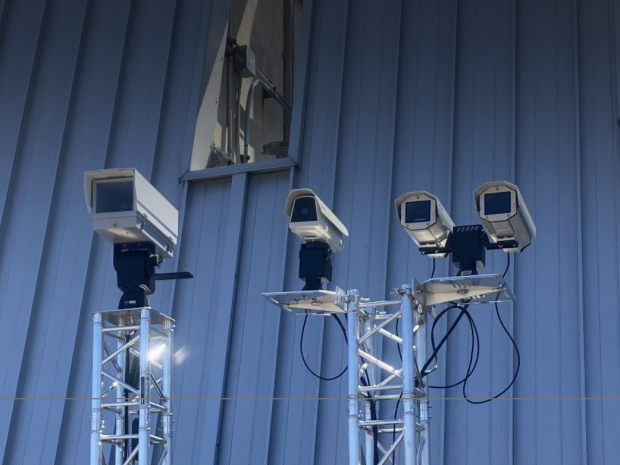
The Center for Urban Science + Progress (CUSP) at NYU Tandon is excited to celebrate the recent expansion of the CUSP Urban Observatory (CUSP-UO).
This event will feature introductory remarks by CUSP Director Dr. Maurizio Porfiri, followed by presentations from Dr. Gregory Dobler (University of Delaware), Dr. Debra Laefer (NYU Tandon), and Dr. Andreas Karpf (NYU Tandon).
The CUSP-UO provides persistent, synoptic imaging and sensing of New York City, enabling researchers to examine interactions among physical infrastructure, the natural environment, and human activity. Researchers have used the CUSP-UO to examine energy usage and stresses on the power grid, assess air quality, and examine how cities shape daily life and public health.
Schedule
- 2:00 – 2:10 PM |Dr. Maurizio Porfiri — Welcome and Opening Remarks
- 2:10 – 2:40 PM | Dr. Gregory Dobler — Better Cities Through Imaging: 12 Years of Urban Science at the Urban Observatory
- 2:40 – 2:50 PM | Audience Q&A
- 2:50 – 3:20 PM | Dr. Debra Laefer — Hyperspectral Standardizing and Sharing Possibilities for Urban Conditions
- 3:20 – 3:30 PM | Audience Q&A
- 3:30 – 3:45 PM | Dr. Andreas Karpf — Technical Instrumentation Highlights
- 3:45 – 3:55 PM | Audience Q&A
- 3:55 – 4:30 PM | Reception
About the Lectures
Dr. Gregory Dobler | Better Cities Through Imaging: 12 Years of Urban Science at the Urban Observatory
With millions of interacting people and hundreds of governing agencies, urban environments are the largest, most dynamic, and most complex macroscopic systems on Earth. The interaction between the three fundamental components of that system (human, natural, and built) can be studied much like any physical system, with observation and application of physical principles to the collection and analysis of that data. Since 2013, the "Urban Observatory", a multi-city facility consisting of a network of observational platforms, has been combining techniques from the domains of astronomy, physics, remote sensing, and AI and machine learning to address a myriad of questions related to urban science and informatics. I will demonstrate the power of these techniques when data from the Urban Observatory is fused with publicly available records and in situ sensing data to provide new insights into cities as living organisms that consume energy, have environmental impact, and display characteristic patterns of life and how that new understanding can be used to improve both city functioning and quality of life for its inhabitants.
Dr. Debra Laefer | Hyperspectral Standardizing and Sharing Possibilities for Urban Conditions
This presentation will introduce a newly inaugurated National Science Foundation grant award 2531997 that aims to advance the use of hyperspectral imaging of in urban settings. Urban materials comprised of manufactured materials (e.g., asphalt, concrete, paint) and naturally occurring materials that have been anthropogenically modified for urban use (e.g., cut stone) present unique challenges to spectral data collection and analysis due to the intersection of (1) decades of pollutant exposure, (2) variable environmental conditions, (3) the composite and/or manufactured nature of most building components, and (4) the absence of sufficient spectral reference spectra. Libraries of such spectra support both direct classification and machine learning applications. When combined with on-site hyperspectral imaging, they have proven effective across a variety of domains including heritage conservation, homeland security, hydrology, and geology. This presentation will introduce the strategies for the forth coming deployment for longitudinal urban building material capture and FAIR inspired data storage. This involves four main components: 1) developing a metadata architecture tailored to longitudinal urban field campaigns; 2) incorporating auxiliary sensors to contextualize spectral variability; 3) Implementing a flexible versioning and querying model that reflects the dynamic nature of repeated, real-world observations; and 4) enabling interoperability across platforms through spectral resampling and standardization pipelines.
Dr. Andreas Karpf | Technical Instrumentation Highlights
This presentation will highlight the technical instrumentation behind the CUSP Urban Observatory and explain how it enables the study of complex urban systems through persistent, synoptic, and high-resolution imaging of dynamic city processes.
Speakers
Dr. Gregory Dobler is an Associate Professor at the University of Delaware's Joseph R. Biden, Jr. School of Public Policy and Administration, and an urban data scientist whose research focuses on studying cities as complex systems. As the Director of the Urban Observatory (UO) facility at UD and NYU, he applies data analysis techniques from astronomy, computer vision, data science, AI, and machine learning to images of city skylines to study air quality, energy consumption, lighting technology, public health, and sustainability. In addition to his work with the UO, Dr. Dobler also leads data analysis projects in collaboration with local government agencies on the equitable distribution of green spaces, surrogate measures for traffic safety, and models of infectious disease spread.
Dr. Debra Laefer is a Professor in the Department of Civil and Urban Engineering and at the Center for Urban Science + Progress (CUSP) at NYU Tandon. With degrees from the University of Illinois Urbana-Champaign (MS, Ph.D.), NYU (MEng), and Columbia University (BS, BA), Prof. Debra Laefer has a wide-ranging background spanning from geotechnical and structural engineering to art history and historic preservation. Not surprisingly, Prof. Laefer’s work often stands at the crossroads of technology creation and community values, such as devising technical solutions for protecting architecturally significant buildings from subsurface construction. As the density of her aerial remote sensing datasets continues to grow exponentially with time, Prof. Laefer and her Urban Modeling Group must help pioneer computationally efficient storage, querying, and visualization strategies that both harness distributed computing-based solutions and bridge the gap between data availability and its usability for the engineering community.
Dr. Andreas Karpf is the laboratory manager for the Civil & Urban Engineering Department, the Mechanical & Aerospace Engineering Department, and the Center for Urban Science + Progress at the NYU Tandon School of Engineering. He works closely with graduate research groups and principal investigators and provides technical support to enable state-of-the-art research and laboratory operations. He is an experimental physicist who earned his Ph.D. in Physics at NYU and has experience in applied optics, spectroscopy, photonics, remote sensing, and pollution analysis. His work has focused on developing new spectroscopic techniques to detect trace contaminants in ambient air, contaminants on solid surfaces, as well as structural defects. His experience extends beyond research and includes designing and constructing prototype apparatus for field use, designing research laboratories, creating instructional lab experiments, as well as software development.
Visitor Information
This event will take place in Room 1201, located on the 12th Floor of 370 Jay St, Brooklyn, NY 11201. Please visit the NYU Tandon website for directions and a campus map. Advance registration through Luma is required for campus access at NYU for external guests. Attendees who are not current students, faculty, or staff at NYU, including alumni, are asked to register using a personal email address.
About CUSP at NYU Tandon
The Center for Urban Science + Progress (CUSP) at NYU Tandon is an interdisciplinary center dedicated to applying science, technology, engineering, math, and social sciences to serve urban communities worldwide.
Founded as a partnership between NYU and the City of New York, CUSP leads research, educational, and entrepreneurial initiatives that advance the science of cities. By applying novel insights to urban issues, we develop data- and technology-driven approaches that drive positive impact. With an additional focus on training future leaders, CUSP offers interdisciplinary academic programs in applied urban science and informatics for graduate students and professionals.
CUSP also engages with stakeholders across city agencies, start-ups, industry players, community-based organizations, and nonprofits to address urgent socioeconomic, environmental, and infrastructural challenges. The center’s ultimate objective is to improve the quality of life in cities by using data to innovate and refine inclusive, equitable, and sustainable practices for cities everywhere.