
Microbial Metrics: Design for the Multispecies City
Speaker:
Elizabeth Henaff, Ph.D.
Assistant Professor, Dept. of Technology, Culture and Society, Center of Urban Science and Progress (CUSP)
NYU Tandon School of Engineering
Abstract:
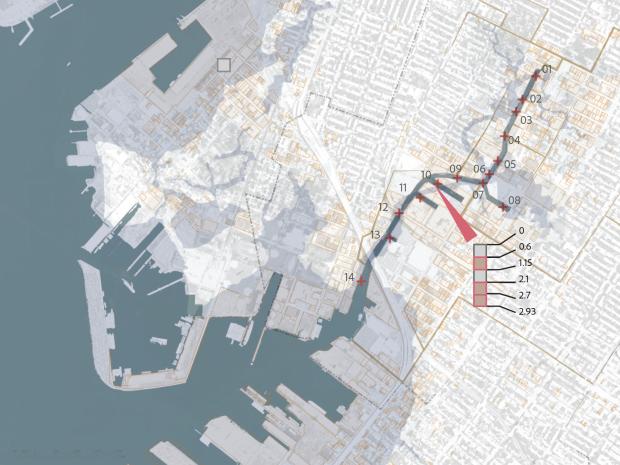
Urban design has long prioritized human infrastructure, often at the expense of the many other lifeforms with which we share our environment. In this talk, Dr. Elizabeth Hénaff presents a compelling case for reimagining our cities as multispecies habitats—spaces where microbial life is not only acknowledged but intentionally incorporated into the design and remediation of urban systems. Dr. Hénaff uses computational biology and metagenomics to reveal the invisible microbiomes that shape the material and ecological identity of our built environment. Using New York City as a living laboratory, her research group investigates how urban microbial ecologies respond to environmental stressors—from climate-related flooding to industrial pollution. Her recent publication on the Gowanus Canal Superfund site uncovers an astonishing array of microbial functions, including pathways for aromatic hydrocarbon degradation, heavy metal detoxification, and biosynthetic gene clusters with untapped biotechnological potential. These microbial capabilities point toward novel strategies for bioremediation and environmental resilience. Through case studies ranging from green wall infrastructure to microbial mapping of post-industrial zones, Dr. Hénaff will share how microbial data can inform bio-integrated design and how ecological stewardship can be reimagined through the lens of microbial cohabitation. This talk invites us to consider how urban planning might evolve if it accounted for the microbial inhabitants of our streets, walls, and waterways—not as contaminants, but as essential partners in shaping a livable, multispecies future.
Dr. Elizabeth Hénaff is a computational biologist and designer whose work bridges science, art, and urban ecology. She earned her B.S. in Computer Science and M.A. in Plant Biology from the University of Texas at Austin, followed by a Ph.D. in Bioinformatics from the University of Barcelona in 2013. Her postdoctoral research included positions at the Center for Genomic Regulation in Barcelona, Memorial Sloan Kettering Cancer Center, Weill Cornell Medical College, and a research associate role at the MIT Media Lab .Dr. Hénaff's projects have been exhibited internationally, including at the Venice Architecture Biennale and the Storefront for Art and Architecture in NYC. In recognition of her innovative teaching, she received the 2024 Distinguished Teacher Award from NYU Tandon, the school's highest honor for teaching excellence.