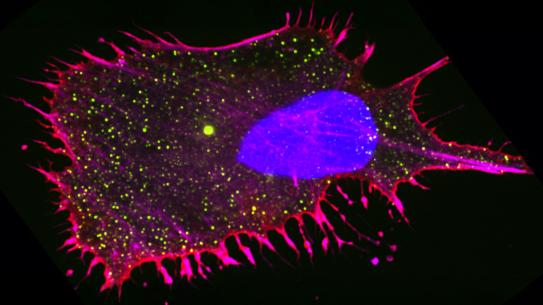

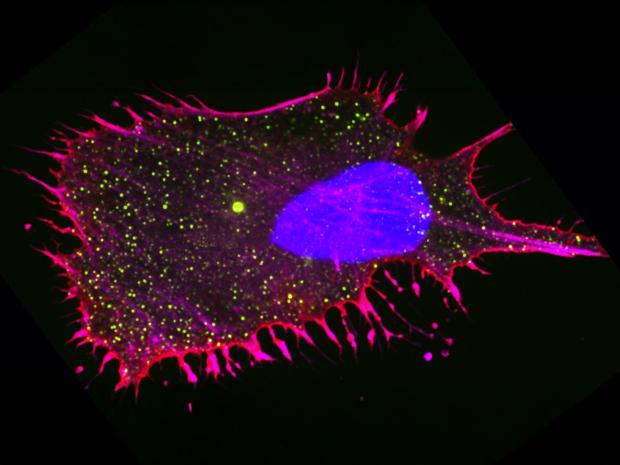
Crushing Cells: How does crowding and compression affect the biology of pancreatic cancer?
Speaker:
Liam Holt, PhD.
Associate Professor, Dept. of Biochemistry and Molecular Pharmacology & Institute for Systems Genetics
NYU Grossman School of Medicine
Abstract:
Pancreatic cancer is one of the deadliest malignancies. Because PC often does not cause any symptoms in in early stages, it is usually diagnosed only after it has spread to other organs. The five-rear survival rate is less than 10%. Dr. Hold tries to understand the fundamental mechanism that underpin the develop-ment of PC, and looks for better ways to diagnose and treat the disease. In this talk he will focus on how pressure influences the development of PC. When solid tumors grow confined within surrounding tissue, they build up pressure. Given that cells evolved to function in a stable mechanical environment, even slight changes in pressure perturb physiology. Normal cells and early-stage cancer cells stop growing when pressure builds up, while advanced cancer cells are better able to grow and survive. This difference implies that cancer cells somehow adapt to physical pressure. This adaptation is of particular importance to pancreatic cancer, which builds up the most pressure of any tumor type. Dr. Hold and his team are building devices to study how mechanical compression impacts the behavior and genome stability of cancer cells. They are leveraging machine learning to understand mitotic catastrophe under pressure and employing next-generation sequencing to understand genome rearrangements. His group is screening for genes that enable cancer cells to survive under pressure and defining the mechanisms by which they cause mechanoadaptation. A better understanding of these processes will lead to more effective ways of early diagnosis.
Dr. Hold earned his Ph.D. in at the University of California San Francisco, where he was a member of the renowned Tetrad graduate program. This highly interdisciplinary program emphasis collaborations among laboratories to solve outstanding problems in modern biology. Subsequently he became a Bowes Fellow in the Dept. of Molecular and Cell Biology at UC Berkeley. He joint NYU as an Assistant Professor of Biochemistry and Molecular Pharmacology in 2017.