

Qinsong Guo
UN Sustainability Goal
- Good Health And Well-Being
Areas of Excellence
- Data Science/AI/Robotics
- Health
Global Challenge: Advance Health Informatics
Abstract:
The human body is a complex system made up of many muscles and joints that allow a wide range of movements; this creates challenges for wearable sensors, which try to measure those movements seamlessly for health monitoring and medical treatments. Wearable movement sensors are usually stretchable electrical circuits attached to human skin or clothing. They can measure bending by monitoring how much they have been stretched, indicated by changes in electrical signals.
However, our joints can do more than bend. When we wave our hands, we first rotate our wrist outwards, then turn our hands sideways. During waving, our wrist constantly rotates, a motion called “torsion,” which only a torsional sensor can measure. Unfortunately, existing wearable torsion sensors suffer a tradeoff between flexibility and sensitivity, where a sensor can either measure small changes or stretch seamlessly, but not both.
My research developed a wearable torsion sensor that is both hyper-flexible and highly sensitive. It is made by twisting fishing lines and conductive sewing threads together so they change electrical resistance under different shapes, formally known as Twisted and Coiled Polymers. With a unit cost of $2.06/m, it can sense torsions as small as 1 degree, stretch to 30% of its length, and maintain a low stiffness comparable to human tissues. I also developed a physical model that predicts torsional and stretch levels through resistance measurements. When woven with wearable stretch sensors, it accurately measures complex wrist movements at around 90% accuracy, with a response time below 1 second.
In my past three years at GLASS, I traveled for service programs (Indonesia, China) and research (Denmark, Michigan, Pennsylvania, California). Through these experiences, I realized a disconnect between cutting-edge research and practical solutions that can create transformative impact. This motivated me to focus on tech accessibility. The torsional wearable sensor I developed uses everyday materials but can provide high-accuracy monitoring for the elderly, rehabilitation, and sports treatments, connecting to my UN Goals of Good Health and Wellbeing, the NAE Grand Challenge of Advance Health Informatics, and Tandon Areas of Excellence of Robotics and Health.
Bio:
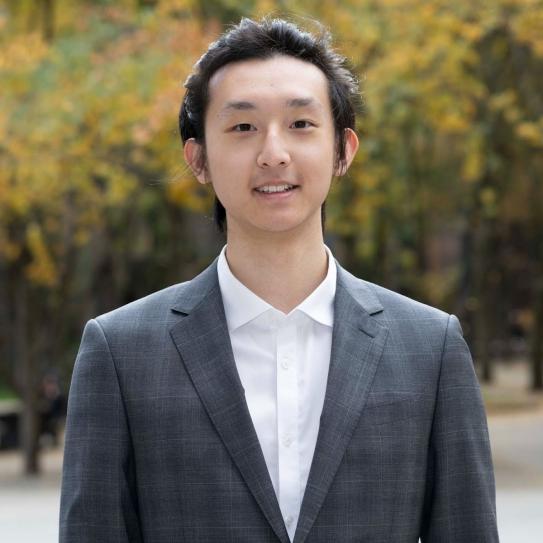
Born and raised in Shanghai, China, Tim enjoys making music, teaching, and traveling with friends. He pursued a degree in Mechanical Engineering at New York University Tandon School of Engineering, where he actively contributed to both research and outreach.
As the leader of the VIP team Self-Drive, Tim organized multiple public-facing events at Tandon and across New York City, introducing high school students to cutting-edge autonomous navigation technologies. He was also a dedicated mentor in the undergraduate course EG1004, guiding students through various design projects. Beyond teaching, he conducted research in the AI4CE and FAMS labs, focusing on soft robotics and medical sensing. Further, his study abroad experiences in Denmark and Indonesia, along with an international internship in China, developed his global problem-solving skills.
Currently, Tim is pursuing higher education in academia, where his diverse experiences in research, leadership, and mentorship position him as a future global leader in robotics.