

UN Sustainability Goal
- No Poverty
Areas of Impact
- Engineering & Culture
- Robotics & Embodied Intelligence
Global Challenge: Analyzing economic development and methods to reduce poverty objectively.
Abstract:
This project examines why poverty remains so difficult to solve even though it is one of the world’s most widely recognized problems. Poverty should not be understood as one single issue with one universal solution. Instead, it is a set of connected challenges involving health, education, infrastructure, weak institutions, and political priorities. Using Poor Economics by Abhijit Banerjee and Esther Duflo, The End of Poverty by Jeffrey Sachs, The Idealist by Nina Munk, recent reports on global poverty, and my own reflections from Abu Dhabi and Vietnam, I compare large scale development visions with smaller, evidence based interventions.
The paper shows that broad development narratives can be helpful because they attract funding and public attention, but they often fail when they ignore how poor people actually live and how local institutions function. Sachs argues that poverty can be reduced through major public investment, while Banerjee and Duflo emphasize testing specific policies to see what truly works. Munk’s account of the Millennium Villages Project shows how difficult it is to turn idealistic plans into lasting results.
The paper concludes that poverty reduction works best when it combines urgency with realism. It requires public investment, but also careful attention to behavior, incentives, and implementation. My experiences abroad reinforced this conclusion. In both Abu Dhabi and Vietnam, I saw that development depends not only on funds, but on long term planning, infrastructure, education, and the ability of institutions to coordinate change. Poverty alleviation, then, should move away from ideology and toward practical, adaptive, and evidence based solutions.
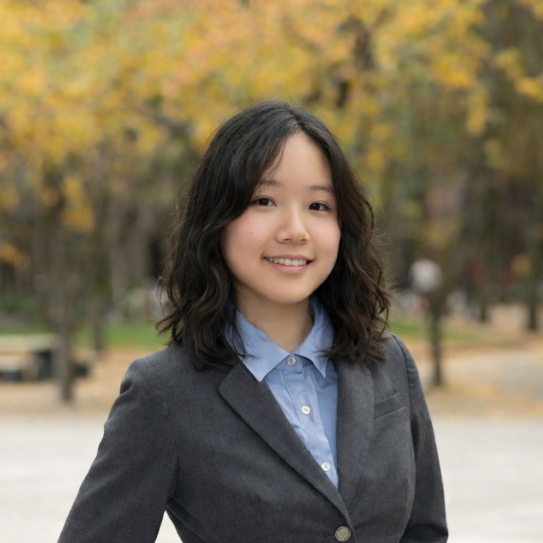
Bio:
Kerry Huang is a graduate of New York University’s Tandon School of Engineering, where she studied computer science with a focus on algorithms. During her time at NYU, she also served as a leader in the Poly Programming Club, where she helped build a collaborative environment for students to explore data structures and competitive programming. She is now a software developer in New York City, focused on becoming a stronger engineer by asking better questions and continuing to learn.