
Where Robots Meet the Deep: NYU Tandon Takes Underwater AI to the Wrecks of Malta
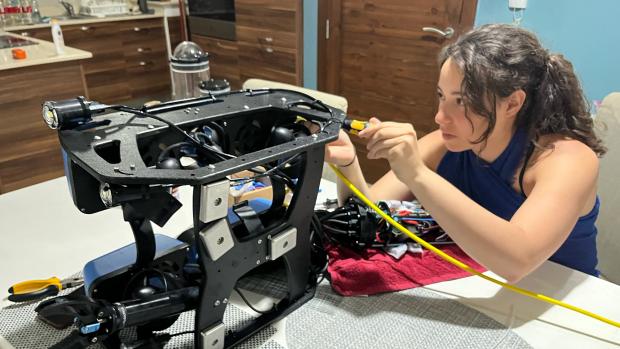
Greta Perez-Haiek works on an autonomous underwater vehicle.
The HMS Olympus sits 112 meters below the surface of the Mediterranean Sea, off the coast of Malta. In 1940, the submarine left port on route to the Straits of Gibraltar; shortly after, it struck a mine and sank, along with 89 of its 98 crewmembers. It sat undisturbed and unfound for almost 70 years. In 2008 a group of divers found the wreck, but it wasn't until 2015 that it was officially identified.
That identification was thanks to the use of a remotely operated underwater vehicle (ROUV), capable of snapping pictures to identify the ship. The vehicle made what otherwise would have been a perilous dive into a relatively easy boat trip. But ROUVs have come a long way since 2015, including dropping the words “remotely operated.” Thanks to a team from NYU Tandon's Center for Robotics and Embodied Intelligence (CREO) they are increasingly becoming autonomous, expanding their capabilities and letting us see a lot more from the watery depths.
Malta’s Wine Dark Seas
Malta is one of the rare places in the world where a research team can step off a boat and be hovering over a historically significant shipwreck within minutes. For Chris Clark, Industry Professor in the Mechanical and Aerospace Engineering department and member of CREO, that proximity changes everything.
"We can take our underwater robotics, we can go collect data, we can train new machine learning models, and we can actually go test them right here on a real wreck," he says. "This is one of the few places in the world that we've been able to come and get work done so quickly and so efficiently."
That work is made possible thanks to a partnership with Timmy Gambin from the University of Malta as well as Heritage Malta, the national agency responsible for protecting and preserving the country's cultural and natural heritage. The collaboration has given the NYU team boat access to sites like the HMS Olympus and Coralita X127, a British World War II ship whose bow sits just five meters below the surface, making it one of the more accessible wrecks in the region — as well as a front-row seat to the conservation problems that robotics might one day solve.
In recent years, marine biologists at the University of Malta have watched as gorgonians and false corals, organisms that have colonized the wreck of the Olympus over decades, are dying. The suspected cause is a dump site nearby. But confirming the hypothesis requires consistent biological sampling, and the wreck is 112 meters down.
"Sending human divers to collect these samples is both time intensive, and money intensive, and there's the risk to human life diving at those depths," says Greta Perez-Haiek, who just completed her master's in Mechatronics and Robotics and joined the Malta expedition as a graduate researcher. "And so there is a demand for robotics to automate these tasks."
To solve this problem, the team is building a system that uses vision language action models to perform those tasks autonomously: identifying specimens, navigating the wreck environment, and eventually collecting samples without a human in the water. The science is being done in collaboration with the University of Malta, and the testing ground is the ocean itself.
The Lab vs. the Ocean
Back at NYU, the Center for Robotics and Embodied Intelligence has a pool for underwater testing. It's a controlled, clean environment where variables can be managed and results replicated. Perez-Haiek is candid about what it can and can't do.
"It's a great environment for doing research. However, it's very manicured, very sterile," she says. "Out here in Malta, we have the wonderful opportunity to go and see shipwrecks up close and actually implement our robotics in the environments that we want them to succeed in."
First-year master's student Luca Macesanu, who spent the summer working with the lab as a graduate researcher, puts it more bluntly. "I control the environment in the lab. Malta doesn't care about what I want."
The ocean has currents that shift in seconds, light that changes with the time of day and depth, varied terrain, sand, rock, coral, wreck structure, and conditions that no pool can simulate. "These are diverse environmental factors that we cannot replicate so easily in a sterile lab," Perez-Haiek says. Even logistics become part of the research challenge. As Moashanu notes, batteries drain, operators need shade, and sometimes the most productive thing you can do is take a break and swim.
For both students, Malta offered something that coursework and lab papers can't: the experience of research that is immediately, visibly useful to real people with real problems.
"In the lab, the purpose is to publish a paper. There has to be some specific scientific novelty," Moashanu says. "Out in fieldwork, the novelty is actually solving people's problems. And I think that's very valuable."
It's also a realization about scope. "Something you don't really learn about in school is how many problems there are out there that you could solve right now with the knowledge you have from coursework that you just don't get to see in the lab."
For Perez-Haiek, the trip marked a turning point of a different kind. "This is the first time I've been in Malta," she says, "and honestly, I feel like I found a place in field robotics. I'd love to continue doing this in the future."
Professor Clark is already looking ahead. The team leaves Malta with richer training data, new partnerships, and a clearer picture of what it takes to build robots that can function in the ocean's least forgiving environments. The research and the collaboration with the University of Malta and Heritage Malta is ongoing.
"I can't wait to come back," Clark says.