
The Order of the Engineer: A Ring, A Promise and a Community
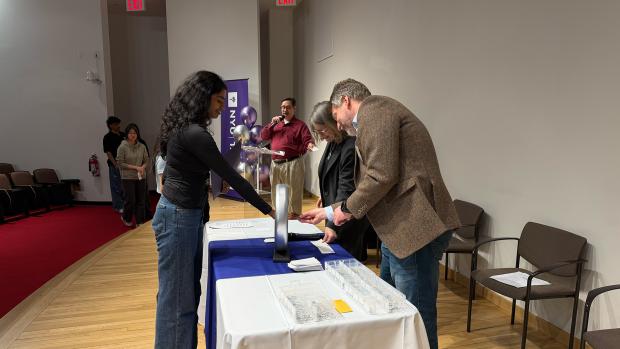
The Order of the Engineer was brought to NYU Tandon through the vision of Professor Nicholas DiZinno, who recognized something that transcends any single course or lab: engineers need a shared sense of identity and responsibility. The Order, a North American tradition linking engineers through a symbolic ring and a formal obligation to uphold the highest standards of the profession, provided exactly that structure.
What began as a quiet introduction to campus life has grown into something far larger and more meaningful than anyone initially anticipated.
A Badge of Honor
In just a few years, the ceremony has become one of the most visible and beloved traditions at Tandon. Graduate and undergraduate engineering students alike have embraced it, not as a formality, but as a genuine rite of passage.
The ring itself carries specific meaning. Made of stainless steel so it will not rust, it was inspired by a Canadian engineering tradition and is worn on the little finger of the working hand. It is deliberately rough on the inside, a physical detail that is anything but accidental. "It is a little uncomfortable," says Greta Perez Hayek, a graduate researcher who recently completed her master's degree in Mechatronics and Robotics, "and it reminds me of the people I have to keep in mind."
For students who have poured years into coursework, labs, late nights, and capstone projects, the Order of the Engineer offers a moment of ceremony, community, and a welcome into a profession. "Lots of late nights," Greta recalls of her time as a student. "I didn't feel like an engineer during the studying. But when I put the ring on, I felt the gravity of my profession on me. The responsibility that I now have."
Habiba, another inductee, describes a similar shift in the moment the ring is placed. "When you first put it on, it helps you realize that what you are doing is actually going to affect people's lives," she says. "It's empowering. You belong to this group of people that you are supposed to uphold the highest standard. It doesn't matter about your background. You belong."
The response has been overwhelming. Turnout has doubled, a testament to how deeply the tradition has resonated across the school's student body.
Demand That Outgrew the Room
That growth has brought welcome challenges. The ceremony has now split into two separate events to accommodate the volume of students who want to participate, and even with two ceremonies, space and guest capacity remain tight. Every seat fills. Every ring placed is one that a student has been looking forward to for months.
What makes the Order of the Engineer at Tandon more than a ticketed event is what it represents in the room. The ceremony is a place where the individual effort that defines an engineering education — the problem sets, the failed prototypes, the defended theses — gets acknowledged in the presence of peers, mentors, and family. It is community building in the most direct sense.
In a school where the work can be demanding and solitary, the Order of the Engineer creates a moment of collective recognition.
The Oath Behind the Ring
Ask any inductee what the ring means and the answer almost always comes back to the same word: ethics. Not ethics as an abstract concept studied in a required course, but ethics as a daily, personal commitment that shows up in every decision, every design choice, every tradeoff.
"It means having a commitment to being the most ethical engineer that you can be," says Habiba. "Remembering that your work will have an impact in some way, and your impact should be good and not harmful. It is an unspoken agreement between all engineers. Like the Hippocratic oath, but for engineers."
The parallel to medicine is one that resonates deeply with Greta as well. "There are a lot of doctors in my family," she says. "My grandmother always told me I should go and make the world a better place. Engineers, like doctors, have a responsibility to the public. I think every engineer should take this oath. It should be part of the curriculum."
That responsibility does not stay abstract for long. Greta points to her own research in underwater robotics and ocean conservation as a direct expression of the commitment she made. "The path I chose is supplementing the oath that I took," she says. "The ring reminds me I can feel good about the impact I am having."
For Habiba, the ring functions as a long range reminder rather than an immediate alarm. "As an engineer, the impact builds up over time. It is not like a doctor treating a patient directly in front of you," she says. "The standard has to hold for a long time, and you need a reminder. This is that reminder."
Both students wear the ring every day. Neither treats it as optional.
"Over time it became an extension of me," Habiba says simply. "I have it on the whole day."
Greta is equally direct. "I feel naked without the ring. It reminds me of my profession. I am not just me, but also an engineer. It reminds me of the challenges I went through, the successes, the projects I have worked toward." In her native Venezuela, she notes, rings tied to professional identity are common. Doctors, engineers, and other practitioners wear them as a mark of their field. "It adds to your personality," she says. "It tells people something about who you are and what you stand for."