
NYU Tandon's C2SMART Researchers Build AI Framework That Predicts Ambulance Speeds Through City Traffic
Developed in partnership with FDNY, the explainable AI model and traffic digital twin let fire departments test emergency response strategies virtually before making changes on real city streets.
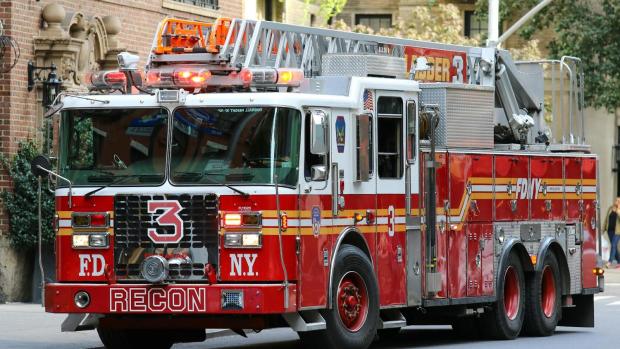
A new AI framework can predict how fast an ambulance will move through city traffic, giving fire departments a way to test emergency response strategies in a virtual environment before making changes on real streets.
NYU Tandon researchers developed and validated the framework as part of a multi-year project with the New York City Fire Department (FDNY) and Tandon's C2SMART transportation center. Their findings appear in Data Science for Transportation.
The work addresses a growing problem. Between 2015 and 2023, FDNY's average response time to medical emergencies increased from about 10.4 minutes to nearly 13.7 minutes, an increase of almost 32% that highlights the growing pressure on city emergency services.
“Every second matters when someone calls 911 for a medical emergency, and finding new ways to respond as quickly as possible can save lives,” said Fire Commissioner Lillian Bonsignore. “This partnership with NYU Tandon and C2SMART demonstrates how innovation and collaboration can help us better understand the challenges our ambulances face on our City's streets. By testing strategies using AI before implementing them in the field, we can make more informed decisions that strengthen our emergency response while ensuring our resources are deployed where they’re most needed. We are proud to work alongside researchers who share our commitment to improving public safety and delivering the highest level of service to New Yorkers.”
"Emergency response agencies operate in environments where even small improvements in travel time can make a meaningful difference," said Kaan Ozbay, Founding Director of C2SMART and the paper’s senior author. "Our collaboration with FDNY demonstrates how transportation engineering and artificial intelligence can come together to help agencies evaluate new strategies before putting them into practice."
Part of the challenge is that ambulances do not move like ordinary vehicles, said C2SMART senior research associate Fan Zuo, who led the simulation development and calibration efforts.
"EMV travel times with sirens on are not identical to passenger vehicle travel times that follow traffic control rules," the researchers write. Ambulances can legally pass through red lights and maneuver around stopped traffic, but they also depend on nearby drivers noticing them and moving aside. As a result, navigation tools such as Google Maps, which are designed around normal traffic, cannot reliably predict ambulance travel speeds.
To address that gap, the team built a high-fidelity Traffic Digital Twin covering West Harlem and Morningside Heights, FDNY's M6 dispatch zone. The digital twin combines a detailed traffic simulation with real-world traffic and GPS data from nearly 1,000 FDNY ambulance responses in 2023.
Using information generated by that simulation, the researchers — led by Joseph Chow of C2SMART — trained an AI model called EMVAID to predict ambulance speeds on individual road segments.
The model identified background traffic speed as the strongest predictor of ambulance speed, followed by roadway congestion. Two-lane streets generally helped ambulances move faster than one-lane streets, while additional lanes offered little extra benefit. Streets with unprotected bike lanes were also associated with slightly faster ambulance speeds, possibly because they provide additional room for emergency vehicles to maneuver around stopped traffic.
To demonstrate how the framework could support planning, C2SMART researchers tested whether changing ambulance base locations — known as Cross Street Locations — could reduce travel times. In their simulated study area, an optimized set of locations reduced expected travel time by 14.5% while increasing the share of calls handled by neighborhood-based ambulances from 41% to 55%. The findings remained stable even after the researchers intentionally introduced prediction errors into the AI model to test its robustness.
Instead of relying only on high-performing "black box" AI models, the team chose an Explainable Boosting Machine that lets planners see why the model produces a particular prediction. Although its accuracy was close to models such as random forests and XGBoost, its transparency made it more useful for planning applications.
The researchers emphasize that the station location analysis is a demonstration of the framework's capabilities, not a recommendation. Because ambulances are often already responding to calls or returning from hospitals, the projected improvement likely represents an optimistic estimate under simplified assumptions.
The C2SMART team ultimately envisions using the AI model to extend the framework beyond a single neighborhood, allowing emergency planners to estimate ambulance travel speeds across the city without having to run detailed traffic simulations everywhere.
The FDNY project was first announced in January 2024 and was recognized in Popular Science's Best of What's New 2024 awards in the Emergency Services category later that year. It adds to Tandon's growing roster of collaborations with New York City agencies. In May, Tandon announced a partnership with the NYC Mayor's Office of Climate & Environmental Justice to develop benchmarks for embodied carbon in city buildings.
In addition to Ozbay, Zuo and Chow, the paper's authors are Jingqin Gao, Farnoosh Namdarpour, Di Sha and Hannah Bonestroo, all of C2SMART. Funding for the project was provided, in part, by the U.S. Department of Transportation through the C2SMART University Transportation Center.