
NYU Tandon-Led Team Developing Wireless Technology to Keep Drones Connected
New project, dubbed FALCON, receives nearly $4.7 million in NSF funding; follows a major NTIA award to NYU WIRELESS to develop complementary upper mid-band radio technology.
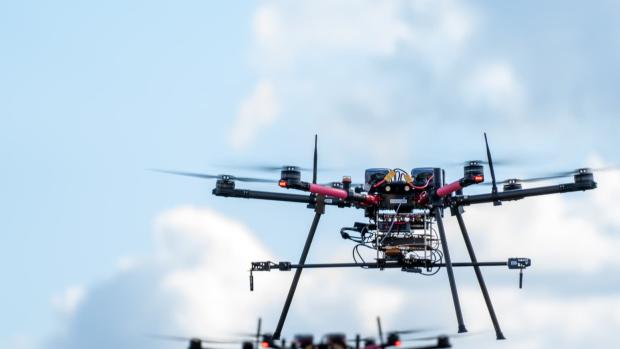
AERPAW drone. Photo credit: Anil Gurses
NYU Tandon's NYU WIRELESS research center has landed a nearly $4.7 million National Science Foundation (NSF) grant to develop technology that keeps drones connected even as wireless conditions change around them.
The award follows a nearly $10 million 2025 federal grant for separate but complementary research, bringing federal investment in NYU WIRELESS-led projects in the upper mid-band — spectrum relatively unused by cellular systems today — to close to $15 million in recent years.
Drones increasingly rely on wireless connections not just to transmit video or receive commands, but to coordinate with other drones and offload demanding AI-based navigation and perception tasks to more powerful ground computers. That connectivity, however, often breaks down exactly where drones are asked to do the most. High altitudes have spotty cellular coverage, metal structures block signals, and some environments involve deliberate interference.
Researchers at NYU WIRELESS, with academic and industry collaborators, are building FALCON (Flexible Aerial Links for Control, Observation, and Navigation), a system that will let drones sense changing wireless conditions, switch frequencies automatically, and adjust flight paths to hold onto a connection.
FALCON also allows a well-connected drone to act as a relay, extending connectivity to another drone or ground robot that cannot directly reach the network, an approach that could be particularly valuable for coordinating drone swarms.
The NSF is funding FALCON from its Verticals-enabling Intelligent Network Systems (VINES) program, which supports next-generation wireless and networking research tied to real-world applications.
The system focuses on two use cases. The first is for construction site monitoring and building inspection, where drones are increasingly used but often lose coverage when they fly above cellular network coverage or into rooftops or tunnels. The second is in coordinated drone swarms where drones are often subject to jamming and uncontrolled interference.
The FALCON team includes companies in both of these vertical cases, providing a path for bringing the new technologies to commercialization.
The project is led by Sundeep Rangan, director of NYU WIRELESS, who also heads up SALSA (Spectrally Agile Large-Scale Arrays), a different project developing a custom radio chip for the same wireless spectrum FALCON targets. That project received nearly $10 million from the U.S. Department of Commerce's National Telecommunications and Information Administration (NTIA) last year.
“NYU WIRELESS has built a long track record of discovery and innovation in wireless research, and the FALCON award, arriving on the heels of the SALSA grant, is a clear demonstration of that continued strength," said Juan de Pablo, NYU's Anne and Joel Ehrenkranz Executive Vice President for Global Science and Technology and NYU Tandon's Executive Dean. "It's a vote of confidence from NSF in the caliber of work coming out of NYU's engineering programs, and a testament of Sundeep’s thought leadership.”
"FALCON advances priorities we've set for NYU WIRELESS around the upper mid-band, satellite-cellular integration and AI,” said Rangan, who is a NYU Tandon professor of electrical and computer engineering. “The upper mid-band in particular offers a combination of capacity and coverage that's hard to find anywhere else in the spectrum, exactly what drones need as they take on more demanding, connectivity-dependent work. FALCON lets us put what we've built here to work solving a real problem, namely keeping drones online in the places where connectivity usually breaks down."
NYU Tandon Professor Yong Liu is leading the multipath networking work, developing technology that will let drones draw on private networks, public 5G and satellite and steer data toward the best-performing connections. FALCON will also determine whether demanding AI tasks should be processed onboard or sent to remote computers. The team also includes researchers from North Carolina State University, University of California Berkeley and Florida International University.
Some FALCON radios will operate in FR3, upper mid-band spectrum spanning roughly 6 to 24 gigahertz. The hardware builds on software-defined radios from Pi-Radio, an NYU Tandon spinout, with a smaller, lighter version planned for drones.
To evaluate FALCON for building inspection, Tall Wall Robotics, also known as Building Diagnostic Robotics (BDR), will help develop and test the system against real-world problems such as rooftop coverage gaps. The startup grew out of NYU Tandon's AI4CE robotics lab.
“BDR is very excited to be part of the VINES project,” said Bilal Sher, BDR’s CEO and Co-Founder. “We're proud that the connections we've fostered with hyper-local NGOs and NYU can provide benefits to the LMI communities of NYC, the research community at NYU and beyond as well as the wider construction community that we serve as a New York City origin deeptech startup. We look forward to developing technology that can help lengthen roof life and cut down on emissions.”
The team will work with Nexcepta Inc, a Maryland-based R&D company specializing in next-generation wireless communications, spectrum sharing, and resilient tactical networks, to support the development and testing of FALCON’s adaptive networking capabilities with coordinated drone swarms operating amid interference and electronic jamming.
“Reliable connectivity is essential when autonomous systems operate in contested and rapidly changing spectrum conditions,” said Sastry Kompella, CEO of Nexcepta. “Through FALCON, we will help translate adaptive networking research into realistic multi-drone experiments, demonstrating how aerial systems can sense changing conditions, adapt their communications, and continue operating when conventional links degrade.”
Sharp Laboratories of America, an NYU WIRELESS industrial affiliate, is contributing expertise in cellular and satellite communications and spectrum sharing.
“At Sharp, we are committed to advancing next-generation wireless systems that extend reliable connectivity beyond the reach of traditional terrestrial networks,” said Hitesh Poddar, Senior Communication Systems Engineer, Sharp Laboratories of America. “The FALCON project aligns closely with our research in cellular and satellite communications, spectrum sharing, and connected mobility applications. By collaborating with leading academic and industry partners, we aim to help develop resilient networking technologies for use in challenging environments where robust communications are essential.”
To facilitate transition to reality, the proposed solutions will climb the TRL ladder, from concepts to experimental demonstrations, at the Aerial Experimentation and Research Platform for Advanced Wireless (AERPAW) at NC State University. AERPAW is a nationally recognized NSF PAWR testbed enabling experiments with programmable vehicles (drones and rovers) and programmable radios (primarily USRPs) over a beautiful flying field spanning several square kilometers. The project will culminate in tests with multiple drones and ground robots.
FALCON and SALSA could ultimately reinforce each other technologically. If SALSA’s custom microchip becomes available during FALCON’s timeline, it could provide a path to smaller, more highly integrated radios suited to drones, where size and weight matter.