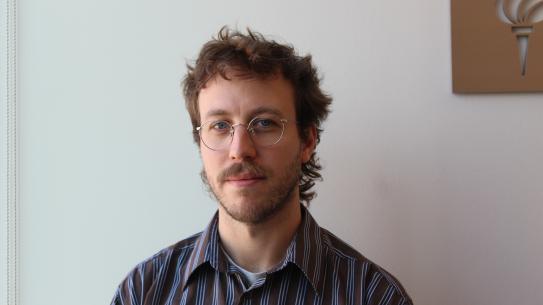

New Professor Onur Mutlu Is Rethinking the Architecture of Computing
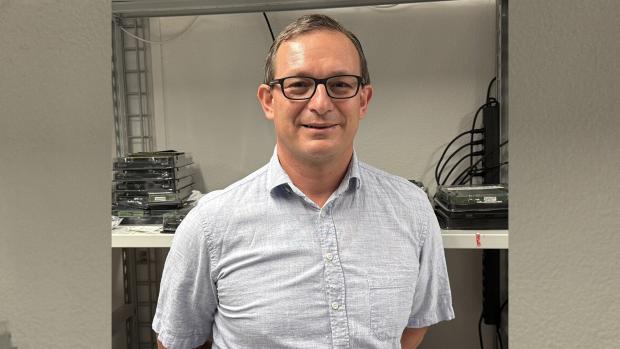
For much of Onur Mutlu’s career, one question has driven his research: What if computers were designed differently from the ground up?
Mutlu, an internationally recognized computer architect, is bringing that question to NYU Tandon School of Engineering, where he joins the faculty with appointments in Electrical and Computer Engineering and Computer Science and Engineering. His arrival also comes with plans for a new center focused on emerging computing technologies and computing systems design, one that he hopes will rethink some of the most basic assumptions underlying modern computer systems and build new, much more efficient and robust ones.
“The goal is to do great research, education, and entrepreneurship,” Mutlu said.
Mutlu comes to NYU from ETH Zurich, where he has been a professor since 2016 and built a research group of more than 40 people. He will maintain an affiliation with ETH during a transition period while bringing more than 10 students and researchers to New York. Before ETH, he was a professor at Carnegie Mellon University and founded the computer architecture group at Microsoft Research. He spent significant time in industry, including various stints at Intel, AMD, VMware, Microsoft, and Google. He earned his PhD from the University of Texas at Austin after studying computer engineering and psychology as an undergraduate at the University of Michigan.
That unusually broad educational background still shapes how Mutlu thinks about technology. He sees growing opportunities at the intersection of computing and psychology — and more broadly computing and the social sciences and humanities — particularly as artificial intelligence systems become more deeply entwined with human behavior in the physical world. AI, he suggests, might eventually do much more than solve mathematical problems. It could help researchers design better psychology experiments or investigate questions about people that have traditionally been very difficult to study.
But Mutlu is best known for his work on computer architecture, especially memory systems, energy efficiency, and hardware security. During his early years as a budding researcher, his PhD studies and internships at Intel and AMD’s cutting-edge microprocessor design teams, he repeatedly encountered the same obstacle: processors were getting better at computation, but moving data to and from memory remained slow and energy intensive.
“I was convinced that that was the biggest problem in computing,” he said. “It’s still the biggest problem in computing. It is worsening today with the increasing demand for data in artificial intelligence and data analytics systems, and systems that interact with the physical world.”
That realization led Mutlu toward what he calls memory-centric computing. Traditional systems are largely processor-centric, with memory and storage feeding data to the CPU. Mutlu’s group has spent years exploring architectures that instead move computation closer to where data is stored, reducing the time and energy consumed by shuttling information back and forth. The challenge has become even more pressing as artificial intelligence models work with enormous datasets.
At NYU, Mutlu wants to broaden that search for new computing paradigms and innovative computing system designs. His proposed center could explore memory-centric computing alongside various innovative technologies, including more efficient interconnects, optical and biological computing, and heterogeneous systems that combine quantum technologies with traditional computing approaches. The common goal is to build fundamentally better and efficient computing systems tailored to both foundational and emerging applications and technologies rather than forcing every application onto essentially the same underlying architecture.
“Doing so requires cutting across the computing stack and designing vertical systems that combine fundamental innovations in both software and hardware,” he says. “For this, we need deep thinkers and system builders who understand many parts of the computing system stack, not just pieces of it. We would like to attract as well as educate the best people here.”
That philosophy has already taken Mutlu’s work into fields far beyond conventional chip design. His group has applied computer architecture to various fields, including AI and large language models, data analytics, security-critical computations, bioinformatics, and genomics, developing ways to accelerate computationally intensive tasks such as mapping DNA sequencing reads at very low energy consumption. More efficient systems, he argues, could eventually make sophisticated genomic and biological data analysis possible on portable devices or in settings where large computing infrastructure is unavailable. Similar ideas could influence robotics, medicine, AI, finance, edge computing, and robust computing systems for harsh and unpredictable environments like space and oceans.
Mutlu sees NYU and New York City as particularly fertile ground for that kind of cross-disciplinary work. NYU has its own history in computer architecture, including work on the Ultracomputer decades ago, and its breadth creates opportunities to connect computing with medicine, biotechnology, finance and other fields.
“We can build a big ecosystem over here that can invent the foundations of future computing systems,” Mutlu said, “an ecosystem where bright minds from academia, industry, government, and venture capital can come together and innovate in a forward-looking, flexible and informal setting”.
For Mutlu, that ecosystem is the attraction. New York offers both an entrepreneurial culture and industries hungry for better computing, along with a large talent base of innovative people. NYU, meanwhile, offers the scale and disciplinary range to turn new architectural ideas into technologies with applications far beyond the computer lab.