
New Professor Andrew Stuart Uses Mathematics to Connect Data, Models and the Real World
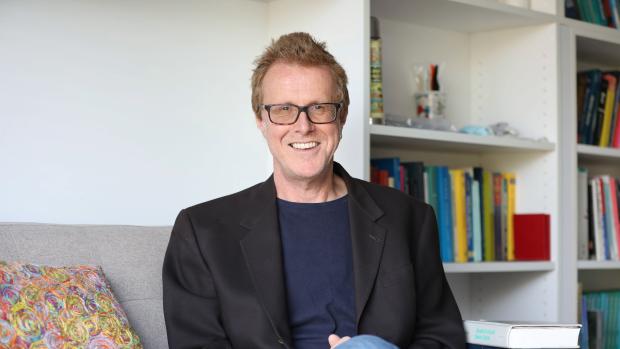
Andrew Stuart has spent much of his career moving between worlds: between the United Kingdom and the United States, between mathematics and engineering, and between abstract theory and problems rooted firmly in the physical world.
Now Stuart is bringing that boundary-crossing approach to NYU, joining the faculty with appointments at the Courant Institute of Mathematical Sciences and NYU Tandon. Trained as a mathematician, he arrives from Caltech after a career that has also included positions at Stanford, MIT, the University of Warwick and the University of Bath.
“I like the abstraction,” Stuart said of what first attracted him to mathematics, “and the way that it links different things together.”
That ability to find common mathematical structures beneath seemingly unrelated problems has become a defining feature of his research. Stuart is an applied mathematician interested in developing methods that can move across disciplines. Rather than concentrating on a single physical system, he asks what scientists and engineers can learn by identifying the mathematical ideas shared among many of them.
One example is weather forecasting. Modern forecasts combine equations describing physical processes with enormous streams of observations from satellites, aircraft, weather balloons and ground stations. The mathematical process for combining equations and data, two very different sources of information, is known as data assimilation.
Stuart became interested in extracting the underlying ideas behind data assimilation and asking where else they might apply. The answer, increasingly, is almost everywhere. He has explored related mathematical approaches in areas ranging from climate modeling to models of the human glucose-insulin system.
“The language of math enables ideas developed in one domain to be used in other domains,” he said.
Closely connected to that work is Stuart’s research on inverse problems. A conventional, or “forward,” problem starts with known conditions and uses mathematical laws to predict an outcome. An inverse problem works backward. Researchers observe an outcome and try to determine the hidden conditions that produced it.
As sensors, computers and experimental tools generate ever larger quantities of information, those problems are becoming increasingly important. Measurements of what can be observed can reveal information about things that cannot be measured directly.
“This data deluge enables us to find out more than just the things we observe,” Stuart said. “We can find out things we don't observe by using data that we do observe, and combining the data with a mathematical model.”
Over roughly the past decade, that interest has increasingly brought Stuart into artificial intelligence and machine learning. Scientists and engineers are rapidly adopting machine-learning tools, but Stuart sees an important role for mathematics in understanding exactly when those tools work, how accurate they are and how much confidence researchers should place in their predictions.
Compared with many classical mathematical techniques, he noted, machine-learning methods often remain less well understood theoretically. Stuart wants to help build the mathematical foundations that can provide guarantees about their accuracy, computational cost and ability to reproduce real-world phenomena.
At Tandon, Stuart will be affiliated with the Department of Chemical and Biomolecular Engineering, an arrangement that reflects his broader approach to applied mathematics. He sees proximity to engineers working on materials, complex fluids and other physical systems as an opportunity to learn new problems and develop collaborations around them. That philosophy extends beyond one department. Stuart hopes his joint position will allow him to build connections throughout Tandon, using engineering problems to inspire new mathematics while bringing mathematical tools into engineering research.
“Applied mathematics, which is my field, thrives on good applications,” he said. Being part of both Courant and Tandon, he added, offers the chance to encounter “more new, cutting-edge applications.”
He wants to create similar bridges in the classroom, particularly through graduate courses connecting applied mathematics and engineering. This fall, he is teaching a course on machine learning in inverse problems and data assimilation.