
New Lecturer Aled Roberts Wants Engineering Students to Think Like Writers

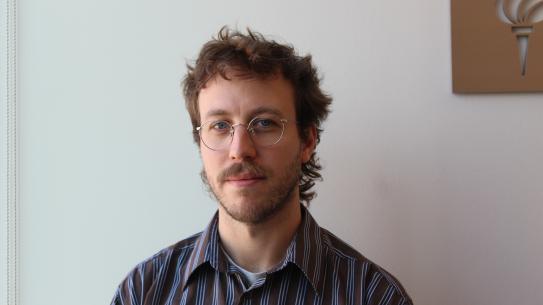
Aled Roberts took an unusual route to engineering education. His academic career began not with circuits, code or calculus, but with medieval literature.
Roberts grew up in Wales. His father was a longtime toolmaker, so engineering was perhaps present in the background, but Roberts ultimately pursued a PhD in medieval literature at Columbia University. His research focused primarily on 14th-century English literature, particularly the idea of patience as a virtue during a period of profound social upheaval, as well as how demons were depicted in 14th- and 15th-century literature.
At Columbia, Roberts taught philosophy, literature and, for several years, a University Writing course called Data and Engineering, later renamed Data and Society. The course examined data, information, bureaucracy and their uses, while introducing students to questions surrounding data engineering and artificial intelligence. Many of his students were first-year engineers and data scientists. Roberts found that he particularly enjoyed working with them.
“What they needed out of a writing class just became clearer and clearer to me,” he says. He saw that students on STEM tracks often had plenty of opportunities to develop technical expertise, but fewer opportunities to learn how to communicate that expertise to people who might not share their knowledge.
That observation ultimately led Roberts to NYU Tandon, where he is joining the engineering school as a Lecturer in the Program in General Engineering. His section of the introductory course focuses on writing up technical work, including lab reports and white papers.
For Roberts, technical writing is not primarily about grammar or producing polished prose. It is about understanding the person on the other side of the page.
One of the most important principles he teaches is to write with a specific reader in mind. Rather than simply presenting information in the order in which it occurred to the writer, students should anticipate how a reader will understand it and guide them through the material.
He compares the process to describing an apartment. A writer might begin with a general list of rooms, but a reader may understand the space more easily by being guided through it: enter the front door, turn left, find one room, then move to the next. The same principle applies at the sentence level, Roberts says. Beginning with information the reader already knows and then introducing new information can make even complex technical material easier to follow.
That skill may become even more important in an era of generative AI.
Roberts expects the students he teaches to encounter AI throughout their professional lives and believes it will inevitably become part of the writing process. But he also sees an important educational opportunity: teaching students to recognize when AI-generated prose sounds artificial.
He describes much AI-generated writing as “woolly and empty and inexact,” filled with impressive-sounding abstractions that can obscure rather than clarify an idea. His hope is that students will develop an ear for those patterns and learn to push beyond them.
“Part of the work is essentially trying to train an ear to hear the way that it kind of formulates its sentences,” he says.
That, for Roberts, gets to the deeper purpose of writing instruction. Writing is not simply a way of recording thoughts that already exist. The process of drafting, revising and imagining how another person will interpret a piece of writing can actually shape the writer’s thinking.
Roberts invokes Joan Didion’s famous formulation that she writes to find out what she thinks. He sees writing as a recursive process in which thinking and writing continually shape one another.
The benefits extend beyond the classroom. Engineers must communicate with colleagues, users, customers and the public. In an increasingly specialized workplace, Roberts argues, the ability to explain an idea clearly can help connect people who otherwise might feel like isolated pieces of a much larger machine.
Ultimately, he sees writing as both a professional skill and something more fundamental: a way of thinking about other people.
“To make yourself understood,” Roberts says, “you have to think about other people, and the fact that other people think differently.”