
New Industry Assistant Professor Amelia Klein Bringing Quantum Optics Into the Classroom
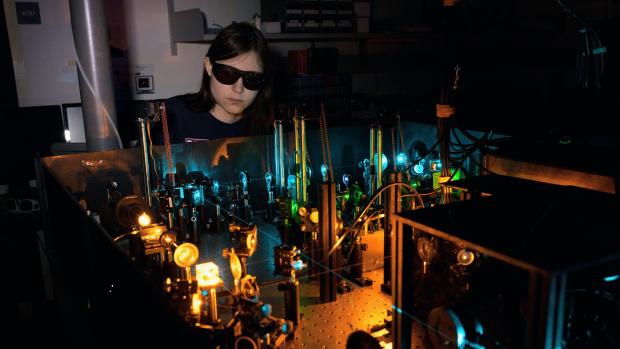
For Amelia Klein, the path to quantum science was less a straight line than a gradual narrowing of interests. Originally from California, Klein spent time growing up around Sacramento and in Arizona before moving to the East Coast for college. At Columbia University, she studied electrical engineering with a minor in applied physics, drawn to the boundary between engineering and physics. For graduate school, she went to the University of Pennsylvania, initially intending to focus on photonics.
Instead, Klein found themselves increasingly interested in quantum systems, particularly the experimental side of the field. Her doctoral research focused on solid-state defects, sometimes called color centers, which can serve as quantum systems embedded within otherwise ordinary crystals. One well-known example she has worked on is the nitrogen-vacancy, or NV, center in diamond. Klein’s recent work has explored europium ions embedded in gallium nitride, investigating whether the useful quantum properties of rare-earth ions can be preserved in a semiconductor material.
The work is fundamental, involving detailed characterization of materials before they can potentially be developed into useful quantum technologies. But Klein’s interests extend beyond the laboratory. Over the past several years, she has become increasingly involved in developing ways to introduce quantum optics to students, from high schoolers to undergraduates.
That experience now forms a major part of Klein’s new role at NYU Tandon, where she is joining the Department of Applied Physics on the teaching track and helping develop a new quantum optics laboratory course for the school’s emerging master’s program in quantum technology.
Klein’s interest in teaching quantum optics took shape through an unusual collaboration. A colleague at West Chester University was working with Thorlabs on educational equipment, including a quantum optics kit designed to give students hands-on experience with quantum experiments. Klein became involved in adapting the equipment for outreach, helping create instructional materials and videos explaining both how to perform the experiments and the physics behind them.
The team eventually brought the equipment into an AP Physics class at a Philadelphia-area magnet high school. Because the experiments require controlled lighting, Klein and their colleagues even built enclosures around the equipment so it could be transported into ordinary classrooms.
The students encountered some of the counterintuitive behavior that makes quantum mechanics so difficult to explain in textbooks. In one experiment, the researchers demonstrated evidence that single photons were being detected before sending them through an interferometer. Despite single photons being indivisible, they produced an interference pattern, a phenomenon students had previously encountered with ordinary light.
“We were able to give them enough that there’s, like, ‘Oh, there’s a contradiction here,’” Klein recalled. “That hints at, like, ‘Oh, that is quantum mechanics, that’s the kind of weirdness.’”
The project grew into a series of laboratory sessions for an undergraduate course at Penn. Klein and another graduate student developed three sessions around the quantum optics kit that were incorporated formally into the course. She also traveled to Thorlabs’ headquarters to film instructional videos, including a roughly 30-minute demonstration of a single-photon Michelson interferometer experiment.
That hands-on experience helped make Klein a natural fit for Tandon’s new program. She will teach introductory mechanics this fall while developing the quantum optics laboratory, which is expected to launch in the summer. The lab will include several small optics tables, each shared by groups of two or three students, with equipment based on the existing kit as well as additional extensions.
Klein hopes the laboratory can eventually become part of a broader experimental component of the program. Quantum technology is expanding rapidly, she notes, creating demand for people who understand not only the theory but also the specialized equipment used to build and operate quantum systems.
For Klein, that makes this an especially exciting moment to enter the classroom. Quantum technology is still developing quickly enough that educators have an opportunity to shape what students learn and how they learn it.
“There's just a lot of change that will be happening,” Klein said. “I like being part of something that is growing, and we don't really know exactly what it's gonna look like even 10 years from now.”
But perhaps the biggest attraction was the chance to help build something new. “I think the biggest excitement is to be able to be a part of this new program from the beginning,” she said, “and involved in developing new types of classes and shaping it going forward.”

